Showing posts with label speculative fiction. Show all posts

Tuesday, 16 June 2026

Review by Aswathy Raveendran of "Sisters of the Pentacle" by Paul Taylor-McCartney


Paul Taylor-McCartney’s Sisters of the Pentacle is the first book of The Broken Pentacle Series, and is a fascinating tale that mixes historical drama, witchcraft, time travel, and the quiet power of sisterhood. Set across three very different time periods in the same corner of Wales, the novel follows three young women who are bound by magic, prophecy, and a sacred but damaged pentacle. It’s the kind of book that rewards patient readers. It is layered, atmospheric, and full of heart. Fans of thoughtful fantasy with real historical grounding will likely find themselves pulled in.

The story shifts between 1650, 1900, and 2080, each period anchored by a compelling young witch. In the plague year of 1650, we meet Mary Harries, a twelve-year-old "Knowing One" with the gift of foresight. Tenby is locked down, bodies pile up, and suspicion falls hard on anyone suspected of witchcraft. Mary’s courage, as she helps with the dead, faces angry mobs, and confronts dark forces on Caldey Island, gives the opening section a raw, visceral edge. Her protective grandmother Nancy and a shape-shifting boy named Abe add warmth and danger in equal measure.

Jump forward to 1900, and we’re with Harriet Gordon, a sharp-witted artist living in St Catherine’s Fort. Harriet chafes against her family’s expectations and her brothers’ cruelty. Her discovery of latent powers, helped along by a mysterious ceremonial blade (an athame) and a voice from the future, brings both wonder and trouble. The inclusion of real historical figures like Winston Churchill and H. G. Wells during a dinner party is a clever touch, and it nicely highlights the tension between Harriet’s inner world and the respectable society closing in around her.

In 2080, Indigo Carmichael takes centre stage. Living in a world scarred by environmental collapse, she’s the daughter of a driven scientist whose time-acceleration technology holds both salvation and peril. Indigo’s sections feel more dystopian and introspective, tying the historical threads together through risky experiments and a desperate hope of mending what’s broken across time.

What holds these timelines together is Taylor-McCartney’s clever use of recurring symbols like the circles of power, glowing portals, animal transformations, and fragments of the pentacle itself. The non-linear structure mirrors the book’s central idea which is all about how the history isn’t a straight line but a looping, interconnected web. Some transitions in the story are seamless and some lean a bit heavily on exposition or convenient coincidences. Still, the overall effect is one of building momentum toward something larger.

Thematically, the novel has real weight. The sisterhood depicted in the story goes beyond blood. It’s about shared resilience, passed-down knowledge, and collective resistance against oppression. Each girl pushes back against the constraints of her time period. If it was persecution and plague for Mary, it was rigid Edwardian gender roles for Harriet, and technological hubris for Indigo. Taylor-McCartney handles the "grey area" of magic thoughtfully, refusing to paint it as purely good or evil. There are strong undercurrents about environmental responsibility, the cost of playing with time, and the long shadow of patriarchy. The pentacle becomes a potent symbol of wholeness in a fractured world, and the respect shown to real witchcraft traditions feels genuine rather than superficial.

The three protagonists are the novel’s greatest strength. Mary’s quiet bravery amid horror is moving. Harriet’s artistic eye and dry humour bring welcome lightness and emotional texture. Indigo, dealing with her own physical limitations and inherited burdens, adds a layer of vulnerability that makes her future feel lived in and urgent. Supporting characters like Nancy, Abe, and even the antagonistic Gordon brothers mostly ring true, though a few (particularly in the future sections) lean toward archetype. The historical cameos work better than they have any right to, adding flavour without derailing the story.

Taylor-McCartney’s prose shines when he leans into atmosphere. The plague-stricken streets of Tenby, the misty cliffs at Harrowing Point, and the sterile glow of futuristic labs all come alive. There are lyrical moments during rituals and invocations that genuinely feel magical. That said, some dialogue runs a touch expository, and a few descriptive passages could have been trimmed. Even though there are few quibbles like these, the book overall gives you an immersive reading experience.

Overall, Sisters of the Pentacle is a success. Its world-building across centuries is impressive, and the emotional core which centres around the bond between the "sisters" across time is something that would stay with you. Pacing occasionally lags, especially when lore or technology needs explaining, and the 2080 storyline feels slightly less developed than the historical ones. But these are the growing pains of an ambitious first volume in what promises to be a rich series.

If you enjoy fantasy that takes its time, respects its traditions, and weaves real history with the supernatural, this one is worth your attention. It’s a story about healing what’s broken across time, across families, and across the land itself. I closed the book eager to see where the pentacle leads next.


About the reviewer
Dr. Aswathy Raveendran is an Assistant Professor of English at Jain (Deemed-to-be University), Kochi, India. Her research focuses on twentieth-century female gothic literature, with broader interests in sensory studies, eco-gothic narratives, and cultural memory. She is also a practising artist whose work explores themes of nature, memory, and the sensory imagination.

You can read more about Sisters of the Pentacle by Paul Taylor-McCartney on Creative Writing at Leicester here

Thursday, 12 March 2026

Review by Iain Minney of "The Dark Fields" by Alan Glynn


Adam Glynn’s 2001 debut is probably best described as the fabled "positive drug story," albeit a cautionary tale about drug use. Strong themes of addiction, excess and greed run through it like a stick of rock.  

More-traditional drug users fall somewhere in-between hallucinating hippies, giggling stoners or hyperactive, gurning ravers, with the perception being uniformly negative. The "positive" drug in this novel, "MDT-48," allows the user to remain uncluttered, learning and performing practical tasks with a radically, evidence-based improvement, unlike other drugs, which merely mess with the user’s perception of themselves. In other words, MDT is the ultimate drug fantasy: it actually DOES make you smart and interesting.

Eddie Spinola is a something of an average guy; a little past his prime and stuck in a rut. The writing assignment he requested isn’t the labour of love and salvation he thought it’d be, and he has little else lined up on the horizon.  But a happenstance encounter with his ex-wife’s shady brother quickly changes his fortune. Literally.

Now (with a certain tiger-in-his-tank) Eddie’s blasting his way up the ladder a little too quickly and a little too impatiently for his own good, in order to quell his various appetites … and with his secret stockpile in place, but all manner of gaps, cracks, hallucinations and allegations becoming increasingly obvious and hard to ignore, the only question seems to be how much higher can Eddie go?

A neat and original premise is wonderfully executed (especially for a debut) and metered out with appropriate caution and respect to the subject of drug use, rather than the fantastical and pithy romanticism that could have been applied to a substance that, thankfully, doesn’t exist. Although MDT could essentially be considered an aid to concentration (some sort of hyper-concentrated Ritalin, for example), it allows the story to expand on "Addiction to ambition" as another interesting sub-reference to the Reaganomics era, to which so much is unfortunately owed.  

The writing style is pleasant too, with the quasi-autobiographical first-person narrative providing a rewarding full-circle twist ending, that underlines what must have been a genuinely thorough and painstaking research process, allowing the author any number of hidden in-jokes. The tycoon character "Van-Loon" seems suspiciously similar to a figurehead brand like Trump, the so-called "Psychopharmacological" writer probably references Tim Leary, and even the title is taken from a line in The Great Gatsby.  There’s even a theme on lost (and rediscovered) love, and a pining for lost youth, signified in Eddie's love of drugs that he used to enjoy back with his ex-wife.


About the reviewer
Iain Minney (B.A. in Journalism & Creative Writing): tall, "mature," sober, comedian(ish). He has dabbled in stand-up comedy - which he has been writing since he was teenager - as well as being involved with comedy sketches, local filmmaking groups and working on local radio for a number of years both as "Head of News" and having his own weekly 3-hour show. He has been interested in writing for some time and even tried recording a number of audiobooks of short stories he's written together with satirical rants based on the standup he never quite "stood up" with. He loves old punk and 80s rock music, all manner of movies, and Bill Hicks and George Carlin SAVED HIS LIFE. But that's a whole other conversation.

Saturday, 22 November 2025

Review by Gus Gresham of "Maybe the Birds" by A. J. Ashworth


This short story collection by A. J. Ashworth is a rewarding read, each story like a piece of mysterious treasure from a dug-up pirates’ chest. The prose is beautiful, understated, sometimes beguiling, and full of humanity.

In the title story, we understand that we are in the midst of something apocalyptic or post-apocalyptic. Aside from hints, the details of the main "event" are left out. The focus is the effects upon the lives of survivors, upon a particular survivor, and the warm relationship between her and her dog. It’s about what we might leave behind as a legacy when the familiar world is lost, and in her case this takes the form of recreating the lost sounds of birdsong with bespoke clay pipes.

"Leather" is effectively a story about a story. It reads as a review of a story about woman’s strange "find" in a second-hand bookshop. This review approach works surprisingly well. It’s a clever, playful and enjoyable device. The story is analysed and questioned for us by a fictional narrator/reviewer who employs tantalising quotes from the story itself. Some of the descriptive language and tone-setting is particularly strong: "… the kind of curdled light that comes before a rainstorm," echoed later, in other lines like fried eggs that are "broken and bleeding yellow onto the plate."

"Mirrors" was a personal favourite. It has the sense of something apocalyptic again, like "Maybe the Birds," but "Mirrors" is even darker, more enigmatic, told in second person, and with the prose itself fractured on and across the pages. Unsettling to say the least, and rendered so beautifully.

There is scope for humour, too, in this collection. The premise of "The Monolith" can be gleaned from the following short quote as the protagonist speaks with her ex on the phone: "…thinks she sees a ripple across the monolith, as if it’s made of black liquid. ‘I’m not joking, Carl. There’s a monolith in the yard.’" There is so much to enjoy in this story. Mystery, inventiveness, the study of relationships, and of course more gorgeous prose: "A gust of wind makes the window frame crack like a bone."

"Small Feathers Falling" centres on the treatment of women by some men. There are creepiness and horror in this tale, which – among other things – stands as a stark reminder of how we should listen to our gut when the early warning bells chime in a new relationship. We dismiss sinister behaviour all too often, don’t we?, and let it slide all too often. The casually delivered, derogatory names the male antagonist calls the female protagonist become "dark moths in her head." The descriptions of the owl are wonderful, and the story’s creepiness and tension build to a point where anything could and does happen.

The book’s "Afterword" is an insightful essay which provides a more academic angle on the book’s themes. Ashworth talks of "… how female characters in postapocalyptic settings … [continue] … with preapocalyptic activities." List-making and sculpture are suggested to be the mainstay here, and indeed the title story comes back to mind with the protagonist’s careful and loving clay-hewn "syrinxes" designed to mimic the sounds of birds in a world that has lost its birds (and we has suspect lost much more).

Each story is also rich with allegory, in my view, and Maybe the Birds is a collection to be savoured.


About the Reviewer
Gus Gresham’s short stories have appeared in literary magazines and online, many of which are now collected in his latest book, Angel Reach. He is author of the novel Kyiv Trance and of the young adult novels Earthrise and Marmalade Skies. He has travelled widely and worked as a mechanical engineer, fruit picker, construction worker, environmental activist, writer, English tutor, audio-book producer, interpersonal skills facilitator, and building surveyor.

You can read more about Maybe the Birds by A. J. Ashworth on Creative Writing at Leicester here


Saturday, 28 June 2025

Review by Mellissa Flowerdew-Clarke of "The Book of Guilt" by Catherine Chidgey


1979, England. It's been thirty-six years since Hitler’s assassination ended the Second World War and a peace treaty was signed that helped fuel great advancements in medical science. In Hampshire, three identical boys—Vincent, Lawrence, and William—wake up every morning at a Sycamore Home and tell one of their three mothers what they dreamt about. Mother Morning writes them down in The Book of Dreams. Mother Afternoon teaches them lessons from The Book of Knowledge. Their sins are written in The Book of Guilt. They rarely see Mother Night unless they are sick. And they are often sick. Dr. Roach prescribes pills and injections to help keep the Bug at bay. The boys dream of the day they will get to join all the other children in Margate—a promised land of performing dolphins and bumper cars. 

In Exeter, Kenneth and Majorie dress their adored daughter, Nancy, in a silvery-green dress that gets tighter every year. Kenneth builds an intricately detailed model railway. Marjorie fills every conceivable space with items purchased from mail-order catalogues. Nancy is never allowed to leave the house. 

The Minister of Loneliness who, herself, seems terribly lonely, is assigned by the Prime Minister to find new homes for the Sycamore boys. The Scheme is coming to an end. Meanwhile, the death penalty has been re-introduced.

Nostalgic references to stickle bricks, fondant fancies, and The Generation Game indicate that this is definitely England in the 1970s, but not as we know it. Chidgey’s novel feels quintessentially British, but this England exists in an alternate political reality. It’s a reality where the state has a God complex, and everyone is dehumanised by mass complicity in the secrets that are kept. The references to Jim’ll Fix It remind us that it’s too easy to turn a blind eye to human cruelty. 

You could compare The Book of Guilt with Kazuo Ishiguro’s novel, Never Let Me Go. Sure, they touch on similar themes of medical ethics and nature versus nurture, but Chidgey’s storytelling deserves to be observed without comparison. The richness of Chidgey’s prose and her use of provincial humour amplify the unnerving horror of it all. The slow unravelling of the plot keeps the suspense throughout, giving the reader enough time to think they know what’s going on, before unexpected connections take us to an even darker place. Bold and brilliant, The Book of Guilt deserves to be read and re-read. 


About the reviewer
Mellissa Flowerdew-Clarke is a playwright and author, with a penchant for the macabre and a fascination with literary explorations of libertinism, psychopathy, narcissism, and coercive control. She is currently undertaking a PhD in Creative Writing a Leicester University, exploring Terror Management Theory in relation to representations of cultism and mass suicide.

Monday, 3 March 2025

Review by Mike O'Driscoll of "Remains" Magazine, Issue 1, ed. Andy Cox


If the visual layout and content seem familiar, it’s because Remains is the welcome new venture from Andy Cox, the publisher and editor of Black Static, the superlative and much-missed magazine of contemporary horror fiction. It features a gorgeous cover and interior artwork from Richard Wagner, whose work also graced the pages of the former magazine, but the real test of Remains resides in the quality of its fiction.

There are seven stories, including ‘Cockatrice,’ a novella from Stephen Bacon, that starts out on familiar ground—an inquisitive child more taken with the monsters of his imagination than with the real ones much closer to home—before morphing into vengeful time travel tale with echoes of Terry Gilliam’s 12 Monkeys. The shifting perspectives in a narrative that touches on infidelity, the power of the imagination, childhood sexual abuse, and the struggle to unsee the horrors one sees, are handled with great skill and compassion by Bacon.

Giselle Leeb’s story ‘Inclusions’ is a subtle and suggestive take on the haunted house theme. It maintains a certain distance from its human characters—the last of a group of writers gathered for a weekend workshop—allowing us to observe their interactions through the indifferent gaze of the house itself.

‘Her Little Ray of Sunshine’ is the story that most clearly evokes the tone of Black Static—no surprise considering it’s written by Neil Williamson, a regular contributor to the former magazine. It’s an unsettling and thought-provoking piece, reminiscent of much Slipstream fiction of the 1990s, with its quiet sense of outrage, even despair, at the extent of the psychological and physical harm men perpetrate on women, and even more so the lies and excuses we deploy to justify our weaknesses to ourselves. 

Also recalling 12 Monkeys, but this time more explicitly, is Jolie Toomajan’s ‘A Heartwarming Tale of a Girl and Her Monkey.’ The tone here is elusive, even somewhat disjointed, such that protagonist Karyan’s motives in unleashing an apocalypse are never quite clear. Yet perhaps that sense of disconnection leads her to bond more closely with the monkey she liberates than with her human co-workers, which may be precisely the point.

The remaining stories range thematically from the delusion of overweening ambition (Rich Larson), to the peril of one’s life being exploited for fictional purposes (Anna Tambour). The final story, James Cooper’s ‘Nothing Special,’ offers a particularly bleak, noirish variation on the cynicism and self-loathing engendered by succumbing to the Hollywood dream.


About the reviewer
Mike O’Driscoll is a writer living in Swansea. His work has appeared in Black Static, Interzone, the Magazine of Fantasy & Science Fiction, and numerous anthologies. His story ‘Sounds Like’ was adapted for a TV movie by Brad Anderson, as part of the Masters of Horror series. Mike blogs on different aspects of genre writing and film here

Tuesday, 11 February 2025

Review by Kirsten Arcadio of "Android Author" by Sapphira Olson


"Eloise slipped in and out of consciousness, a flickering representation of reality played in her mind like images in a Victorian zoetrope." Set in a dystopian world where androids write novels, Android Author is a steam-punky romp that explores themes of creativity, artificial intelligence and the boundaries between humans and AI. 

The novel is colourfully meta, chopping between the narrative of its various protagonists and the texts they are writing. Wild and fast-paced, the novel makes interesting use of intertextuality with multiple references to To Kill a Mockingbird and overtones of George Orwell and Philip K. Dick.

Initially, the narrative follows the fate of an AI story-writing machine (Android Writer PD121928) whose sole purpose is to produce stories and novels, churning out a concoction of weird and wonderful stories including a 140-character "novel," the only one of its works that is accepted for publication. During the process the reader learns about the AI’s life: its cat, killed by a drone delivery, the late wife it dismantled because it had begun to "hate her a little bit," and the ever-present existential threat of being killed if its stories are not accepted by a publisher. After its demise, its stories are collected by Eloise, a human prostitute, who endeavours to keep them alive in a number of different ways. 

The world of this novel is a rich and varied futuristic landscape, full of all manner of funky androids, including Mary Whitehouse sex androids and Audrey Hepburn killer fembots. In this world, the old literary classics of a bygone human era are considered "filth" and Eloise’s plight to publish a story a lost cause. 

As the novel progresses, Eloise’s aim to bring authentic storytelling back into the world takes her on a kaleidoscopic journey through time with a scientist Umberto and a varied cast of androids on a spaceship not unlike The Heart of Gold in The Hitchhiker’s Guide to the Galaxy

I thoroughly enjoyed Android Author. It’s a rich, psychedelic experience, perfect for fans of Douglas Adams, graphic novels, and speculative fiction that is original and fun. 


About the reviewer
Kirsten Arcadio is a novelist and digital marketing professional based in London and the East Midlands. She holds a PhD in Creative Writing from the University of Leicester. 

Thursday, 29 August 2024

Review by Doryn Herbst of "The Headland" by Abi Curtis


This is a speculative novel running along two timelines: the aftermath of the Great Storm in southern England, 1987, and events that unfold several decades later.

Delores, a painter, has been unable to produce anything for over a year. She decides to move permanently to her summer studio in the Headland, a coastal community of free-spirited artists, fishermen and tourists but overshadowed by the nearby nuclear power station. 

The morning after extreme weather ripped across the South, Delores walks along the shingled beach near where she lives to assess damage and to check up on her friends.

She stumbles across a piece of driftwood, utterly beautiful, smoothed by water and smelling of sea salt. Preparing to take her find home for the garden, Delores sees something strange sheltered inside a crevice resembling a mouth in the wood. The something is plant-like, animal-like, energy-like, a ball of pulsating colour, and alive. Delores feels a connection to the creature but wonders whether it has emerged as a result of the storm, radioactive emissions or a mixture of both.

The driftwood is installed on her living-room table. Delores subsequently develops an emotional relationship to the being inside, calling it Violet. Her new companion becomes a source of power which fuels inspiration and a phase of prolific creativity follows.

Approaching forty, Morgan is at the Headland, the place of his childhood summers, to tie up legal formalities and attend his mother Delores’s funeral. Her solicitor gives him a box of documents and a letter from her explaining its contents and their importance.

Morgan’s girlfriend is pregnant but he doesn’t feel ready for this next phase of his life. He does not know who his father is and hopes the box will contain information about this stranger. Instead, Morgan uncovers other secrets within the pages of a journal his mother kept following the Great Storm.

At the core of this captivating story is the experience of loss and of being lost, the devastating consequences of grief and the process of healing. The narrative also explores the yearning to belong and the need to understand the past in order to encompass the present. Questions about fundamental beliefs challenge lineal notions of time and space and suggest the relationship between the two may not be what we imagine.


About the reviewer
Doryn Herbst, a former water industry scientist working in Wales, now lives in Germany. Her writing considers the natural world and themes which address social issues. Poetry in print and online includes work in: Osmosis, The Storms, The Wild Word, anthology – It’s not SYMPTOMATIC It’s Systematic. She is a reviewer at Consilience.

You can read more about The Headland by Abi Curtis on Creative Writing at Leicester here

Wednesday, 12 June 2024

Review by Harry Whitehead of "Merchant" by Alexandra Grunberg


Grunberg’s promising debut paints a dark picture of a far future, climate-broken, quasi-fantasy Earth where the few survivors of "The Flood" eke out meagre lives on mountain tops above lethal seas. Jessica, a half-Jewish girl and the "merchant" of the title, lives in a Venice relocated to the slopes of K2 in the Himalayas. Cem is a Venetian boy slowly falling into the mindless "hiss" of the Feral who haunt the darker caves. Shinobu is a scribe to the Empress of Fuji, whose people provide algae-block food for the world’s few human survivors with their still-functioning tech.

Jessica has memorized all of Shakespeare’s plays and regularly performs them in the segregated streets of Venice. But when she pushes a Fujian sailor into the sea to be devoured by the ever-present eels, she sets off a riot that results in many of the other Fujian sailors’ deaths and the algae blocks stop. Now Jessica must travel to Fuji to persuade the empress to forgive the Venetians and not to let them starve. And Shakespeare will have final word.

There’s certainly much to enjoy in the novel, with unusual settings, and folding Shakespeare’s words intrinsically into a dystopian, fantastic world, as well as loosely using The Merchant of Venice as a story model. Some of the writing is truly unsettling and often beautifully rendered. Broken statues "wore their pain plainly, told it clearly, even in their resolute silence." Less clearly carved at times – forgivably in this the first novel by the author – is the narrative direction, the central crisis and its direct connection to the actions of the protagonists. Jessica helps inaugurate the journey to Fuji (and, of course, pushes the sailor to his death, though we do not directly see this vital inciting action). Yet then Jessica becomes often almost invisible through the novel’s second half. She is a bit-part player, a pawn for others – the Empress, the antagonist (if there is one) Dario from the cannibalistic city-state, Les Alpes. The story meanders, rather, through the second half, towards – for this reader – a somewhat abrupt conclusion.

But I don’t want overly to critique an often potently imagined fantasy eco-fiction by a debut novelist. The book is professionally produced by Goldsmiths Press (although the non-indented, double-spaced paragraphs look more like a philosophical tract of aphorisms and, at first, had me trying to read more meaning than there was into a paragraph. The work’s genre and style do not suggest such a layout). Overall, Grunberg has written a deeply imagined and passionate novel and I look forward to seeing how her work evolves.


About the reviewer
Harry Whitehead a novelist, academic and researcher on climate change and the arts at the University of Leicester, UK, where he directs the Centre for New Writing.


Friday, 16 February 2024

Review by Paul Taylor-McCartney of "Hollow Daughter" by Katherine Hetzel


Readers already familiar with Hetzel’s previous output as author of children’s fantasy fiction, including the epic The Chronicles of Issraya series of books, will find much to enjoy in this collection of short stories that are aimed at adult readers but also draw their inspiration from the fantastical. 

The title of the collection, Hollow Daughter, is not only the story that opens proceedings, but also provides a unifying theme for the eclectic array of flash fiction and longer pieces that follow, chiefly, girls and women who face extraordinary situations that either serve to empower them or leave them at the mercy of more powerful forces. 

The collection contains a dizzying array of characters, settings and narrative styles, many of which offer the reader a mere glimpse of an alternative universe. Hetzel’s trademark economy of form is able to relay both an entire society and a turning point in a character’s much larger story. There are the familiar shades of Atwood’s Gilead in the title story, "Hollow Daughter," whereby a parent seeks the help of Mother Alish when her daughter fails to menstruate. "'We need your help, Mother.'” The Mother indicated the daughter. 'If her situation continues, there will be accusations laid against her, that she’s preventing her own fruitfulness.'" Hetzel leads the reader to many a satisfying cliff-hanger, shown to devastating effect in the title story, but also elsewhere in the affecting "The Pink Feather Boa Incident," "The Memory of Amelia Maybelove" and "Red Moon Rising." The last of these, along with the stunning "Miss Aveline’s Summerhouse," are so convincing and well-executed they hint at a potential future direction for Hetzel to pursue – the full-length ghost story.

I thoroughly recommend this collection. Hetzel’s stories surprise and delight in equal measure but are sure to leave readers reflecting on the nature of female identity and power, in its myriad forms. I look forward to seeing where Hetzel takes her readers next as she develops her skills as a writer of quality adult fantasy fiction. Any number of universes, as presented in this dazzling collection, would prove ripe for exploration. 


About the reviewer
Dr. Paul Taylor-McCartney is a writer, researcher and lecturer living in Cornwall. His interests include dystopian studies, children’s literature and initial teacher education. His poetry, short fiction and academic articles have appeared in print and electronic form, including: Aesthetica, The Birmingham Journal of Language and Literature, Education in Practice & Writing in Practice (National Association of Writers in Education), Dyst: Literary Journal, Intima: A Journal of Narrative Medicine, The Crank and Bandit Fiction. His debut children’s novel, Sisters of the Pentacle, was recently published by Hermitage Press.

Tuesday, 13 February 2024

Review by Jon Wilkins of "This Is Not a Science Fiction Textbook," ed. Mark Bould and Steven Shaviro


Well you could have fooled me! It is a textbook and then some. This is the perfect resource for a sci-fi fan. Excuse the trendy reduction. But it is also a wonderful introduction to the science fiction world for those not au fait with the genre. The book is an education. 

The book is divided into three sections: Theory, History, Key Concepts, followed by a fantastic bibliography and a list of further reading which deliver a smorgasbord of sci-fi delights that should be on any fan's reading bucket list.

We can read highly researched and insightful articles on everything we need to know and on things we didn’t know we needed to know. Each page offers a fresh insight. What I love about the format is that with every essay we have a selection of films or books that the writer recommends. These suggestions unsurprisingly open up a whole world of different worlds - worlds we could have never imagined if we didn’t delve deeper into science fiction. If you follow the authors' advice you will see that the sci-fi genre is not something to be scoffed at, but an insightful world of imagination and invention. 

Science-fiction writers have given us so much over the years, promoting ideas that seem to have come true, despite sometimes being ridiculed when they were written. Ahead of their time, these writers were inventive, perceptive, challengers of the status quo and magicians of the written word.

I personally have not always really enjoyed science fiction writing, but I really did enjoy the articles written here and especially loved the hints as to what I should read next. This is advice I will now be taking. As a textbook this has really taught me a great deal in an easy-to-read format that encourages further reading of the genre - and what could be better than that?


About the reviewer
Jon Wilkins is 68. He is married to the gorgeous Annie with two wonderful sons. He was a teacher for twenty years, a Waterstones bookseller and coached women’s basketball for over thirty years before taking up writing seriously. Nowadays he takes notes for students with Special Needs at Leicester University. He has had a work commissioned by the UK Arts Council and several pieces published traditionally as well as on-line. He has had poems in magazines and anthologies, art galleries, studios, museums and at Huddersfield Railway Station. He loves writing poetry. For his MA, he wrote a crime novel, Utrecht Snow. He followed it up with Utrecht Rain, and is now writing a third part. He is currently writing a crime series, Poppy Knows Best, set at the end of the Great War and into the early 1920s. Next year he takes up the UEA Crime Fiction Creative Writing MA. The game's afoot! 


Monday, 8 January 2024

Review by Paul Taylor-McCartney of "Autodrive" by Jordan Crandall


Jordan Crandall’s speculative fiction, Autodrive, is a thought-provoking and highly-experimental read that imagines a world in which a new form of super-intelligence has become so embedded in our lives it has taken centre stage and relegated humans to a peripheral role. This is not entirely new ground for the genre, of course, with evident nods being made to the likes of Kurt Vonnegut and Philip K. Dick, whereby the human-machine interface has become so stifling and so much a part of everyday reality, it has transformed the very meaning of ‘collective consciousness.’ 

Structurally speaking, the novel is composed of a series of discrete, partially-connected chapters with each one focusing on a different character or scenario, onto which the author etches a fleeting scene or moment - often done with great humour and pathos - before moving onto the next vignette. This was initially disorienting, particularly as Crandall commits to a second experiment with language itself – creating a hybrid of human and machine expression. So jarring is the effect, it felt almost as if parts of the novel had been created by AI and then fashioned by the author to create a consistent voice across the whole piece. Stylistically, I was reminded of the work of Alain Robbe-Grillet, whose seminal work, Jealousy, is akin to a Cubist painting, with a single day repeated over and over from different angles. It is a testament to Crandall’s compositional skills (himself a renowned artist and media theorist) that he manages to evoke similar feelings to those I felt when encountering Robbe-Grillet for the first time all those years ago.

Autodrive is a short, intricate novel, and is for anyone who enjoys the challenge of drawing together the disparate parts an abstract, literary experiment - especially one that is centred on the highly topical theme of human over-reliance on AI and technology. Crandall’s true skill here is in employing art to help us make sense of this brave new world of technocracy, even if we are unable to navigate it without the consent of those machines we once created to serve us. 


About the reviewer
Dr. Paul Taylor-McCartney is a writer, researcher and lecturer living in Cornwall. His interests include dystopian studies, children’s literature and initial teacher education. His poetry, short fiction and academic articles have appeared in print and electronic form, including: Aesthetica, The Birmingham Journal of Language and Literature, Education in Practice & Writing in Practice (National Association of Writers in Education), Dyst: Literary Journal, Intima: A Journal of Narrative Medicine, The Crank and Bandit Fiction. His debut children’s novel, Sisters of the Pentacle, was recently published by Hermitage Press.

You can read more about Autodrive by Jordan Crandall on Creative Writing at Leicester here

Sunday, 3 December 2023

Review by Gus Gresham of "Umbilical" by Teika Marija Smits


While savouring this stunning collection of stories, I kept asking myself (as an avid reader and writer) ‘What’s the most effective way of getting a reader’s attention?’ Because Umbilical does grab the attention and does not let go. It’s stylish, intriguing, beautifully written. There are characters and concepts that fascinate, beguile, bewilder. But there is something else going on here …

Teika Marija Smits is not writing sci-fi, fantasy, horror or speculative fiction for its own sake; she is employing elements of these in ways that are on-point. Whether a story has social justice at its core, the human condition, relationships, or the dangers of unfettered medical and tech development, the ideas are handled with subtlety and skill. 

She trusts her own intuitions, too – like the narrator of the title story who hears “those ancient, knowing whisperings arising from my womb”. Smits knows that the ‘darker’ parts of ourselves that we so often dismiss are the places where treasures may be found.

Because it would be difficult to summarise any of the stories (without committing spoiler-crime), I can only tantalise and tease:

In ‘Death of the Grapevine,’ we meet a computer engineer whose job it is to troubleshoot an in-house AI system and carry out a bizarre and strangely sad form of maintenance. In ‘His Birth,’ amid the sensitive and powerful rendering of the bond between a mother and child, we meet a creature known as a lamphine. In ‘Girls’ Night Out,’ the first-person plural pronoun ‘we’ takes on a whole other mysterious and resonant meaning. In ‘Our Lady of Flies,’ loss, misunderstanding and a failing relationship are deftly explored. In other stories, such as ‘Star Making at Sellafield,’ we encounter tenderness and hope.

As for the earlier question (What’s the most effective way of getting a reader’s attention?) Teika Marija Smits’s answer is to explore issues from quirky angles, thereby offering unique, enthralling perspectives.

A thoroughly engaging and enjoyable collection.


About the reviewer
Gus Gresham has a Master’s degree in Creative Writing (NTU) and has worked as a mechanical engineer, construction worker, fruit picker, community activist for Greenpeace, writer, English tutor, audio-book producer, medical-scenario simulator/facilitator, civil funeral celebrant, and building surveyor. He’s had short stories published in literary magazines including Brittle Star and Under the Radar, and his most recent novel, Kyiv Trance – a dark, twisty, love story and crime thriller – is available on Amazon.

You can read more about Umbilical by Teika Marija Smits on Creative Writing at Leicester here

Saturday, 2 December 2023

Interview with Roppotucha Greenberg


Roppotucha Greenberg is the author of a flash and micro-fiction collection Zglevians on the Move (TwistiT Press, 2019) and four silly-but-wise doodle books for humans, Creatures Give Advice (2019), Creatures Give Advice Again and it’s warmer now (2019), Creatures Set Forth (2020) and Cooking with Humans (2022).

Roppotucha has lived in Russia, Israel and now Ireland. She speaks three languages fluently and has tried to learn six more. Arachne Press has previously published Roppotucha’s stories in the Solstice Shorts Festival anthologies, Noon and Time and Tide. She shares regular micro-fiction on X/Twitter: find her @roppotucha.

Below, she talks to Laura Besley about her new novella, Getting by in Tligolian


Interviewed by Laura Besley

LB: Firstly, congratulations on the publication of Getting by in Tligolian – it’s a fantastic novella! 

RG: Thank you so much! 

LB: Often, while I’m reading – whether it be a novel, novella or one of the various forms of short fiction – I find myself wondering what sparked the story. Was there a moment or a character or an image or something entirely different that led you to write Getting by in Tligolian

RG: It was the image of that city: those huge glass enclosures, the traffic, and the narrow streets with tired looking shops, and the river. The giant as well. His presence was almost instantly apparent in my imagination. 

LB: There are various strands to this novella, one of which being ‘language.’ In the story ‘Appendix,’ the main character states: ‘I tried to learn Tligolian so many times and forgot it just as many.’ Did you purposefully use language, or the lack of language, to disorientate her and set her up as ‘an outsider’?

RG: I think she would be an outsider regardless of the language. Apart from the physical fact of immigration, her chronic naiveté both protects her and isolates her from the world. Through learning Tligolian, which is not necessary for communication in Tligol, she attempts to ground herself in the world. Language learning makes things seem simple, especially in the beginning when one talks of girls eating apples and your mother being a teacher and things like that. Of course, this does not work, because language turns into layers of forgetting, while its difficult tenses wrap around her and make her confusion grow. 

LB: The main character describes Tligol, the fictional city in which the novella is set, as ‘so beautiful, I convinced myself that I was in charge of the perfect expression of its beauty.’ Do you feel the city functions as a character within the novella and if so, how did you go about conjuring that feeling? 

RG: Thank you for citing this line. In a way, Jenny spends the whole book chasing the city, trying to express its beauty, learn its language, find its giant, take the trains to all its time layers. The city is a character. Like other places in real life, it is alive and wonderful, but it also evades easy capture. One comes near, but only just near enough, and being in the midst of the thing you want to capture complicates matters. 

LB: Another aspect of the novella is ‘time.’ Did you layer in that complexity through multiple versions and/or edits, or was that aspect of the novella clear in your mind from the outset?

RG: That was something that became apparent very soon, in one of the early drafts. Time-travelling trains are an inherent part of the city.  Though other aspects of the city became apparent earlier – the way its spaces are not quite stable, for example, or the way living people get recorded as ‘reflections.’ 

LB: All of the chapters are short, some only a few lines. Was this a conscious choice? What is the effect of this on the reader? And what benefits do you feel you gain as a writer by learning to write/writing concisely? 

RG: Yes, this was a conscious choice, but it was motivated by the needs of the story. For me, the novella in flash works so well for fragmented narratives and stories that work with negative space - in the sense that the narrative gaps are a part of the story. Without giving away too much, I feel that the form of the text works well with its ending.  

LB: Thank you very much for taking the time to answer my questions!  

RG: Thank you for being such a generous and attentive reader. I am very grateful. 


About the interviewer
Laura Besley is the author of 100neHundred and The Almost Mothers. She has been widely published in online journals, print journals and anthologies, including Best Small Fictions (2021). Her work has been nominated for the Pushcart Prize, twice nominated for Best Micro Fiction and she has been listed by TSS Publishing as one of the top 50 British and Irish Flash Fiction writers. She is an editor with Flash Fiction Magazine and a Creative Writing MA student at the University of Leicester. Having lived in the Netherlands, Germany and Hong Kong, she now lives in land-locked central England and misses the sea. 

Friday, 24 February 2023

Review by Isabelle Kenyon of "The Love Genes" by Eleni Cay


In her novel The Love Genes, Eleni Cay presents a thought-provoking exploration of love, relationships, and mental illness in a futuristic society set in 2039 Sweden. Through the eyes of protagonist Katie, the reader is transported to a world that is both familiar and strange, where technology has advanced to the point of ubiquitous phone use, but where societal norms and attitudes towards mental illness are still very much a work in progress.

Cay's writing is vivid and evocative, painting a detailed picture of the setting and the characters. The opening scene, in which Katie takes a train from London to Sweden, sets the stage for the novel and provides insight into the fast-paced, technologically advanced society in which it is set. The reader is immediately drawn into the world of the novel and is able to relate to Katie's struggles as she adjusts to her new life in Sweden.

One of the novel's main themes is the relationship between Katie and her boyfriend Mark, and the couple's struggles with infertility and their desire for a child. Through their conversations and interactions, the reader is able to gain a deep understanding of their characters and the complexities of their relationship. The novel also explores the impact of medical conditions, such as Katie's Multiple Sclerosis, on relationships and the difficulties of managing pain and sleep.

The novel also delves into the darker side of relationships, as Katie starts dating someone called Erik, who turns out to be violent and dangerous. This storyline raises interesting moral questions about the nature of mental illness and the effectiveness of prison as a means of rehabilitation. The novel's exploration of these themes is both nuanced and thought-provoking, and it invites the reader to consider their own attitudes and beliefs about these issues.

Overall, The Love Genes is a thought-provoking and well-written novel that explores complex themes and characters in a futuristic society. It is a novel that will resonate with readers who are interested in exploring the nuances of relationships, mental illness, and societal norms. Highly recommended.


About the reviewer
Isabelle Kenyon is a writer of prose and poetry based in Manchester with her two guinea pigs. She is the Managing Director of Fly on the Wall Press and also runs PR and editing services under Kenyon Author Services. She tweets at @kenyon_isabelle


Saturday, 4 February 2023

Review by Nina Walker of "The This" by Adam Roberts


Social media is becoming an increasingly pervasive companion as the twenty-first century drags its mangled body onwards. The idea of engaging with the virtual world before you even get up to brush your teeth has become something of an unquestioned norm for many (myself included). It is these new abnormal norms that The This plays upon. The novel centres on ‘the this,’ a device in the roof of your mouth that allows you to tweet without lifting a finger. When I have presented this concept to friends, the response is always a slightly horrified and yet intrigued grimace. 

We are already too deeply entangled with social media and yet the allure and elegance of a hands-free interface! You have to admit it has some attraction about it. But from the first chapter we become aware that ‘the this’ aims for more than just an easier user experience. It wants to create an empathy gorge - a virtual space where you can live a million lives in the same way you might ravage a packet of Revels. ‘You are a farmer. You are a farmer. You are a farmer. You are a farmer, pressed into the army and spiked with a spear from behind on a battlefield whose name you do not know.’ We have become the product people pay to experience; our lives and traumas are just raisins in the trail mix of The This. Your life is no longer private or special. That treasured memory of your wife kissing you for the first time is now everyone’s treasured memory of your wife. 

What is so startling about Robert’s novel is not only its relevancy - it is, after all, science fiction - but how unbelievably alluring it is. To never be lonely again, to access the knowledge of your peers, and be truly useful: who could turn down an offer like that? 

Not me. 

That’s for sure. 


About the reviewer
Nina Walker is studying a Modern and Contemporary literature MA at the University of Leicester. She writes poetry on modernity, dogs, and pub men (among other things) which can be found on her blog here. Her most recent project is an extended prose piece on work culture called The Anatomy of Work. She also enjoys dystopian fiction, producing digital art and the work of e. e. cummings. She can’t swim or ride a bike so it's probably for the best that she stays inside and writes. 

You can also read one of Nina's poems on Creative Writing at Leicester here

You can read more about Adam Roberts's The This on Creative Writing at Leicester here

Friday, 27 January 2023

Review by Jon Wilkins of "Cities on Fire" by C. H. Wilkins


Cities on Fire is a genre-bending mash-up of the superhero and spy genres, with a creeping and sinister dose of horror.

Spoiler Alert, as we say, the author is my son.

Even so, having followed his writing career for quite a while and read his earlier self-published novels, I approached this as I always do with eyes wide open and ready to critique if indeed critique is needed.

Cities on Fire, to quote the author, is '… a superhero conspiracy thriller, inspired by the comics I grew up with, and the answer to "what if you crossed the Avengers with The X-Files?"' And that’s exactly what you get. As we currently store over 11,000 of our son’s graphic novels in our attic, I can see the influences that weigh upon him and our bedroom ceiling. They are reflected in no small measure in his writing which at times echoes the visceral nature of the modern graphic novels, but still keep a sense of humour.

Whilst based on no particular super hero, the writer's characters maintain the usual features that we can expect from them, indeed his characterisation is one of the many highlights of this intriguing novel. The writer sets out his stall in the very first chapter when an attempt on the president's daughter causes mayhem and Madison is only able to overcome her adversary by sticking her hand into … No perhaps I’d best save you that image.

Cities on Fire takes place on new recruit Madison Myer's first day with the ALEPH organisation, when all hell breaks loose across the world. A rogue nation declares war! A long-dead supervillain hijacks the airwaves! A mysterious enemy targets key figures in ALEPH's leadership! Madison didn't think she'd have it easy, but she never thought it'd get this hard, and soon she's thrust onto the frontlines of a conspiracy with repercussions for the wider world.

While this is taking place, new evidence comes out suggesting that The Shrike, a disgraced superhero imprisoned for ten long, painful, years for a series of brutal murders, might not have been as guilty as everybody thought. How can you re-enter a world that turned its back on you, and what does it mean for the people you left behind? Or better yet, those who left you behind?

Wilkins doffs his blood-splattered cap to the history and legacy of comic books and skilfully transfers it to the written world. I find that his writing conveys the same magic of the comic book that we read in childhood and beyond into adulthood.  It will be up to you, the reader, to make what you wish of his various nods to comic book royalty. That alone is a pleasure in this blood-curdling, rip-roaring novel.  

The novel defies convention, defies reality as we know it, defies any attempt to pigeon hole it into a particular genre. It is a mash-up of all that we know from the super-hero world and more as Wilkins delves into the world of music and pop culture, of dystopian horror, villains and heroes, of murder and mayhem whilst maintaining a cohesive story line that will force you to the next page and the next. 

To call this a rollercoaster ride would be an understatement. Nothing is straightforward, we can only wish Madison Myer good luck for the next adventure that confronts her and hope that C. H. Wilkins delivers the sequel in good time.


About the reviewer
Jon Wilkins is 67. He is married to the gorgeous Annie with two wonderful sons. He was a teacher for twenty years, a Waterstones bookseller and coached women’s basketball for over thirty years before taking up writing seriously. Nowadays he takes notes for students with Special Needs at Leicester University. He has had a work commissioned by the UK Arts Council and several pieces published traditionally as well as on-line. He has had poems in magazines and anthologies, art galleries, studios, museums and at Huddersfield Railway Station. He loves writing poetry. For his MA, he wrote a crime novel, Utrecht Snow. He followed it up with Utrecht Rain, and is now writing a third part. He is currently writing a crime series, Poppy Knows Best, set at the end of the Great War and into the early 1920s. Next year he takes up the UEA Crime Fiction Creative Writing MA. The game's afoot! 

Tuesday, 16 August 2022

Review by Paul Taylor-McCartney of "One Drop" by Peter Kalu


Having recently completed a PhD in which I creatively and critically explore the function of memory in dystopian fiction, I was very much looking forward to reviewing Peter Kalu’s own, unique, contribution to the genre, One Drop

In war-torn Britain, inseparable Black Radicals, Axel and Dune, are arrested, have SIMs implanted in their heads and are placed in a prison camp for those who defy the white supremacist government, known as the Bloods. 

At its heart, this novel is a love story about surviving against all odds. The peculiar horror here is that all prisoners have to suffer as their SIMs brainwash them with the Bloods’ evil philosophy, whilst drones constantly monitor their movements and thoughts. In order to combat this living nightmare, Axel and Dune have to take the brew called ‘maidenhair’ (and in increasingly heavy doses) as well as applying a resin to their hair in order to create a temporary shield against the drones’ memory re-writes. Most strikingly of all, Kalu’s protagonists recount some of their happiest memories from their lives before imprisonment, referred to as ‘storyfying.’ This form of resistance – of subjective memory cast in direct opposition to collective compliance – is a defined trope of the dystopian novel and is explored with masterful nuance by the author. Similarly, Offred retreats into the past, to escape her present, in Margaret Atwood’s A Handmaid’s Tale, whilst the rebels recite whole books from memory at the end of Ray Bradbury’s Fahrenheit 451. Of course, memories being wiped entirely from an individual’s mind have featured elsewhere in the genre, as evidenced in Anna Smaill’s The Chimes, Yoko Ogawa’s The Memory Police and Philip K. Dick’s We Can Remember It for You Wholesale, which later became the hit sci-fi film Total Recall. As Rafaella Baccolini (2003) argues, ‘in order to fabricate a single, true, hegemonic discourse, which citizens unquestionably follow … it may be necessary to erase memory itself.’ 

The passages where Kalu’s narrator has to observe, up close, his non-binary partner retrieve fewer and fewer of their own memories, make for some of this novel’s most memorable, albeit disturbing, scenes: 

         ‘You remember any of this?’
         ‘Nope.’
         ‘Nothing at all?’
         Maybe they heard my disappointment because they squeezed my hand and said, ‘It’s alright. I don’t need thousands of memories. I only need to hear your voice, Ax. Everything’s in your voice. I hear you and I know I’m alive.’

Overall, this is brilliant and important novel. A fast-moving, well-structured narrative moves swiftly through its scenes to reach a satisfying climax and, in keeping with the genre, Kalu leaves enough questions unanswered for the reader to speculate about what kinds of future may be waiting for those who manage to survive the many terrors of the camp. Perhaps Kalu’s greatest achievement is that he skilfully revisits and reinvents the slave narratives of the late twentieth century by other notable black authors such as Haley, Walker and Morrison, to remind us how easily the past can be resurrected when both political and populist views become, once again, about binary oppositional thinking and the rise of violent extremist ideologies. Both timely reminder and proof of Kalu’s sheer verve and originality as an author of speculative fiction, One Drop is a thought-provoking and inventive exploration of hope coming from the most hopeless of places. 


About the reviewer
Dr. Paul Taylor-McCartney is an author, researcher and lecture, with interests in dystopian studies, children’s literature and initial teacher education. His poetry, short fiction and academic articles have appeared in a range of notable UK and international publications including Aesthetica, The Birmingham Journal of Language and Literature, Writing in Practice (National Association of Writers in Education), Intima: A Journal of Narrative Medicine and Dyst: A Literary Journal. He lives and works in Cornwall. You can find out more about him and his work by visiting https://paultm.org/ 


Tuesday, 15 February 2022

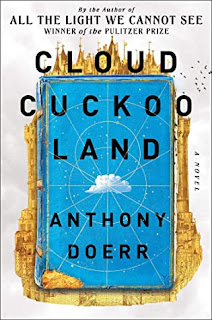
Review by Lisa Williams of "Cloud Cuckoo Land" by Anthony Doerr


“Part fairytale, part fool’s errand, part science fiction, part Utopian Satire ...” You might recognise the name? Doerr won the Pulitzer prize in 2015 for All the Light We Cannot See. That’s another book (Netflix Series next year) that stays with you for a long time after reading and the reason I picked this book up. 

Cloud Cuckoo Land is a book about the power of a story. We are taken to the past, the future and the present with seemingly unconnected stories, different characters and places. At first it’s hard to fathom a link between them all but as the story progresses it becomes clearer. There’s no getting lost in the shifting settings as each chapter begins with a date and location for the unfolding action.

This is an exquisite read, one you’re torn between speeding up to get to the story’s conclusion and wanting to slow down so you can savour its delights forever. This is a book that when I reached the end I immediately wanted to start it again. 


About the reviewer
Lisa Williams is a shopgirl and a graduate of the MA in Creative Writing at the University of Leicester. She is on Twitter @noodleBubble 


Monday, 12 July 2021

Review by Colin Gardiner of "New York 2140" by Kim Stanley Robinson


New York 2140 is the brilliant vision of a flooded metropolis struggling against capitalist greed and the ravages of climate change.

Kim Stanley Robinson weaves multiple storylines to capture the imagination. The characters are vivid and the narrative expertly paced, but the real lead character of the story is the city itself. Towering out of the flooded skyline, with its canals and submerged secrets, New York really shines in this luminous tale.

This is a great, almost-utopian novel that provides hope for these uncertain times.


About the reviewer
Colin Gardiner lives in Coventry. He writes short stories and poems and has been published by The Ekphrastic Review, Ink Pantry, The Midnight Street Press and the Creative Writing at Leicester blog. More of his work can be read here.

Tuesday, 13 April 2021

Review by Mahveen Syed of "A River Called Time" by Courttia Newland


Courttia Newland, well known for his scriptwriting of the BBC show Small Axe, takes a leap into the popular territory of speculative fiction with his latest and long-awaited novel. His previous works, including his debut novel, The Scholar, depict real-life situations and experiences of the West Indian community in both the UK and US. Despite this previous focus on realism, A River Called Time does not disappoint. This alternate reality where colonialism and slavery do not take place, allowing African traditions and religious practices to flourish throughout the globe, is captivating, complex and wholly original. 

The layers of Newland’s novel ensure it does not become predictable, the pace built through the selective glimpses we receive of his alternate London, renamed Dinium, and The Ark. Dinium is not wholly other to our world; the richest borough remains in the West End and Barnsley and Charlton Football Club continue to be rivals. 

The journey of Markriss’ character introduces us to this world, even as he is introduced to it himself. His journey into the Ark, from Outer City to Inner City, only scratches the surface, astral energy wielded to create parallels that are unforeseeable. Newland’s cautious protagonist highlights the fluidity and instability of this world, where control is unavoidable and poverty inescapable. 

Enjoyable and filled with vitality, this novel draws you in steadily and inexplicably, paving the way for Newland’s upcoming speculative fiction short story collection, Cosmogramma. A River Called Time ensures we have an investment in this alternate world where we see what could have been.


About the reviewer
Mahveen Syed is a second year English student at the University of Leicester. Her passions include reading, writing and travelling. Having lived in the UAE, she has been exposed to different cultures and lifestyles, using these unique experiences to inspire her creative writing.