Wednesday, 27 July 2022

Review by Jon Wilkins of "The Portable Nine" by Pete Mesling


I’ve steered clear of American thriller writers for a while now, but after reading this novel I can’t understand why!

Pete Mesling concocts a world of shadows and deceit as his protagonist, Davenport, fails on a mission, a mission to kill. Davenport is an assassin, known as the Mad Marksman of Malta. When the contract to kill Max Brindle misfires, and with his mission unfinished and his courage shaken, Davenport has to face the consequences and they are far reaching. 

Mistakenly thinking the contract has been fulfilled, the mastermind behind it, the Black Phantom, plans to perform a spiteful act of retribution. Davenport has no choice but to join again with a group of skilled mercenaries in an effort to exact his own revenge as he finds himself the target of the Phantom's displeasure. He needs to work again with his old compatriots. These are the Portable Nine: Davenport, Abel Hazard, Miranda Gissing, Joseph Intaglio, Mr Bonnet, Twitch Markham, The Butcher, Lovinia Dulcet and Robin Varnesse. 

They operate outside the law, but they still maintain a code of ethics. They may all be outcasts, but they are still heroes to the underclass and adversaries to society's enemies. But what is the society they try to maintain? They are the white knights to the brutal black knights, they are clever and resourceful, brave and fearless, and they will all stop at nothing to see that their brotherhood maintains the status quo.

Well written, though perhaps over the top, the novel draws the reader into the seedy cold-hearted underbelly of society. Should evil ever win or should another, different evil be allowed to succeed? The age old story of an eye for an eye is given new life by Mesling. Whose side will you find yourself on? Who are the truly evil?


About the reviewer
Jon Wilkins is 66. He is married to the gorgeous Annie with two wonderful sons. He was a teacher for twenty years, a Waterstones bookseller and coached women’s basketball for over thirty years before taking up writing seriously. Nowadays he takes notes for students with Special Needs at Leicester University. He has had a work commissioned by the UK Arts Council and several pieces published traditionally as well as on-line. He has had poems in magazines and anthologies, art galleries, studios, museums and at Huddersfield Railway Station. He loves writing poetry. For his MA, he wrote a crime novel, Utrecht Snow. He followed it up with Utrecht Rain, and is now writing a third part. He is currently writing a crime series, Poppy Knows Best, set at the end of the Great War and into the early 1920s.


Tuesday, 26 July 2022

Review by Jon Wilkins of "The Secret Garden of Yanagi Inn" by Amber A. Logan


A beautifully written opening chapter draws us into Amber Logan's world of Marissa Lennox - a world I’m not sure that we'd want to enter. Still grieving her mother’s death, the pain almost unbearable, Mari Lennox travels half way across the globe to Kyoto, Japan to take photographs of Yanagi Inn for a client. As she wanders about the inn and its grounds, her camera captures unusually fascinating images, which seem to uncover layers of mystery that envelope the old resort, the most enticing, overgrown, secret garden on a forbidden island. 

But then eerie weeping starts to keep Marissa awake at night. The only problem is that no one else in the inn seems to hear the sounds. Mari searches the old building, despite the warnings of the staff, to find the source of the spectral sobbing, only to discover that her own family’s history is intertwined with that of the inn, its mystical abandoned garden and the frightening enigma it shrouds.

Beautifully written and wonderfully illustrated, I recommend this to all who want to have company on a dark night as the wind and the rain sweeps against their window. At least I hope it is the rain.


About the reviewer
Jon Wilkins is 66. He is married to the gorgeous Annie with two wonderful sons. He was a teacher for twenty years, a Waterstones bookseller and coached women’s basketball for over thirty years before taking up writing seriously. Nowadays he takes notes for students with Special Needs at Leicester University. He has had a work commissioned by the UK Arts Council and several pieces published traditionally as well as on-line. He has had poems in magazines and anthologies, art galleries, studios, museums and at Huddersfield Railway Station. He loves writing poetry. For his MA, he wrote a crime novel, Utrecht Snow. He followed it up with Utrecht Rain, and is now writing a third part. He is currently writing a crime series, Poppy Knows Best, set at the end of the Great War and into the early 1920s.


Monday, 4 July 2022

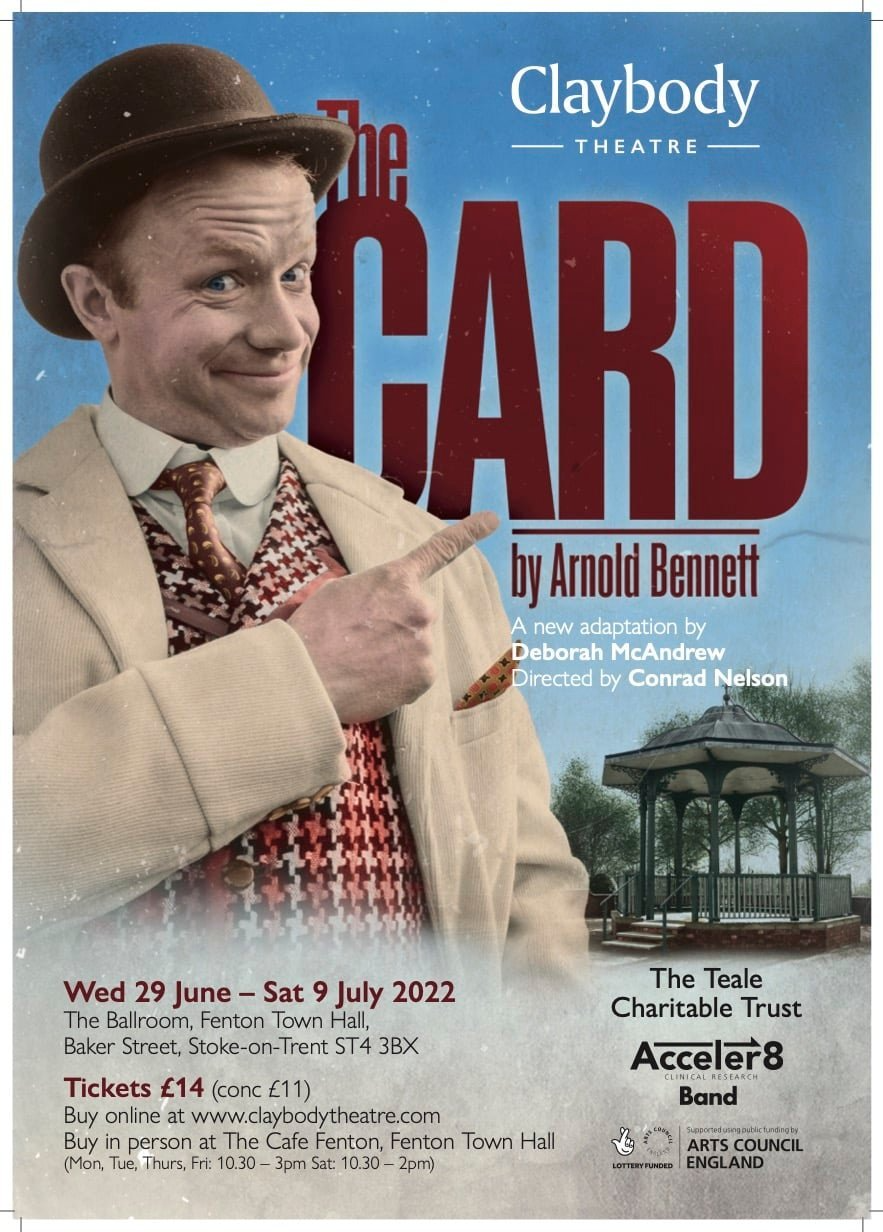
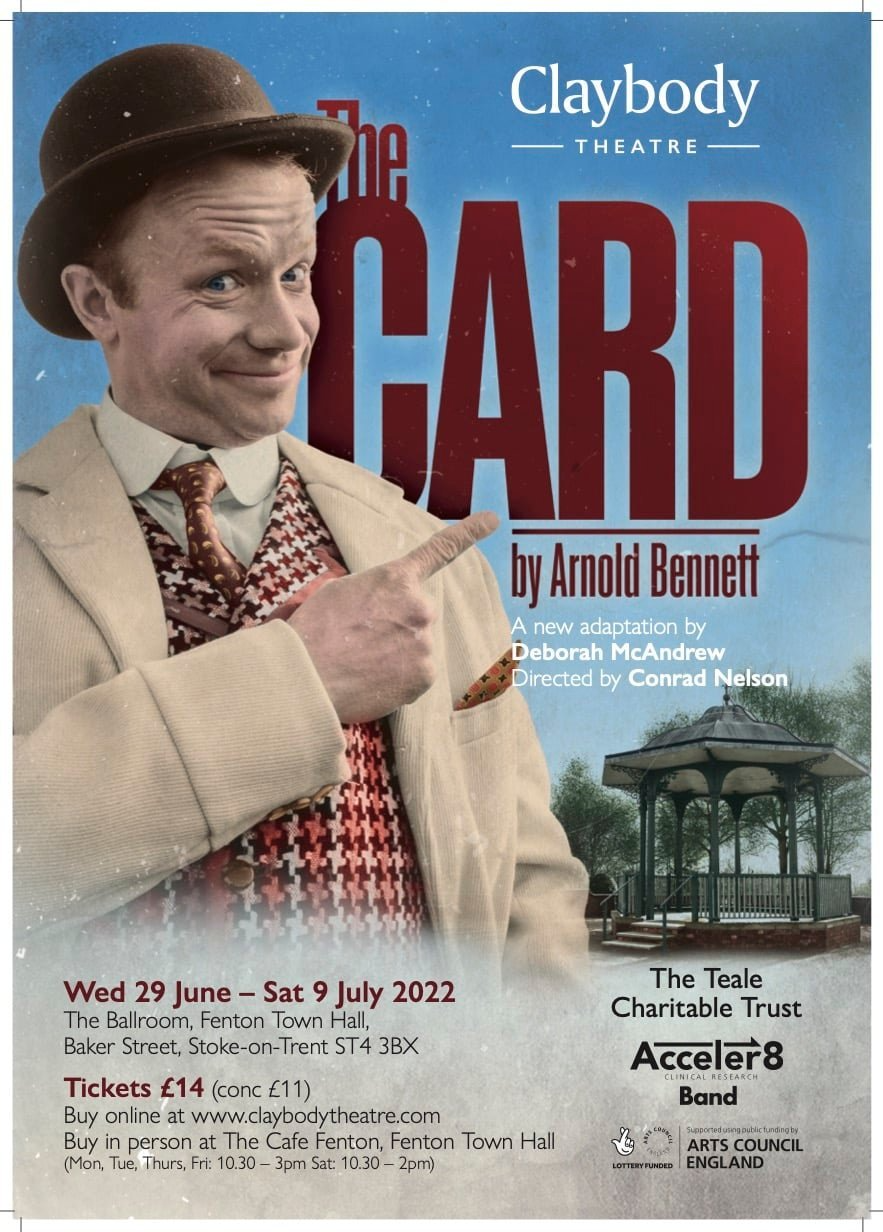
Review by Julian Salt of "The Card" by Arnold Bennett, adapted by Deborah McAndrew, with the Claybody Theatre


My wife and I have just seen a stunning adaptation of Arnold Bennett’s The Card. Claybody Theatre's Deborah McAndrew, writer, and Conrad Nelson, director, have produced an enthralling masterpiece which should not be missed. The seven professional actors / musicians with supporting brass band and the enthusiastic entourage of Claybody volunteers created a gem of a riotous romp from start to finish. The actors played multiple roles and were all accomplished singers and dancers.

Bennett’s novel showed how with ‘dash’ we can break through adversity and ;cheer up' the world. O how we need  this today! McAndrew's and Nelson’s genius warms the heart and  makes you want to unleash the Denry in us all … we loved every moment of it!

Well done especially to the supporting cast of Claybody Theatre's volunteers. On a shoestring you have produced a most memorable show, which fully deserves a wider audience.

The renovated Fenton Town Hall gave the performance authenticity and a historical canvas exuding its own vibe, which served to enhance this exquisite production.

After watching Deborah McAndrew, the writer, pick up a basket of the actors' clothes and take them away to wash them, ready for tomorrow's performance, we appreciated the work ethic she shares with the whole of her team. The way the actors gave freely of their time afterwards reflected their wholehearted approach to the project. Celebrating the Potteries and Fenton, (the missing sixth town) in Fenton Town Hall, this masterpiece was given a magical authenticity. 

Throughout, the show was a rich kaleidoscope of polkas and waltzes, shanties and folk songs, Potteries humour and dramatic irony all of which warmed our  hearts in these cold Putinized days. From shades of unscrupulous landlords to excursions to Llandudno, from love to ambition and greed, politics and intrigue, all were combined within a simple tale of a Stokie who made good.

McAndrew, originally from Leeds and Conrad from Liverpool - we salute you. Welcome to The Potteries Hall of Fame for writing and directing such a stunning show! 


About the reviewer
Julian Salt is a retired Psychologist born in Fenton, who now lives in Derbyshire and enjoys revisiting his roots.

You can read another review of this adaptation of The Card here


Friday, 1 July 2022

Review by Carolyn Ruane of "The Card" by Arnold Bennett, adapted by Deborah McAndrew, with the Claybody Theatre


I went to the opening night of this new adaptation of Arnold Bennett's novel, The Card, adapted by Deborah McAndrew, with the Claybody Theatre in Fenton Town Hall, Stoke-on-Trent.

The show is stupendous. Gareth Cassidy is amazing as Denry Machin. The part that amused me most was Howard Chadwick playing Mrs Machin; he was hilarious. 

The singing and dancing are preformed very well. It was slick. No first night nerves! The way the cast go out of one door, and then reappear through another door with a change of clothes is fabulous. 

The canal scene is done really well: you really feel worried about the water coming in. It's believable. The runaway horse is great and again you feel the action. 

The fact most of the cast play multiple parts does work really well. 


About the reviewer
Carolyn Ruane is from Stoke on Trent. She is a keen member of the Arnold Bennett Society. She enjoys plays at the theatre and is an avid reader. 


Thursday, 30 June 2022

Review by Sally Evans of "The Last Days of Petrol" by Bridget Khursheed


This first poetry book by Bridget Khursheed, who lives in the Borders near Melrose, is full of powerful, distinctive poems, mostly about countryside phenomena, with a sense of continuity through ecological awareness and awareness of the present. Its seventy-eight pages, packed with poems, display a certainty of vocabulary, rhythm and phrase unusual in a first book of poems. There’s the same certainty about line ends in the poems, which vary from page width to a few having very short lines.

Some of these poems are essentially ‘nature’ poems, some imply family and children, a few are quietly polemic, like the poem about Helen Duncan, a well-researched and unusual take on the Scottish woman who became involved in Churchill’s war propaganda, or the title poem, about frantic car messages round the country, descending to

           empty journeys,
           fast except by speed cameras,

           and the trip to the shops
           things nobody needs packed
           by a teenager …

Whether these poems are set in her local Borders with their unknown lanes and riversides, Edinburgh’s Easter Road, Kelvingrove, the Eildons, or Darnick, Khursheed’s strong sense of place gives a background to the range of poems, in which there is always a link between the clearly pictured observations and the observer. In City wood above the bypass,

           I am walking through the machine-gun wood,
           looking for siskins.

and then we are told what she finds:

          the path is needled
          and high above the pitched notes of crossbill
          and goldcrest
          are the blown wires that tear up the sky

to the surprise conclusion:

         I am looking for siskins in the pinewood
         and instead I find only me.

All he vocabulary is precise and consistent. There are a few country words: cleavers, scroggs (perhaps the most obscure, meaning crabapples), technical words when wanted, freshly used words: 'Toys abraded  / into nightmare in the silence,' or 'Rucksacked, the baby cries for home.'  

With so many people publishing poems these days, and it’s a good feature of Scottish culture that poetry can thrive in this way, not too much is generally expected of a first book. But this one raises the game. It raises the hopes and discoveries of the poetry reader and shows us a live, properly managed, healthy, modern, country Scottish English. Not a line wrong, not a word out of place.


About the reviewer
Sally Evans edited Poetry Scotland from 1997-2018, and was awarded a PhD in Creative Writing at Lancaster University in 2022. 

You can read a review of Sally Evans's novel, Wildgoose: A Tale of Two Poets, on Everybody's Reviewing here
 

Wednesday, 29 June 2022

Review by Tracey Foster of "Let's Ride Leicester Literary Tour," on Saturday 25 June 2022


Saturday was a good day to go on a bike ride. What a great way to see the backstreets and alleyways of our city! I must admit, I was a little nervous as I signed up to join the "Let’s Ride Leicester Literary Tour" to visit the key sites and places associated with our great writers, Joe Orton and Sue Townsend. The scale of the ride looked daunting, but the pace was slow enough to enjoy it. 

The University of Leicester’s Dr Emma Parker talked us through the relevant history and gave us a valuable insight into the life of Joe Orton from his humble beginnings, making plays in his garden with his sisters, to applying for a place at the Little Theatre. The subsequent demolition of his childhood home took away our sense of place as Emma read snippets from his teenage diary and his sister’s memoir (Leonie Orton, I Had It In Me). We also visited the University’s David Wilson Library that houses a ceramic pot made by Joe Orton’s niece, Rachel Barnett and a stencil artwork by street artist Stewy. We also stopped off at a local kebab shop that has been decorated by Leicester City Council with an image of Joe Orton to celebrate his success.

The highlight of the tour was the stop at the Pork Pie Library in the middle of the Saffron Lane estate where both writers grew up and visited in their youths. This magnificent old building has now acquired listed status and has retained some of the original interiors and fixtures. The head librarian Tracey Inchley was very keen to welcome us and gave us a fascinating talk about the library and its historical connections to the two writers. We saw the board game made by teenagers working on a 2017 exhibition about Joe Orton by Soft Touch Arts that reflected the struggles and pitfalls of growing up on the Saffron Lane Council Estate. Peter Simmonds talked enthusiastically about Sue Townsend as the reluctant writer, and creator of Adrian Mole, who never broadcasted her fame but remained faithful to her beloved Leicester all her life. He read snippets of Mole wisdom outside the buildings that were related to the text.

Combining gentle exercise with insight into two local literary heroes was a great idea and a tour that was well worth the effort. I recommend this event to the keen reader and the gentle cyclist alike. Many thanks to all those who were involved with organising and presenting on the day.

If you’d like to give it a go, this ride will run again during Leicester Comedy Festival / LGBT History Month in February. 


About the reviewer
Tracey Foster started off in a long career as an Art and Design teacher but wanted to refocus her creative energies into writing poetry and prose. After helping others find inspiration in the world around us, she has taken the MA course in Creative Writing at Leicester University and has not looked back. She finds inspiration in the past and the events that shape us. Previous work has been published by Comma Press, Ayaskala, Alternateroute, Fish Barrel Review, Mausoleum Press, Bus Poetry Magazine and The Arts Council.


Friday, 24 June 2022

Review by Jon Wilkins of "Paper Crusade" by Michelle Penn


The poems here echo Shakespeare's Tempest and are a response to The Tempest Replica, a dance performance choreographed by Crystal Pite.

How often do you
sit and read a poem
and are transported
to
a
Different world?
To storms and sea?
To wars and death?
And meet
absolute power, 
an evil colonialism, 
the wild exotic environment, 
magic, 
music and 
language?
Who is 
C?
The daughter?
The father?
Is the winged spirit truly
Ariel or
Another?
Who are the white suited
paper masked
army?
Who do they fight?
And why?
We follow the journey.
The words draw us in
each chosen for
their immaculate 
tone.
Willingly we
Go.
The words
different 
relevant 
unwavering in their 
Truth.
Drawn in
to a parallel 
world
of sprites and fancy
war and death.
A perfect mix
For any reader.
Of any age.
For any Age.


About the reviewer
Jon Wilkins is 66. He is married to the gorgeous Annie with two wonderful sons. He was a teacher for twenty years, a Waterstones bookseller and coached women’s basketball for over thirty years before taking up writing seriously. Nowadays he takes notes for students with Special Needs at Leicester University. He has had a work commissioned by the UK Arts Council and several pieces published traditionally as well as on-line. He has had poems in magazines and anthologies, art galleries, studios, museums and at Huddersfield Railway Station. He loves writing poetry. For his MA, he wrote a crime novel, Utrecht Snow. He followed it up with Utrecht Rain, and is now writing a third part. He is currently writing a crime series, Poppy Knows Best, set at the end of the Great War and into the early 1920s.


Thursday, 23 June 2022

Review by Jon Wilkins of "The Cry of the Icemark" by Stuart Hill


This is a thrilling fantasy novel from Stuart Hill's acclaimed Icemark series. Written mainly at the tills of Waterstones in Leicester during the stores quiet times, this is an epic contribution to the fantasy world. The book was reissued mid-Covid and is well worth a read. 

When her beloved father dies in battle, the fourteen-year-old Thirrin becomes Queen of the Icemark, a tiny kingdom situated between dangerous neighbours. Thirrin needs to raise an army to protect her people from the seemingly invincible Imperial invaders. She searches for allies far beyond her kingdoms borders, and meets former enemies in the Land-of-the-Ghosts and the frozen Hub of the World. But the one question that haunts her is: can she save her kingdom?

Thirrin is a true Warrior Queen and a major force in Hill’s fantasy world.

The book and others in the Icemark Trilogy deserves a new audience, a new generation of readers who will delight in the battles in the Icemark.

It is beautifully written, a true page turner that rampages across the pages, drawing the reader into the story, delighting them as they enter the vivid imagination of Stuart Hill.


About the reviewer
Jon Wilkins is 66. He is married to the gorgeous Annie with two wonderful sons. He was a teacher for twenty years, a Waterstones bookseller and coached women’s basketball for over thirty years before taking up writing seriously. Nowadays he takes notes for students with Special Needs at Leicester University. He has had a work commissioned by the UK Arts Council and several pieces published traditionally as well as on-line. He has had poems in magazines and anthologies, art galleries, studios, museums and at Huddersfield Railway Station. He loves writing poetry. For his MA, he wrote a crime novel, Utrecht Snow. He followed it up with Utrecht Rain, and is now writing a third part. He is currently writing a crime series, Poppy Knows Best, set at the end of the Great War and into the early 1920s.

Wednesday, 22 June 2022

Interview with Philip Tew


Philip Tew is a writer of fiction, a poet and an academic who focuses on the Anglo-American novel from 1920 to the present, especially avant-garde fiction. After a varied career, he became Professor of English at Brunel University London where he completed a second doctorate in Creative writing (Fiction) awarded in 2016. He retired in August 2021 and was made Professor Emeritus at Brunel. He lived in Leicester from 1972 to 1981 and toward the end of that time taught in several local schools, at one of which Jon Wilkins was a colleague.  


Interviewed by Jon Wilkins

JW: Tell us about yourself and your time in Leicester. 

PT: I came to Leicester in 1972 as a student at Leicester University, studying law, but I changed to American Studies after my first year. Also, in that first year I met a local woman from Welford who was a fellow student and a keen Foxes fan. I stayed on after graduation in 1976, getting married during the great heatwave of that summer. I thought about joining the RAF, but I didn’t want my hair cut short, and my wife would not contemplate leaving the area. Instead, I trained for a year at Leicester Polytechnic, at their Scraptoft site, to become a teacher, a PGCE, with my main teaching practice at a middle school in Wigston. I think it’s now South Wigston High School, for 11-16 year-olds, previously 10-14 under the Leicestershire Plan. I was mentored by a great older chap who’d gone into the profession straight out of the army. He wore a suit. I was casual and scruffy. After lots of interviews where my face clearly didn’t fit (or was it my non-posh London accent perhaps?), I found my first job at Lancaster Boys’ School, a secondary modern offering single sex education. That’s where Jon and I first met as colleagues, and became friends. As you know well it was a pretty grim place in which to work back then.  After my separation from my wife I disappeared back down to the smoke, as Sue Townsend used to call it. More of her in my responses to other questions below. 

I had an ambivalent relationship with Leicester, because I missed London and wanted out of teaching, but couldn’t see me doing that in the city as it was then. Looking back I enjoyed the sports, the pubs and the crowd of people I hung around with. I loved my house which we bought for about six grand in South Knighton in maybe late 1977. However, I found everything recurred, the same people at exceedingly similar parties, same crowd in two or three pubs, and same Waitrose every Friday evening. I wanted more from life. We drank in the Cradock, the Clarendon, the Magazine; I went for occasional pints with a character called Chris Challis (again more on him below) in the Rifle Butts. It’s mostly in my novel, Afterlives, apart from the shopping.  

JW: What was the literary scene like in Leicester in late 1970s?

PT: The literary scene locally, for me that was brilliant, with lots of poetry groups, workshops and magazines, writing workshops and a plethora of alternative bookshops. The university and the polytechnic ran events and writers’ groups, so did local people. There was one night class I attended run by Rosalin Brackenbury (née Crabtree), a skilled writer in the Woolfian mould, who now lives in Key West, Florida and appeared to be still active in 2019. 

Overall, it was a very lively scene, very supportive. I saw Ginsberg, Bunting, McGough, Adrian Henri, Graham Greene and many other lesser names. I suppose the local poet, Chris Challis, was a kind of mentor to me, although I didn’t realise it at the time. He was a quirky but very generous guy, a definite long-hair from the 1950s and 1960s. He’s a key character in my first published novel, Afterlives (2019). During my time in Leicester I wrote and published poetry in various magazines, even gave readings on occasions when Challis was the headline act. I remember one at Nene College in Northampton—where he was writer-in-residence—and another in the Vaults, a traditional pub in the market place in Uppingham. Aged twenty-five I spent my second summer holidays while a teacher writing a novel entitled Swallows in the Sky, a crappy, juvenile title adapted from Junket’s ‘Ode to Autumn.’ I tapped away during late July and August at my ancient portable, bottle of Tippex to hand, upstairs in my terraced house in South Knighton. Later, I published several scenes as short stories in the university arts magazine, Luciad. Another guy, an English lecturer at the university, J.C. ‘Ian’ Hilson (1946-1980), encouraged me in this. However, unfortunately just as the eighties began he died on 9th June in an accident when his car was struck by a speeding motorcycle doing about a ton along London Road, going into town I believe. Such a waste, a real tragedy as Ian was only about thirty-four! He’d read my first novel, which he thought showed great promise, but I never did a thing with it in the aftermath of his death, somehow couldn’t bring myself to return to it. 

JW: You started a literary magazine in Leicester, tell us about it.

PT: A group of us got together, not sure how and where, to think about a Leicester-based arts magazine, which we bid for funding. It was a monthly I think, with reviews, an events page and interviews etc., the usual mix. We had local authority and Arts Council funding, and we had to present a business plan for this support. However, the first pair of main editors immediately shifted direction and they spent most of our money on a launch hosted by the theatre in town, the Haymarket, then by the Clock Tower, trying to find long-term, generous advertisers. We had caterers and lots of booze. The returns were negligible. Our title was magazine (lower case, imagining that made some sort of statement). We managed three issues, but the printer held back the third because of our debts. 

I liked Sue Townsend a great deal, met through Challis. She too had been encouraged to write by him. Together we persuaded her to contribute a feature to magazine, which was the diary of a teenager, Nigel Mole. She changed the name later, advised it was too close to the Nigel Molesworth stories by Geoffrey Willans, illustrated by Ronald Searle. I recall laying out the second issue of magazine on a huge pine table in Sue Townsend’s house in Highfields, drinking copious amounts of wine and beer. As we all now know, Sue went on to deserved fame and success, but she remained as grounded and modest as when I first met her in her years of struggle. I remember her well from workshops at the Phoenix Theatre where she’d gained a bursary. This was opposite the Magazine pub, one of my favourite city-centre hostelries. Sue—after whom the arts centre was renamed in 2015—would have been working on Womberang, which was performed at the Soho Poly in London in 1979. Many people have forgotten she was a gifted and funny playwright.  It was the news of her death in April 2014 (on my car radio) that persuaded me to start writing fiction again.

JW: BS Johnson, the subject of your doctoral thesis was a huge influence. Tell us why.

PT: Well, he was a working-class Londoner, working on experimental fiction, a sub-genre I’m drawn too. There’s something brutally honest and puritan about Jonson’s fiction, whose style is very controlled and compelling. There’s not a hint of bourgeois sensibilities. These were all things to which I aspired when younger, but could not achieve. When I decided to undertake a doctorate he was the obvious choice, plus back then he was much neglected, almost forgotten, so limited secondary sources which gave me the space to be original, and not face screeds of reading in my preparation. That would be very different today, as much scholarly work has appeared on this author and still does. For anyone unfamiliar with his work (especially aspirant writers) I’d highly recommend Albert Angelo and Trawl

JW: Which Leicester writers influenced you?

PT: At the time that I lived there, Chris Challis, Sue Townsend and Rosalind Brackenbury, plus Malcolm Bradbury, Colin Wilson and Joe Orton. They offered an example of how one might turn the everyday into significant modes of creative expression. I think of all of them Orton intrigued me most. And at that time I hadn’t twigged the slenderest of Leicester connections of Julian Barnes, as first he’d only produced his first novel, Metroland, which was only six months old when leaving, but he is a Foxes fan. 

JW: What informs your writing today?

PT: My past life and the world of the university sector as it evolved institutionally over the past forty or fifty years. I’m often concerned with issues of sexual fidelity, and the degradation of personal relationships after betrayal. I’m also motivated by what I mostly don’t find in British fiction. There are many writers who for me, whatever the merits of their novels, just don’t get how it is to be an ordinary person. I want B. S. Johnson’s stark honesty, the well-observed mundane cynicisms and singular interconnections of an early Muriel Spark, but mostly we get bourgeois niceties, even when and where the world purveyed is bleak. So, what mostly informs my writing is seeking to achieve is to capture the subtleties and nuances of everyday life in a fictional or quasi-fictional format, so very much B.S. Johnson again. Although my style is very different from his, the underlying ambitions are very similar. 

JW: How has your writing developed since you left Leicester?

PT: A huge amount: I think it’s far more fluent, well-edited and thoughtful, and certainly many readers seem to think so. I left Leicester when I was almost twenty-seven, so still a young man, but I was very troubled by the vicissitudes of my personal life, my divorce. And, I knew I was still learning to write. After a break of a year or so, I continued writing and tried to find publication after that for a period of maybe fifteen years, but without much success. So somewhat disillusioned, I abandoned fiction as a creative practitioner. After having completed a doctorate on Johnson, I turned to academic writing after that and produced as author, editor or by various collaborations twenty-seven volumes. A twenty-eighth will appear next year, a final one I think. Now I focus on fiction and occasional poetry, as I have done since 2014.  

JW: How much has Leicester influenced your writing? There are a lot of echoes in your stories.

PT: For me Leicester is all about the ambivalence, of living somewhere that has great merits, but you’d rather be elsewhere, needing a return to your roots. However, as I age, the city also represents a phase of my youth, one full of passions and energy, a phase of my life I enjoy revisiting. Plus, I had so many good friends and met so many interesting writers in an environment you might not anticipate doing so. Echoes is correct: Leicester resonates within me, confuses me, and delights me in equal measure. All of which is fertile ground for a writer of poetry and fiction. 

JW: Tell us about your novels and which one(s) you are happiest with.

PT: Afterlives involves an extended autobiographical reflection of all the creative people I had known, many of whom had died, mostly without much public success. I was not only convinced that they were good writers, but that my interactions with them also offered certain insights into creativity. My fictional alter ego is Jim Dent, the protagonist. However, this is certainly not a memoir, and has lots of fictional elements. You might consider my life as being used like a clothes hanger, in essence a framework upon which I can set out new and different sets of clothes. Hence it provides a chronology, a logic of existence, places and certain people, but they are all adapted to convey the nuances of life I mentioned earlier, with a touch of hubris here, amity there, an element of spirit, nostalgia, feeling, 

Fragmentary Lives is a companion piece, but is fully fictionalized. In it the past is explored in three interconnected novellas. The first novella, ‘Another Long Weekend,’ incorporates my time as a play-leader for the Greater London Council (GLC) and explores the tensions and loyalties of male friendship when facing a mutual object of desire. The second, ‘Swimming the Goldfish Bowl,’ features Luke Windsor, a young doctoral student drawn into the machinations of an attractive, but hard-faced blonde who moves into lodgings in the house in Tufnell Park he shares. The third, ‘After the Revolution (Failed to Materialize),’ explores retrospectively the presumptive political idealism of the hard left during the seventies and eighties. 

My second novel, Clark Gable and his Plastic Duck, is set in 1991 and centres on Bill Pugh, another play-leader working for the GLC. In this alternate reality Thatcher has lost the Falklands War and after a failed premiership of Michael Foot, followed by a misguided one led by Michael Heseltine, Alan Clark has become Prime Minister. He initiates a right-wing government, an effective coup. Protests and a bombing campaign follow. Pugh is more concerned with his failed romance and the arrival of an attractive female co-worker. A privatized new security apparatus (modelled in part on the wartime SOE) hires thugs to enforce a new orthodoxy and Pugh comes to their attention after the surprise visit of a school-friend, Connie Chidley. This prompts a host of memories, some highly uncomfortable. Their lives are once again intertwined, with notable consequences for both. 

JW: What are you working on now?

PT: I’m finishing off what I consider to be my best novel to date, Heroes and Villains. My son agrees, and he’s an excellent judge of these things. This narrative has various experimental elements, and it has three narrative perspectives set out in three different sections, following a different account of the tribulations of Luke Windsor. Overall, his struggle animates the narrative. If I said any more all suspense would be lost.  

JW: Having read the earlier drafts of Heroes and Villains I can attest to the fact that it will be well worth a read when published. I will be writing a review on Everybody’s Reviewing when it comes out. Phil returned to London after various adventures at home and abroad and now works out of his garden shed in Enfield. I love the nods to Leicester in his writing, evidence of the positive influence our fair city has had upon Phil.


About the interviewer
Jon Wilkins is 66. He is married to the gorgeous Annie with two wonderful sons. He was a teacher for twenty years, a Waterstones’ bookseller and coached women’s basketball for over thirty years before taking up writing seriously. Nowadays he takes notes for students with Special Needs at Leicester University. He has had a work commissioned by the UK Arts Council and several pieces published traditionally as well as on-line. He has had poems in magazines and anthologies, art galleries, studios, museums and at Huddersfield Railway Station. He loves writing poetry. For his MA, he wrote a crime novel, Utrecht Snow. He followed it up with Utrecht Rain, and is now writing a third part. He is currently writing a crime series, Poppy Knows Best, set at the end of the Great War and into the early 1920s.

You can read Jon Wilkins's review of Clark Gable and His Plastic Duck by Philip Tew on Everybody's Reviewing here