Showing posts with label collection. Show all posts

Friday, 24 July 2026

Review by Lee Wright of "New & Collected Poems" by Jeffrey Wainwright


Forty-eight years in the making, Jeffrey Wainwright’s New & Collected Poems takes us back. It begins in 1978 with his collection Heart’s Desire – a maiden voyage to bring love and war to the page, giving the reader every ounce of life’s frustration and elation. Wainwright allows the poems to spill from his pen like a gardener shaking earth from a bulb of garlic. 

In Selected Poems (1985), his verses are often as cold as sealskin, but it’s a cold we all must face, to understand what it is to feel human. Even the subject of love in Selected Poems barely moves grass. Love, like poetry, is present, but it doesn’t change the world. Wainwright remains tightly focused on the human mind. The poems wind around the reader like vines. He avoids happiness and instead writes of Thomas Müntzer, the deteriorating mental health of George III and dead sweethearts. What is in Wainwright’s mind cannot be touched. 

The Red-Headed Pupil (1994) is a gentle reminder that as the world changes, so we change. We are, as Wainwright points out, plasticine men, shaped by our surroundings. He asks the reader tenderly if they are content among the paving stones. 

The poems stretch from 1999 to the present day, and it is these newer poems that feel deeply personal. "Did you just give up and go" is a line I’ll never get over or forget. In another line he asks, "O my soul, where are you?" which is one of those questions we collect like scars on the body as we age. Is it possible to avoid becoming world-weary as we hold on to the years? Throughout New & Collected Poems, Wainwright is concerned with this question. And who will replace us when we’re gone? That too is something the collection left me asking.  

To borrow Wainwright’s line, "the fish in cold preserve their flesh," just as the ageing poet preserves his reputation in this collected works. 


About the reviewer
Dr Lee Wright holds a PhD from the University of Leicester in Creative Non-Fiction and has had numerous pieces of short fiction and non-fiction published. 

Wednesday, 25 March 2026

Review by Lisa Natasha Wetton of "Writing Elegies for Dead Men I Didn't Meet" by Cathi Rae


This is everyday life, simply depicted, suicide taken in a stride, elongated spaces between the words giving breath where there is none. The reader is given space to pause to reflect and then continue, taking in the gravity of this subject matter in as easy a way as possible. 

          "Is this real?"
          "Shit, I think it’s real"
          "He really really did it"
          running in real time
          while time has stopped for you.

Writing Elegies for Dead Men I Didn't Meet is a series of poems based on real-life stories, creating a narrative that shines a light on issues around men's mental health and the tragedy of male suicide. In her preface, the author refers to it as "a 21st century tragedy." She brings home the finality of life-ending decisions made in everyday circumstances, in order to make individual men visible in a culture that, as the collection quietly argues, has made them very easy to overlook.

Every kind of suicide and situation weaves through this collection. Teenage boys, middle-aged men, drunken fathers snatched from life in a moment that cannot be taken back. Some planned, some more spontaneous, all terminal and unchangeable. The sadness and tragedy are stark and unrelenting, with a wish that it could be something other. 

The simplicity of descriptions mirrors the commonality of suicide. Men of all ages are taking their lives under the compounding weight of circumstances that ground them down - feeling unseen, carrying shame they were never equipped to name, or simply exhausted by the effort of continuing. 

In the opening piece, "Slicing Through the Information Superhighway with a Scalpel," Rae writes about the process with which she created the content:

           my computer glitches
           won’t stop scrolling page after page
           name after name after name
           until I have to look away block away the tears
           writing elegies for dead men I didn’t meet.

Poem after poem, man after man, the weight of it builds and builds. These are not isolated failures, not men who simply couldn't cope. They are every age, every background, every circumstance. "Club 18 to 35" feels like the collection's breaking point. This is an almost-angry reckoning with what we are doing to men, and what we are allowing to continue.

Male suicide is becoming an often silent, global epidemic, with men dying by suicide approximately three to four times more often than women. Rae reaches out to shed light on an issue that must be addressed. These poems provide perspectives of people choosing to take their own lives and how, as well as acknowledging those left behind. 

In "Finders," Rae bluntly puts it, 

          your discovery       just a delay
          in the everyday of commuting home
          a flicker of frustration
          and then reset
          Someone has to find you ... 
          someone who will keep that memory
          forever
          even if they wish they couldn’t
          who might prefer that you had stayed
          unfound.

Here, she acutely presents the devastating impact that ripples out from suicide. Lights go out on a life, as the world inevitably, indifferently, keeps on turning. This is a collection that deserves to be read widely - not as a comfortable experience, but as a necessary one. 


About the reviewer
Lisa Natasha Wetton (aka Lisa Life) is a regular contributor to the English pages of L’eco de Sitges, Barcelona. She is a Creative Artist, Coach & Hypnotherapist. She collaborates on Writing Retreats with American Author Will Bashor, with whom she co-authored Soul to Pages - A Weekend Journey to your Novel/Self-help book, a process used to support budding writers that incorporates meditation and visualisation sessions. She is currently refining edits on her first completed book, A Guide to Spirituality from a Working Class Girl. She has a twenty-year history working in Dance & Theatre and has been based in Barcelona for almost seven years. You can find Lisa at https://linktr.ee/NewLisaLife.

You can read more about Writing Elegies for Dead Men I Didn't Meet by Cathi Rae on Creative Writing at Leicester here

Friday, 25 October 2024

Review by Peter Raynard of "After the Rites and Sandwiches" by Kathy Pimlott


Kathy Pimlott’s heart-breaking pamphlet, After the Rites and Sandwiches, portrays the impact of her husband’s sudden death from falling down the stairs of their home. In the aftermath, the reaction and readjustment is immediate and ever-present.

In an early poem, "No shock advised," short, punchy lines put you under no illusion as to the enormity of the event.

          It’s cruel work
         To kneel down
         and hunch over
         a so-familiar body at the foot of the stairs

But even then, when the defibrillator says, "no shock advised" and it’s apparent that there is nothing to be done, "still the sweet mad hopeful brain insists it will be okay."

The pamphlet is both a portrayal of grief and biography of a marriage. Tears become the episodic outpouring of emotion, almost carrying the weight of a seizure: "It’s impossible to foretell what will provoke tears, the sort that well up and tip over while you hold onto the kitchen sink waiting for them to subside."

Grief is also full of surprises, one of which is guilt: 

         Forgive me, I’ve laughed,
         glided lightly round garden centres, sipped fizzy wine
         with friends, sorted out edge pieces of puzzles.

Grief may not have feathers, but it does have a long tail; for although her husband is gone his presence remains, in objects, memories, as well as his ashes, and knowing what to do with them. In "Death Admin I," "Your demise constitutes a quarter off council tax, removal of a vote you seldom cast." Then in "Death Admin II," when collecting his ashes, 

        It shouldn’t be a surprise, the weight, the quantity.
        Not knowing what to expect, I take a pink rucksack, 
        carry you again, all down Holborn on my back.

Pimlott beautifully crafts the poems, with a matter-of-factness laced with incisive metaphors, which detract from the possibility of being overly maudlin. 

There is also dark humour as she almost parodies self-help, in titles such as "How to be A Widow," "Death Admin I & II," and in the final poem, "Coda: Tips on avoiding the offered consolations of Religion and Therapy": "If it’s Religion, it’ll spot you, even when you’re crouched low behind the credenza," or: "Therapy requires acuter acting skills. Better pretend you’re a dog (a Dalmatian, the least intellectual)." Also in the poem, "What I do with you now you’re dead," Pimlott writes: "in a laughing panic, [I] dumped a quarter of your ashes and ran away, the illicit thrill exactly what you would have wanted."

After the Rites and Sandwiches is a stunning biography of a marriage and its aftershock, that will stay in the reader’s memory long after the book is laid to rest.


About the reviewer
Peter Raynard is an independent researcher, poet and editor of Proletarian Poetry. His three books of poetry are: Precarious (Smokestack, 2018), The Combination: a poetic coupling of the Communist Manifesto (Culture Matters,2018), Manland (Nine Arches Press, 2022). A debut pamphlet (a heroic crown of sonnets), The Harlot and the Rake: poems after William Hogarth, was published by Culture Matters in September 2024.

You can read more about After the Rites and Sandwiches by Kathy Pimlott on Creative Writing at Leicester here


Tuesday, 22 October 2024

Review by Geoff Sawers of "Pain Sections" by Paul Ilechko


Ilechko's first chapbook, Bartok in Winter (Flutter Press, 2018) was, as one might expect from the title, taut and spare with few words wasted; a book of clean lines and compressed, even drilled, language. Pain Sections is looser, more expansive – the larger paper format suiting the frequent use of very long lines – but continues the poet's searching investigation into the nature of the body as an unreliable medium, as both cage and vessel. A series of unspecified medical procedures are undergone; perhaps inevitably there is a yearning to escape at times, moments of panic, of surreal reverie, of frailty and fear. A poem that starts "A body drenched in joy / thicketed / and bruised / overwhelmed with pollen" ends with the lines "the iron-tasting leaves that still / eclipse / the lamp-lit room" ("Marrow of Purity"). If it was important for the reader to know the nature of these investigations, presumably we would have been told. But since that information is withheld it gives a weird, dislocated feel that I suspect is deliberate, since the very unreliability of the interfaces between mind and body seem to be the crucial site of much of the work's focus. Cancer is mentioned, but that appears itself to be a metaphor for something else.

At this point in the book there seems little escape: "and I wonder if / inside of each of us / there is only pulp / as inside each other / we liquefy ..." we read a few pages later ("Bruising"). The body is as tender as fruit; the natural world is a constant metaphor, with the erosion of coastlines mimicking the potential disintegration of a human body. But soon the possibilities of communication, especially in "Breath as Wave and Breath as Particle," begin to offer a way out of this stifling trap. At times we find what may be whispered lovers' dialogues, though the voices are unspecified and unsettling. Just as Bartok in Winter frequently switched voices within one poem, this book expands upon that technique and ends with a lengthy dialogue poem. If I have a real criticism to make it comes at this point as this fourteen-page dialogue, which seems to want and perhaps be able to resolve the tensions set up earlier in the book, is at times abstract or unfocussed. The most overused word – "leakage" – is still important however as it comes to emphasise the many unsoundnesses of the body. Even though this dialogue section contains memorable lines ("as light that flows through the cracks of our investment / I sold my waters for profit / I sold my light for kicks") it slips at one or two moments into bathos and could do with further careful editing.

Nevertheless, Ilechko's unflinching attention to detail is at times startling; little curls of the romantic or lyrical never distract from his serious purpose. Small touches of very dark humour come through too at times. Looking back once more at his earlier book the themes were all there, but the language was archer, more stylised. References to various artists – Ryman, Borges, Hopper – seemed unnecessary when, in the latter two cases at least, their influence was quite plain to see. In Pain Sections, Ilechko's voice is much more assured, biting without being sarcastic, and unafraid to tackle the most difficult of themes.


About the reviewer
Geoff Sawers (he, him) is the author of several books including a collection of linked short stories, Friends of Friends (Diehard, 2024). He is a lone parent of a disabled child and lives in Reading, UK. You can read a review of Friends of Friends on Everybody's Reviewing here

Monday, 17 June 2024

Review by Jonathan Wilkins of "Mother Night" by Serge ♆ Neptune


Beautifully written in a myriad of forms, structures and styles, Mother Night is a difficult and disturbing read. Having said that, it should be read as it opens up an underworld that we might have missed and experiences that demand questions from us without providing obvious answers.

It takes great courage to look so deeply into the past and this must have had a cathartic effect on Neptune as they examined the events that have had such a profound effect on them. The issues raised are at times hard to come to terms with but the quality of Neptune’s writing allows us some insight into their world, uncomfortable as it is. The descriptions of their early life are so skilfully narrated that they allow us to understand something of what the narrator experienced. This was an earlier life that was tainted by abuse and pain. 

That Neptune has grown from this only does them credit and the ability to put the experiences into words so skilfully is an art in itself. Quite disturbing in their intensity, the poems delve deep into the psyche of the writer and allow us as the reader to enter their world. The past is intensely interrogated and we are invited into a life deeply impacted by extreme events. But the beauty of Neptune's poetry is compelling. They use images and scenes that intrigue us and encourage us to enter their world.

The poetry almost acts to cleanse the past and to mediate a way forward, in a way that only this art form can achieve. The words bring clarity and make sense of the past as only poetry can do. As writers we know the sense of wellbeing that we can find by putting our thoughts and feelings onto paper and Neptune must truly have felt a release as they wrote this, trying to expunge the past, and to move forward, yet allowing us to share their memories with them. 

Does the narrator want us to learn from their life tales? Is the book a warning to us or is it a celebration of the fact that they have overcome the trauma to lead their current life? Neptune’s work is outstanding, though upsetting and challenging. The world can be a problematic place and we can face challenging things. It is how we respond to this that makes us who we are. Neptune shows he has learnt from life and his experiences and been able to move forward. That is the very least we would wish for ourselves.


About the reviewer
Jonathan Wilkins is 68. He is married to the gorgeous Annie with two wonderful sons. He was a teacher for twenty years, a Waterstones’ bookseller and coached women’s basketball for over thirty years before taking up writing seriously. Nowadays he takes notes for students with Special Needs at Leicester and Warwick Universities. He has had a work commissioned by the UK Arts Council and several pieces published traditionally as well as on-line. He has had poems in magazines and anthologies, art galleries, studios, museums and at Huddersfield Railway Station. He loves writing poetry. For his MA, he wrote a crime novel, Utrecht Snow. He followed it up with Utrecht Rain, and is now writing a third part. He is currently writing a crime series, Poppy Knows Best, set at the end of the Great War and into the early 1920s.

You can read more about Mother Night by Serge ♆ Neptune on Creative Writing at Leicester here


Tuesday, 13 June 2023

Review by Harry Owen of "Wildfire" by David Mohan


Where does one begin with the ‘wildfire’ running through this excellent collection? With an attempt at definition, perhaps.

The obvious one is of any raging, destructive conflagration that consumes vast areas of woodland, brush and veld, devastating wildlife and threatening human habitations. Even in a world increasingly familiar with the devastation caused by anthropogenic climate change it still shocks to read the first lines of the title poem, ‘Wildfire’:

           The world is kindling for a dropped match … 

           the fire spreads like dawn
           igniting brush, forest, grass, it cuts
           black footprints, a poacher’s report
 
           in backwoods, on the street.

Different forms of wildfire emerge, from the strange incendiary mixture of ‘Greek fire’ used in ancient warfare, to the mysterious will-o’-the-wisp and luminescent ‘foxfire’ of the imagination, something half actual, half mythic, wherein

          wildfire will sleep between dreams
          of lake water and reservoirs
          …
          riled and vicious and ready to terminate
          this touch paper planet.

The ecopoetic spirit of Wildfire – expressed in the recurrent motif of burning – is clearly evident, as in ‘The Field Fire Almanac’ where 

           you might find a thousand 
           charred spiders, larvae,
           crickets, beetles, slugs,
           two centipedes: a mass grave 
           …
           just the potash of dust.

Other forms of burning, psychological and emotional, smoulder in poems that explore close human relationships of one kind or another – friend, lover, spouse – experienced in times of despair or loss (‘Black Dog Tattoo’; ‘Gorse Fire’; ‘Black Light’). In the yearning poem ‘Votives,’ for instance, we learn, without being told directly who is being addressed, that 'I wanted // more than this for you, I swear, / a bonfire, flames, a burning ship.'

And in honour of Oscar Wilde, a fellow Dublin native, David Mohan pays his moving tribute to the great man after visiting the hotel room in Paris (‘Hôtel d’Alsace’) where he died, sick and destitute, in 1900. 

For all the recurrence of ‘black’ and ‘fire,’ I very much enjoyed these finely crafted and emotionally powerful poems, genuine amusement appearing in the wonderfully dark humour of ‘Vacuum’:

            Vacuum

            I like retraction, reversal
            of the Hoover’s stomach—
            disembowelled it reveals
            what’s left to settle in a room.

            I find pockets of lint,
            cough-balls of fluff,
            a static vest
            of vacuous fabric;

            what’s through with happening;
            the fall of dust become edit—
            yarn bulbs of stuff,
            a bolus strung out to a mess.

            Unravelled, I relish strewing it,
            returning it to the carpet,
            to mattresses, polished surfaces,
            like a mourner emptying ash.


About the reviewer
Harry Owen is the author of nine poetry collections, the latest being Thicket: shades from the Eastern Cape (2022), and editor of three anthologies. Before emigrating to South Africa, he had been appointed the first Poet Laureate for Cheshire in 2003. He lives now near Stellenbosch in the Western Cape winelands. His website is here and his blog is here.


Thursday, 30 June 2022

Review by Sally Evans of "The Last Days of Petrol" by Bridget Khursheed


This first poetry book by Bridget Khursheed, who lives in the Borders near Melrose, is full of powerful, distinctive poems, mostly about countryside phenomena, with a sense of continuity through ecological awareness and awareness of the present. Its seventy-eight pages, packed with poems, display a certainty of vocabulary, rhythm and phrase unusual in a first book of poems. There’s the same certainty about line ends in the poems, which vary from page width to a few having very short lines.

Some of these poems are essentially ‘nature’ poems, some imply family and children, a few are quietly polemic, like the poem about Helen Duncan, a well-researched and unusual take on the Scottish woman who became involved in Churchill’s war propaganda, or the title poem, about frantic car messages round the country, descending to

           empty journeys,
           fast except by speed cameras,

           and the trip to the shops
           things nobody needs packed
           by a teenager …

Whether these poems are set in her local Borders with their unknown lanes and riversides, Edinburgh’s Easter Road, Kelvingrove, the Eildons, or Darnick, Khursheed’s strong sense of place gives a background to the range of poems, in which there is always a link between the clearly pictured observations and the observer. In City wood above the bypass,

           I am walking through the machine-gun wood,
           looking for siskins.

and then we are told what she finds:

          the path is needled
          and high above the pitched notes of crossbill
          and goldcrest
          are the blown wires that tear up the sky

to the surprise conclusion:

         I am looking for siskins in the pinewood
         and instead I find only me.

All he vocabulary is precise and consistent. There are a few country words: cleavers, scroggs (perhaps the most obscure, meaning crabapples), technical words when wanted, freshly used words: 'Toys abraded  / into nightmare in the silence,' or 'Rucksacked, the baby cries for home.'  

With so many people publishing poems these days, and it’s a good feature of Scottish culture that poetry can thrive in this way, not too much is generally expected of a first book. But this one raises the game. It raises the hopes and discoveries of the poetry reader and shows us a live, properly managed, healthy, modern, country Scottish English. Not a line wrong, not a word out of place.


About the reviewer
Sally Evans edited Poetry Scotland from 1997-2018, and was awarded a PhD in Creative Writing at Lancaster University in 2022. 

You can read a review of Sally Evans's novel, Wildgoose: A Tale of Two Poets, on Everybody's Reviewing here
 

Monday, 13 June 2022

Review by Paul Taylor-McCartney of "Blood Sugar, Sex, Magic" by Sarah James


The front cover of Blood Sugar, Sex, Magic by Sarah James makes it very clear that much of the material found within this poetry collection is going to deal with impact of living with type one diabetes - charting what it feels like to have to continually deal with the highs and lows of living with the condition.  

The poems that deal directly with what it felt like for the author to be diagnosed at the age of six are incredibly thought-provoking and moving. In ‘Admitted Nov 30, 1981, age 6: diabetes mellitus,’ James recalls the painful experience of teaching her 'fingers to force the need deep into an orange … First an orange, then my leg / The world shrinks, small as this sphere.' Whilst in ‘Diabetes’ unwell of Night Hypos,’ the child is plagued by 'Flesh sweats and shivers, the brain quakes.' To show the shifts in high and low blood sugar levels, the poet has individual words and phrases scatter and then re-configure towards the end of the page in rigid, claustrophobic constriction.

James proceeds to map her journey with diabetes and the route to some sort of acceptance, within herself, first and foremost. Intriguingly, this is coupled with a second narrative: that of a dead sister whose life ended as the younger twin’s began. In ‘Not quite the changeling,’ James admits 'I was born from my dead sister – embryo berthed in her water-logged lungs, bones moulded in her absence.' For the poet, that point in time when she came into the world comes to signify that moment for all of us when the path we are on hints at what could be or might have been: the possibilities of other selves and other identities. In ‘Constantly Reliving,’ we learn 'The girl who isn’t my sister / won’t stop laughing / at the narrative she’s made of me.'

James is an extraordinary poet. She is often wildly inventive but also respectful of traditional forms, imbuing each of her poems with a confessional tone that is reminiscent of Sylvia Plath, Anne Sexton and Carol Ann Duffy. Like the very best of the female poets, she examines what it is to be a modern woman and alive to the potential of life, employing unique methods to share her experiences with those willing to listen. James herself notes in the ‘Foreword’ to the collection, ‘Diabetes happens to be one ghost implicitly looking over my shoulder when I write.’ The power of this collection is in the fact it uncovers and dissects the ghosts that haunt not only James, but each of us – shaping our nightmares as well as our dreams. 


About the reviewer     
Paul Taylor-McCartney has recently completed a PhD in Creative Writing with Leicester University. His research interests include dystopian studies, children’s literature and initial teacher education. His poetry, short fiction and academic articles have appeared in a range of notable UK and international publications including Aesthetica, The Birmingham Journal of Language and Literature, Education in Practice (National Association of Writers in Education), Intima: A Journal of Narrative Medicine and Dyst: A Literary Journal. He lives and works in Cornwall.

You can read more about Blood Sugar, Sex, Magic by Sarah James on Creative Writing at Leicester here


Sunday, 10 April 2022

Review by Cathi Rae of "The Fox’s Wedding," poems by Rebecca Hurst & illustrated by Reena Makwana


As a poet who recently and joyfully placed the word "bosky" into a piece and who has written on The Children of Lir, a collection located in landscape, rurality and the re-imagining of fairy tales is clearly right up my street - or should that be "breaches" (to steal from the poem “Into the Woods” in this collection). If you can imagine Angela Carter, but a reined in, hyper-controlled Carter, where every word is perfect and carries superbly judged weight and musicality – this collection is precisely that.

These are fairy stories that dig back into narratives of blood and skin and teeth, where happy endings are de-railed and deconstructed. The girl raised by wild dogs ("Teeth") returns to the pack and turns her back on “the bones of polite behaviour.” The boy who hides to watch the fox's wedding ("The Animal Bridegroom") is spared his life, but loses language – a word a day until he is “as silent as any beast and lonely.” Even The Frog Prince ( in "The Frog Prince") is "a damp squib of a boy from the wrong side of Tunbridge Wells."

The motif of pins and needles run through many of these poems – the prick of memory in quilt made by a mother – needles to ask needle sharp questions – the path of needles and the path of pins and the task of making impossible fairy tale clothing, "seven nettle shirts seven years dumb in a tree" ("Brothers").

This collection comes from The Emma Press, a Birmingham-based small press, who specialise in producing collections of poetry, short stories, children’s books and art squares where design, layout and illustration are an integral part of the reading pleasure. The illustrations in this collection, by Reena Makwana, are as perfectly executed as the poems themselves.


About the reviewer
Cathi Rae is an award-winning and widely published poet. Her collection Your Cleaner Hates You & Other Poems was published in 2019. She is currently funded by M4C to work on a large scale collection on voicing the marginalised. 

You can read a review of Your Cleaner Hates You & Other Poems on Everybody's Reviewing here

Monday, 5 October 2020

Review by Laura Besley of "Seventy Percent Water" by Jeanette Sheppard


In the title story of her debut flash fiction collection, Seventy Percent Water, Jeanette Sheppard describes how a woman’s body transforms from the usual seventy percent water to a hundred percent after a relationship ends. ‘In the sea she reformed and swam away from the storm.’ 

Sheppard has a natural flair for the obscure. In 'Trumpets,' a woman who wanted her arms to be more ‘finely tuned’ ends up with trumpets for arms. On the surface this is a piece dealing with the practical repercussions of having arms that no longer bend and are made of cold metal, but in reality it’s about the deterioration of her relationship. ‘This morning, as he left for work, I saw him glance at my brass arms and swallow a sigh.’ 

Although there is a wide variety of stories, it is in her stories about old age and all the frustrations and fears that come with that – for both the older person, and those caring for them – that Sheppard truly shines. 

In 'Mirror in the Bird Bath,' the main character puts her mirror in the bird bath because ‘the new one at physio said you had to adapt to your circumstances’ and ‘she had dementia, she knew that, but it didn’t make her a fool’; rage ignites in 'Kindling' at the main character’s brother who takes no responsibility for the care of their mother; in 'Domestic Fairy Tale,' the main character’s ‘mother lays in her hospital bed, reading over and over the two sheets of A4 … attached to the cupboard doors explaining where she is,’ as her care plan is discussed, just out of earshot; 'The Last Time I visited My Mum' hits hard when the mother produces a photo, saying ‘Look, it’s my daughter!’ 

Seventy Percent Water is an accomplished debut flash fiction collection with rich imagery and beautiful language. 


About the reviewer

Laura Besley is a full-time mum to two young boys and squeezes her writing time into the bookends of her day. She has recently been listed by TSS Publishing as one of the top 50 British and Irish Flash Fiction writers with her story ‘On Repeat’ (Reflex Fiction). Her flash fiction collection, The Almost Mothers, was published in March 2020 and her collection of micro fiction, 100neHundred, will be published in May 2021. She tweets @laurabesley


Friday, 11 September 2020

Review by Laura Besley of "This Alone Could Save Us" by Santino Prinzi


          What would be lost if the moon were to disappear, how ordinary the sky might be
          without it.
- Santino Prinzi

The moon features heavily in Santino Prinzi’s flash fiction collection, This Alone Could Save Us. Sometimes a recurring character, always a metaphor for each of the powerful stories in this collection, the moon is steady, looming large above us, but also pulling away at a pace that is imperceptible to the naked eye. It’s in these gentle shifts that Prinzi’s stories shine.   

The first and last stories of the collection act as bookends, almost mirroring each other. At the beginning of the collection, people are desperate: ‘When we realise the moon is shifting away, we beg it not to go. We vow we can change. ’ By the end, this desperation is intensified, but has turned against the moon: ‘Following the will of the people, the government decide to nuke the moon .… Some people believe the moon is the source of all their worldly problems and it’d be for the best if the moon was gone.’ Prinzi’s layered messages in 'The Moon is a Foreign Body, We Can No Longer Trust It' shine as bright as a full moon on a clear night. 

This is a fabulous collection, exploring a range of emotions and situations. There is hope for Louise and her fourth husband, Edwin, who find their way back to each other in 'It Sometimes Snows in April' and the boy who is finally freed from his mother’s snapping in 'How to Make the Magic Work'; sadness for Clyde in 'Bonsai and Clyde,' and something in between for the characters in the title story. Highly recommend. 


About the reviewer
Laura Besley writes short fiction in the precious moments that her children are asleep. Her fiction has appeared online, as well as in print and in various anthologies. Her flash fiction collection, The Almost Mothers, was published in March 2020. You can read a review of it here. She tweets @laurabesley.

Thursday, 3 October 2019

Review by Jonathan Taylor of "Banjo's Inside Coyote" by Kelli Allen


In her strange and highly original new poetry collection, Banjo's Inside Coyote, Kelli Allen cites a quotation from Leonard Cohen: ‘If you don't become the ocean, you'll be seasick every day.’ Allen’s poetry is fascinated by such sea-sickness, and its apparent opposite, ‘oceanness’; like the Romantics before her, that is, Allen’s poetry explores both tragic alienation from, and possible transcendent union with, the natural world. 

It does so by drawing on natural, mythological, mystical and even Jungian imagery, refracted through intense experiences which somehow combine both alienation and union, sea-sickness and ‘oceanness.’ These experiences – love, sex, writing, swimming, dying – are radically unstable sites where the human meets the natural realm, where opposites mingle and clash. 

One such site is the writing desk. Allen suggests that ‘storms retire when the calmest sea lays down its head / on our desk made from oak and stag bone’: the writing desk is both a site for the sea to ‘lay down its head,’ and a place marked by nature’s death (dead oak, ‘stag bone’). Writing is where nature ‘retires’ in a double sense – retiring to, and retiring from. 

At times, Allen herself seems to retreat (or retire) from writing, in an attempt to recapture visceral, natural experiences. She declares: ‘This morning I looked at your sleeping face / and instantly threw my maps / into the brush pile.’ The experience of love at least offers the possibility of transcending writing (‘maps’):

How you look at me in afternoon light. 
Consummation is communion only 
After you admit, round eyes watching 
My throat, that we are here. We are here.

‘Hereness,’ nowness, presence in nature seems attainable, at least for a moment. But hereness is also transient, gone as soon as it is mentioned – and, for the most part, humans ‘make trouble everywhere / we go.’ 

Such trouble is often embodied in the many birds that flit in and out of Allen’s poems. For Allen, the birds are powerful markers of human alienation from nature, particularly in their rejection of human signification. The pathetic fallacy – the age-old, anthropocentric idea that nature somehow reflects human concerns – has broken down, and the birds only signify themselves. She remarks that ‘the birds are probably correct to assume / fallacy anyway,’ and ‘those birds we wept over / the first afternoon will swoop into the country / as though nothing here matters.’ For the birds, as for nature in general, nothing human really matters. ‘The world’s spine is a bible,’ Allen remarks – but a very different bible to the human realm, written in an alien and unreachable language. 

Ultimately, the only permanent transcendence offered – the only permanent union with the natural world – is that of death, or at least dying. Allen’s poetry seems to stand with Keats in dreaming of ‘an easeful death,’ in order to ‘leave the world unseen, / And … fade away into the forest dim.’ For Allen and for Keats, this death is a process, a fading, not just an end-point – and it is the process of dying, of what Heidegger famously called ‘being-towards-death,’ which is our deepest connection with nature. ‘Eventually,’ Allen writes, ‘anything loved is going to drown’:

We are one counteragent to entropy; we are creatures 
ramshackle, propulsion after severance, stillness before.


About the reviewer
Jonathan Taylor is an author, editor, lecturer and critic. His books include the memoir Take Me Home (Granta, 2007), the novel Melissa (Salt, 2015), and the poetry collection Cassandra Complex (Shoestring, 2018). He directs the MA in Creative Writing at the University of Leicester. His website is www.jonathanptaylor.co.uk 


Thursday, 29 November 2018

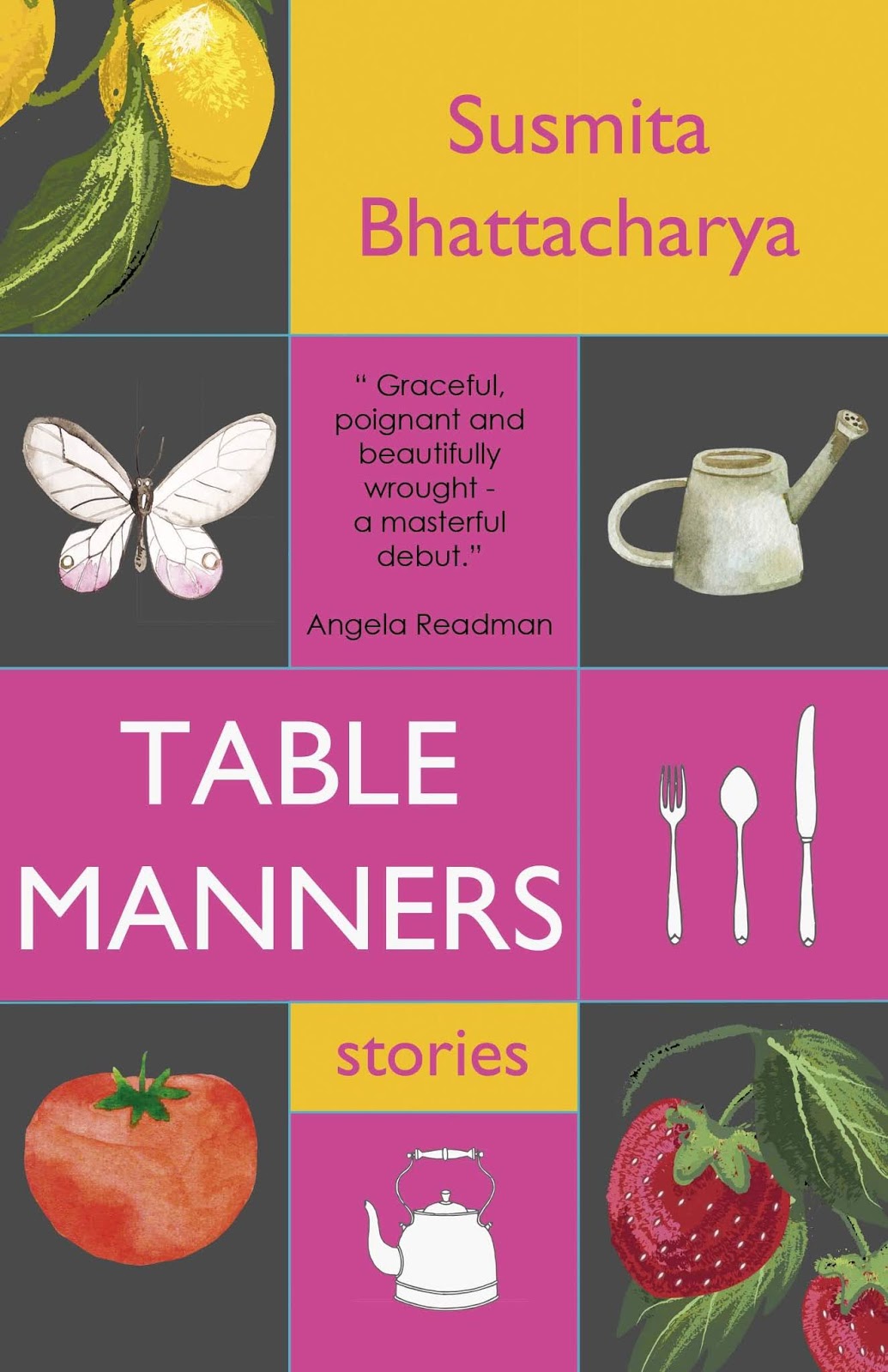
Review by Jon Wilkins of "Table Manners" by Susmita Bhattacharya


Susmita Bhattacharya is a writer and creative writing tutor. She was born in Mumbai and graduated in applied art from B.D.Somani Sophia Polytechnic. Following her marriage she sailed around the world with my husband on oil tankers. Later they moved to Cardiff, where she did her Master's in The Practice and Teaching of Creative Writing at Cardiff University. Her first novel, The Normal State of Mind, was published by Parthian in 2015. This collection of short stories, Table Manners, is published by Dahlia Publishing.

This is a beautiful book, so beautifully written. I don’t really need to expand upon that , but I will. Every story is a subtle blend of place and setting. We identify with every situation as it is always so clear as to where each story comes from. Be it India, Venice, Wales, China or England, we know almost instantly where we are and start the process of empathy with the writer. We are sad when she is sad, homesick as she misses her birthplace, jealous of others as they have what we aspire to and we feel the pain of those who are dying. All the emotions are finely wrought and we feel them all.

All the sorrow that Bhattacharya writes about tugs at our heart. We really do feel what her protagonists feel and this is due to her concise compact writing that doesn’t waste an idea or a heartbeat. Life is brought to life, in the kitchen where we can smell and taste the food being prepared, in the streets of India where we feel the heat and see the poverty, in Wales where we can measure the racism line by line.

The women, the strong women in every story are unwavering. They see all and have an undiminished power about them no matter what their situation. They are key. Bhattacharya  allows us to see into her worlds and to experience what she feels in them. We share her pain, we share the loss of her youth, we believe in her strength as she fights against what is wrong with the world.

Every story makes us think, makes us confront our own prejudices and makes us aware that though we may feel we have everything that others, even if they lack money, status or power, have more. It may be that people in Cardiff are richer than those in Mumbai, but at least the rain drops are bigger in India.


About the reviewer
Jon Wilkins is sixty-three. He has a gorgeous wife Annie and two beautiful sons, and loves to write. He is a retired teacher, lapsed Waterstones’ bookseller and former Basketball Coach. He taught PE and English for twenty years and coached women’s basketball for over thirty years.  He has always loved books and reading.