Monday, 23 May 2022

Review by Gary Day of "I Left My Hair in San Francisco" by Sallie Durham


Lucky the reader who stumbles on this debut collection. Here they will find balm for the spirit, succour for the soul. Sallie Durham’s poetry is wistful and gentle with tinges of melancholy and, very occasionally, a hint of the macabre. Her great achievement is to conjure a feeling for the being of things, whether it is her mother’s old cook book or sunflowers - one of her favourite subjects. In one poem they speak of themselves with pride and stoicism: ‘we, who were once goddesses- / suddenly old dames in hard hats.’ 

The connection between females and flowers is apparent in one of the best poems in the volume, ‘Iris,’ whose life cycle ‘recall[s] the lives of women / our weeping and our bleeding disguised in fine attire.’ Durham’s nature poems are quite different from the moralising Wordsworth and the melodramatic Ted Hughes in that she insists on identity and kinship, even with the humble ‘The Crane Fly’ whose stumbling dance of death proves as much a work of art as a poem, a defiant gesture against inevitable extinction: ‘slumped down on the windowsill / his last two fingers up in a V.’ 

The poems about love and family are deeply touching. ‘Ladders’ will resonate with anyone who is, or has been, in a long relationship. ‘Vigil,’ a poem about Durham’s dying father, is full of tender, piercing images and uses rhythm to great effect, repeating the same words at the beginning of the poem at the end but changing the earlier chugging sound to staccato sobs. The tonal range is impressive from the comic title poem to the slightly manic ‘Finland’ but it’s the imagery which stays in the mind. It is consistently striking and inventive: ‘The clouds continue to bank / their platinum.’ One can only hope there is more to come from this new kid on the block. 


About the reviewer
Gary Day is a retired English lecturer. He is the author or editor of a dozen books including a two volume history of modern British poetry. He had a column in the Times Higher for a number of years and has been actively involved in amateur theatre for many years.


Friday, 20 May 2022

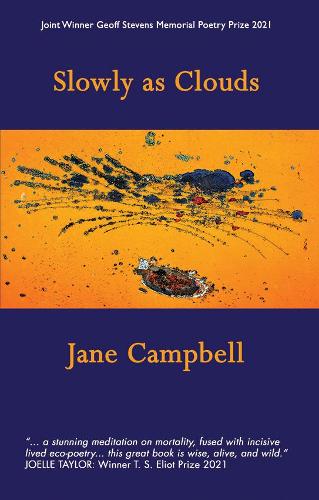
Review by Gary Day of "Slowly as Clouds" by Jane Campbell


Jane Campbell’s poetry has edge: it glints rather than glows. ‘Degrading’ is one such example in this raw, uncompromising but strangely beautiful collection. The poem recounts a group of girls surrounding the young poet demanding she prove the arrival of her first period. The ending brilliantly transforms this humiliation into a triumph: ‘recasting them / in perpetuity / slow for their age.’ 

The theme of change or metamorphoses is present in many of the poems, particularly those to do with parents or lovers. Campbell pays tribute to the political activism of her mother whose frailty in age is a spur not to forget how she impressed her daughter ‘with the importance of rights / that once they had bite were revoked.’ But this tribute has a darker feel in ‘Fairy Tale’ where the speaker apologises for tormenting her parent. 

Campbell’s portrayal of her father follows a similar trajectory. At first he is a monumental figure, ‘an army of hands and feet’ but then we see him shrivelling in a hospital bed, while the poet envisages his evolution into a ‘butterfly, then rabbit, then antelope.’ The ending of this poem, ‘Metamorphosis,’ is not only exquisite but also a demonstration of Campbell’s knack of finding new and unusual rhymes. 

There is sober realism in the poems about love; a celebration of its joys in ‘May moaning from our mouths,’ and an acceptance of its sorrows. There is a particular poignancy in ‘Let Go’ where though desire has run its course that ‘doesn’t mean / I don’t still love us.’

Campbell is highly versatile. She can write a shocking futuristic poem like ‘Always Alice’ and a gentle, almost Hardyesque one like ‘Wishing Well’ which should be included in any future anthology of English poetry. An ever-present consciousness of mortality does not sour her sense of life’s abundance. ‘Compost Loo’ shows that even waste is a form of enrichment. 


About the reviewer
Gary Day is a retired English lecturer. He is the author or editor of a dozen books including a two volume history of modern British poetry. He had a column in the Times Higher for a number of years and has been actively involved in amateur theatre for many years.

Wednesday, 18 May 2022

Review by Beth Gaylard of "A Mile of River" by Judith Allnatt


I just read this in one sitting and really enjoyed it - thanks to Jonathan Taylor for recommending it. It’s a story of farming folk in the 1970s. Although the action takes place over the summer of 1976, when England and Wales were in the grip of a drought from May until September, the catalyst is the mysterious break up of the farmer’s (Henry’s) marriage and the disappearance of his wife Sylvie over a decade before the novel opens. Allnatt is ruthless in describing Henry’s emotional illiteracy but she is also very precise and concise in her language, which makes everything he says and does to his long suffering children feel like a knife stab to the reader. But I didn’t stop reading; I really cared about Jess and Tom (and Tom’s kitten) all the way through. This is one of Allnatt’s first novels, and already, she is skilled in presenting powerful negative emotions and the damage they do. When Henry should reach out to his family, or when he could do, he does the opposite - a mean action, a spiteful put down. It's not clear why, either. It just seems to be behaviour learned from his (annoying) mother.  

The descriptions of the rural farming landscape and how it alters in the 1976 drought are evocative; I was sixteen that year and remember it being very much as shown. Only two thunderstorms in the whole four months, I used to go for midnight walks when it was too hot to sleep. It was my little secret and helped me deal with 0-level nerves (I deserved to be nervous, all my revision was so last minute).

There are positive moments too, including an upbeat ending (no spoilers). I think this novel well deserved its initial success; and since then it has taken its place in the body of fiction about the darker aspects of life in rural England.


About the reviewer
Beth Gaylard is a writer and PhD Creative Writing student at Leicester University. Published works include an SF novel Firebrands and various poems. Her work in progress is a piece of rural dystopia. Her home is in Leicestershire.


Tuesday, 17 May 2022

Review by Beth Gaylard of "Creative Writing Student Showcase" at Literary Leicester Festival, 2022


I attended lots of events that ran as part of the recent Literary Leicester Festival, but one of the most memorable for me was the showcase for Creative Writing students. Usually, as students listening to each others’ work, we are in a forum where commentary and critique are required. It’s quite rare to get a chance to listen and absorb peers’ work, without that requirement. For recently enrolled MA, PhD and BA students, working on our research through the pandemic, there hasn’t been the opportunity for any networking offline for ages, so there was a bit of a ‘school’s out’ atmosphere.

Ten writers, poets, storytellers and novelists chose extracts or short works not necessarily connected with their current projects and read them aloud to an audience of peers and their guests. Some were published, some not. The main objective was to choose something you liked that you’d written yourself, and read it aloud to a roomful of near strangers. While some readers confessed to feeling nervous, the event wasn’t billed as a performance, and most if not all of us read off the page. There was a feeling that it was a positive opportunity. Hopefully the listeners enjoyed it as much as the readers; they seemed to, judging by the applause and the buzz of conversation afterwards.

There is a simple pleasure in sharing work with an attentive, mutually supportive audience, and this is enhanced in the experience of hearing your own words aloud. You get that ‘leap off the page,’ that is so empowering when you’ve spent a lot of working time in a quiet place, on your own, perhaps feeling quite unsure that what you’ve done has any potential, let alone any significance.  

So … Please can we do it again!


About the reviewer
Beth Gaylard is a writer and PhD Creative Writing student at Leicester University. Published works include Firebrands, an SF novel and various poems. Her work in progress is a piece of rural dystopia. Her home is in Leicestershire.


You can read more about the Creative Writing Student Showcase 2022 on Creative Writing at Leicester here. 

Monday, 16 May 2022

Review by Victoria Delderfield of "The Former Boy Wonder" by Robert Graham


Consider the adages: Fifty is the new forty! If you haven’t grown up by the time you’re fifty you don’t need to! Or, my favourite, from David Bowie: “Ageing is the extraordinary process of becoming who you should have been.” Mid-life is the time to regain a positive sense of oneself, explore one’s interests and generally make the most of your remaining innings … But what if mid-life feels more like hitting a dead wall? When the pillars of marriage, children and career begin to crack and possibly crumble. This is the dilemma facing Peter Duffy, protagonist in Robert Graham’s playful and extraordinarily well-observed ‘coming-of-old-age’ novel, The Former Boy Wonder.

Former music journalist, Peter, is confronting humankind’s fundamental question, that of purpose: “If time is now limited, is this how I want to spend it?” Pushing fifty, Pete wonders if his choices so far have been satisfying or sacrificial, courageous or cowardly. If he’d acted differently at key junctures, would he be happier at life’s mid-point? The monsoon of longing that unravels is highly relatable, whatever your age. This is a book with enormous heart, cloaked in wit and wry intertextuality.

For Peter, the re-appearance of his first love, Sanchia Page, triggers a quest – part fairytale, part DC Comics - to re-write his narrative, tear up unworkable plot lines, change the genre of his life from tragedy to romance and start again at the beginning. (Imagine Peter as a middle-aged Billy Fisher, the fantasist who prefers his "imaginary country" in Billy Liar). To do this, Peter first has to remember everything correctly and that, of course, isn’t easy. Memories are slippery and can morph with time. A look, a gesture, a decision can all be remembered wrongly, even misinterpreted. Peter admits, “I may not be capable of summoning up the true past … I’m looking for truth here.” That truth, about himself and his actions – when finally grasped – might just be the making of Peter Duffy, aged forty nine and three quarters.


About the reviewer
Victoria Delderfield is author of The Secret Mother. Her website is here.

You can read more about The Former Boy Wonder by Robert Graham on Creative Writing at Leicester here. 

Monday, 9 May 2022

Review by Robert Richardson of "In Glad or Sorry Hours: A Memoir" by Alastair Niven


I first met Alastair Niven in 1988 when, as Director of Literature at the Arts Council, he provided me with a letter of support for the events I was organising, for the following year, to celebrate the 70th anniversary of the origins of Imagist poetry. This helped open doors to cooperation from The Poetry Society and the literature venue within the Royal Festival Hall. It was also the beginning of a friendship that continues to this day.

With a mere outline of his life—Dulwich College, Cambridge, Director of Literature at the Arts Council and the British Council, Principal of Cumberland Lodge (an institution with Royal patronage at Windsor)—it would be all too easy to dismiss Alastair Niven as a conventional establishment figure. Such sketchiness would be unjust and inaccurate, as his memoir makes clear. He inhabited these roles as an enlightened (small "l") liberal, but for a more complete portrait he was, and remains, a radical internationalist.

The book shows his defining experience to be early on, with the time immediately following his graduation from Cambridge spent teaching at a university in Ghana. This led to a strong interest in African literature, and it was also where he met his future wife, Helen, who provides the foundation of a happy personal life. Though mainly focused on his professional activities, the memoir also skilfully weaves in aspects of his family background.

His commitment to post-colonial literature was deepened through a doctorate from Leeds University and an academic post at Stirling. Subsequently, he left full time academia to direct the Africa Centre in London. Niven had the vision to combine a welcoming environment for African writers, and those creating in all art forms, resident in London, or visiting it, with solid policies and initiatives to promote their work and develop audiences.

Approaching the first twenty-five years of the twenty-first century, with diversity casting becoming standard in theatre, film and television, Niven, in his time as Director of Literature at the Arts Council in the 1980s and 90s, can be seen as a pathfinder for the consciousness necessary for this. He shifted funds to make sure they included black and Asian writers and supported placements that launched the careers of ethnic minority professionals in mainstream publishing. Wasafiri, a journal he initiated during his Africa Centre days, received Arts Council funding, and in 1994 his department helped bring about Out of the Margins at the South Bank Centre, the biggest celebration of black and Asian literature ever to take place in London. There was an "emphasis on the determination of writers from minority communities to be heard at the centre of British culture." These initiatives from the past are now a marker for the present and future, and this book importantly places them on record.

His relatively short time at the British Council was not so happy or productive, its structures limiting the number of positive impacts he could make. He was even cornered into closing libraries, with the poet Christopher Logue once saying to me "Alastair would want to be opening libraries, not closing them."

His final appointment as Principal of Cumberland Lodge became his "dream job." Its founding agenda was as a place for the discussion of ethical issues, primarily by groups from universities, although other groups visited too (one included a third of Britain’s Chief Constables). To these types of programme, he also added more emphasis on the arts.

Niven’s retirement is predictably busy, and he continues to show that an appreciation of a post-colonial world leads to the enjoyment of a better world.


About the reviewer
Robert Richardson is a visual artist and writer. His work appears in Artists’ Postcards: A Compendium (Reaktion Books, London) and Leeds Postcards (Four Corners Books, London), and it is included in collections of the British Museum and the Australian National Gallery. In 2021, he was a Residency Artist of the Digital Art Observatory: Ukrainian and British artists combining for online exhibitions, and in 2022 he was selected to present work at the first European Digital Art Fair. His website is here.

Sunday, 10 April 2022

Review by Cathi Rae of "The Fox’s Wedding," poems by Rebecca Hurst & illustrated by Reena Makwana


As a poet who recently and joyfully placed the word "bosky" into a piece and who has written on The Children of Lir, a collection located in landscape, rurality and the re-imagining of fairy tales is clearly right up my street - or should that be "breaches" (to steal from the poem “Into the Woods” in this collection). If you can imagine Angela Carter, but a reined in, hyper-controlled Carter, where every word is perfect and carries superbly judged weight and musicality – this collection is precisely that.

These are fairy stories that dig back into narratives of blood and skin and teeth, where happy endings are de-railed and deconstructed. The girl raised by wild dogs ("Teeth") returns to the pack and turns her back on “the bones of polite behaviour.” The boy who hides to watch the fox's wedding ("The Animal Bridegroom") is spared his life, but loses language – a word a day until he is “as silent as any beast and lonely.” Even The Frog Prince ( in "The Frog Prince") is "a damp squib of a boy from the wrong side of Tunbridge Wells."

The motif of pins and needles run through many of these poems – the prick of memory in quilt made by a mother – needles to ask needle sharp questions – the path of needles and the path of pins and the task of making impossible fairy tale clothing, "seven nettle shirts seven years dumb in a tree" ("Brothers").

This collection comes from The Emma Press, a Birmingham-based small press, who specialise in producing collections of poetry, short stories, children’s books and art squares where design, layout and illustration are an integral part of the reading pleasure. The illustrations in this collection, by Reena Makwana, are as perfectly executed as the poems themselves.


About the reviewer
Cathi Rae is an award-winning and widely published poet. Her collection Your Cleaner Hates You & Other Poems was published in 2019. She is currently funded by M4C to work on a large scale collection on voicing the marginalised. 

You can read a review of Your Cleaner Hates You & Other Poems on Everybody's Reviewing here. 

Friday, 8 April 2022

A Book That Changed Me, by Philip Tew: “Albert Angelo,” by B.S. Johnson.


A book that certainly changed me was Albert Angelo by B.S. Johnson (1933-1973). This tale centres on the various frustrations of young male graduate, Albert Albert, having become a peripatetic supply teacher in schools near Highbury and the Angel, Islington. In the mid-1970s I holidayed with my girlfriend (later wife) away from our Leicester home in Whitby on the Yorkshire Coast. Early closing day found us dodging showers. We retreated into a bookshop in a narrow side-street, its shelves of paperbacks part of a front for an illicit back-room trade in pornography. There was the Johnson book, a nude on the cover, unpriced. Our determination to buy several novels surprised the proprietor.

Johnson wove into life’s mundanities striking experimental devices (a hole through two pages, double columns of narrative from different simultaneous perspectives), expressing his self-referential need to account for himself. I loved the class tensions, particularly the minor privileges and snobberies of others he detailed. A unique quality permeated Johnson’s quasi-autobiographical peregrinations, his profound and troubling vulnerability. I graduated, married, divorced and retreated to London in 1981 after nine years exile.

In 1983, not quite thirty, I lived at the Angel, Islington beside the Regent’s Canal. As a reluctant supply teacher I cycled daily along the towpath. Near my flat Albert is murdered by a gang of students at the end of Johnson’s book—doors away lies the final bedsit of Joe Orton (1933-1967), evoking my Leicester days. Bored one Easter, I rediscovered Albert’s professional and creative vicissitudes. The similarities to my own life seemed uncanny, including the sexual, romantic betrayals. I was inspired to research a doctorate on Johnson’s fiction (completed in 1997), subsequently becoming an academic for many years. In April 2014 the death of a Leicester friend, Sue Townsend (1946-2014), set me off writing my own fiction, rereading Johnson’s book for inspiration. I completed a second doctorate in Creative Writing. Much revised, Afterlives: A Novel (2019) would be published, featuring Sue as a character. From her I learnt that creatively one ought to persevere since time is finite. Plus, writing is its own reward. From Johnson I gleaned two key lessons: write from direct experience; and the essence of life is to be found amidst the everyday minutiae of our existence. 


About the reviewer
Philip Tew is a novelist and Professor Emeritus in English Literature and Creative Writing at Brunel University London. He spent nine years in Leicester in his late teens and twenties both as a student and school teacher. His forthcoming third novel, Heroes and Villains, will appear later in 2022.

You can read a review of Afterlives on Everybody's Reviewing here. 

Thursday, 7 April 2022

Review by Sue Mackrell of "House Work" by Khadija Rouf


In House Work, Khadija Rouf evokes the seismic shock following the birth of a first child: ‘After the baby everything changed. / My body rebelled against me, / I was no longer myself … Our home felt unchartered then. / Her in my arms, / trying to re-negotiate each room slowly, / realising I knew nothing at all’ ('After'). She captures a familiar moment of overwhelming panic: ‘Among mountains of washing / the only things moving / were my terrified eyes’ ('13 Ways of looking at a washing-machine').

There are so many moments of recognition in these poems; I had my own children in the 1970s and now watch my own daughter navigating the same but different waters. But there is more here than the kitchen sink; Rouf places the minutiae of household routine into its universal context as the 'domestic becomes cosmic' and 'galaxies swirl under beds' ('The formation of dust'). She writes beautifully of erotic tenderness, the loving chaos of family life and the warmth of female friendship. There are seahorses, snail shells, and 'tip-of-the-nose prints / from marvelling at a sunset or a starlit night' ('Window pane'). 

But in 'Femme Maison 1945-47,' Rouf responds viscerally to the anguish expressed in the paintings of Louise Bourgeois: ‘She is me. / What was once a woman / is now naked, torso and bare legged, / conjoined with a house … Will she be herself once more, one day? I need to know.' 

Relationships are redefined: 'A man and a woman are equal / For a time. / Then, a woman and a washing machine are one' ('13 ways of looking at a washing machine'). Life is dominated by the tyranny of sorting bins, cleaning toilets, preparing a meal before work, ‘in time credit for once’ ('Cooking'). 'Hoovering / is an act of violence, Amazonian, full of fury' ('Hoovering'). A 'woman in Derby goes on rampage, / sucking up objects in her path, / …psychologists try to explain the trend, / but have to admit, they just don’t know' ('Hoovering II'). A chasm of misunderstanding opens; there is 'scrapping over the division of / labour.’ Rage over an un ironed skirt explodes, and ‘You stand in wonder … Somewhere the skirt still lurks, creased and ready’ ('Skirt').  

Rouf reserves her astonishment for the women who were ‘…so angry with Selma James / All she said was, imagine if housework were paid? ...  this work done for love / somehow discounted, not seen as toil / [but if] caring would have currency / …We could speak invoices, take time owing’ ('For Selma James'). Perhaps the most powerful poem in this collection is ‘Minding:’ ‘We budget for someone to look after our baby…’ Its repetitions convey the anguish of leaving a child with a stranger, for money, ‘praying to God, / the hand over, praying that she will not hurt my baby, / Transactions of love and care, the split inside, the ache so I can work, the unnamed cost of wanting both.’ 

In ‘Unattainable,’ Rouf writes: 'Serious: the work for which I am paid is cerebral, muscular…Valueless – the work for which I am unpaid / is expected.’ In the 1980s as a divorced single parent and a student, I was told by a male lecturer my place was in the home looking after my children, while women lecturers were introducing me to Betty Friedan, Adrienne Rich, and Selma James. 

Rouf prefaces this collection with one of James’ most famous quotes: ‘By demanding payment for housework we attack what is terrible about caring in our capitalist society.’ She founded the International Wages for Housework campaign in 1972 arguing that women’s unwaged work should be paid for by governments, but it attracted a great deal of hostility from those who feared women would be institutionalised in the home, and other women’s groups focused on fighting for the right to work outside the home and equal pay. Now in her nineties, James is still campaigning and writing; in a recent interview she said, 'I never understood that argument because women were already institutionalised in poverty in the home. Women were dependent on men.' It was a time when I had to get my husband’s signature on a rental agreement and women relied on their husband’s NI contributions to fund their pensions – many women are still suffering the consequences of that.  

In 2020 James wrote: ‘Especially since the Covid19 virus hit, it is undeniable that waged and unwaged carers are front line, and that we rely on them for survival.’ Rouf’s thoughtful and cogent poems contribute to a long and continuing tradition of making the personal political. 


About the reviewer
Sue Mackrell’s poetry has been published in a range of print and online publications including Diversifly (Fairacre Press), Agenda Poetry and Ekphrastic Review. She has an MA in Creative Writing (Loughborough) and taught there for several years. Retirement gives her time to write, indulge grandchildren and enjoy her garden.