Showing posts with label Philip Tew. Show all posts

Wednesday, 22 June 2022

Interview with Philip Tew


Philip Tew is a writer of fiction, a poet and an academic who focuses on the Anglo-American novel from 1920 to the present, especially avant-garde fiction. After a varied career, he became Professor of English at Brunel University London where he completed a second doctorate in Creative writing (Fiction) awarded in 2016. He retired in August 2021 and was made Professor Emeritus at Brunel. He lived in Leicester from 1972 to 1981 and toward the end of that time taught in several local schools, at one of which Jon Wilkins was a colleague.  


Interviewed by Jon Wilkins

JW: Tell us about yourself and your time in Leicester. 

PT: I came to Leicester in 1972 as a student at Leicester University, studying law, but I changed to American Studies after my first year. Also, in that first year I met a local woman from Welford who was a fellow student and a keen Foxes fan. I stayed on after graduation in 1976, getting married during the great heatwave of that summer. I thought about joining the RAF, but I didn’t want my hair cut short, and my wife would not contemplate leaving the area. Instead, I trained for a year at Leicester Polytechnic, at their Scraptoft site, to become a teacher, a PGCE, with my main teaching practice at a middle school in Wigston. I think it’s now South Wigston High School, for 11-16 year-olds, previously 10-14 under the Leicestershire Plan. I was mentored by a great older chap who’d gone into the profession straight out of the army. He wore a suit. I was casual and scruffy. After lots of interviews where my face clearly didn’t fit (or was it my non-posh London accent perhaps?), I found my first job at Lancaster Boys’ School, a secondary modern offering single sex education. That’s where Jon and I first met as colleagues, and became friends. As you know well it was a pretty grim place in which to work back then.  After my separation from my wife I disappeared back down to the smoke, as Sue Townsend used to call it. More of her in my responses to other questions below. 

I had an ambivalent relationship with Leicester, because I missed London and wanted out of teaching, but couldn’t see me doing that in the city as it was then. Looking back I enjoyed the sports, the pubs and the crowd of people I hung around with. I loved my house which we bought for about six grand in South Knighton in maybe late 1977. However, I found everything recurred, the same people at exceedingly similar parties, same crowd in two or three pubs, and same Waitrose every Friday evening. I wanted more from life. We drank in the Cradock, the Clarendon, the Magazine; I went for occasional pints with a character called Chris Challis (again more on him below) in the Rifle Butts. It’s mostly in my novel, Afterlives, apart from the shopping.  

JW: What was the literary scene like in Leicester in late 1970s?

PT: The literary scene locally, for me that was brilliant, with lots of poetry groups, workshops and magazines, writing workshops and a plethora of alternative bookshops. The university and the polytechnic ran events and writers’ groups, so did local people. There was one night class I attended run by Rosalin Brackenbury (née Crabtree), a skilled writer in the Woolfian mould, who now lives in Key West, Florida and appeared to be still active in 2019. 

Overall, it was a very lively scene, very supportive. I saw Ginsberg, Bunting, McGough, Adrian Henri, Graham Greene and many other lesser names. I suppose the local poet, Chris Challis, was a kind of mentor to me, although I didn’t realise it at the time. He was a quirky but very generous guy, a definite long-hair from the 1950s and 1960s. He’s a key character in my first published novel, Afterlives (2019). During my time in Leicester I wrote and published poetry in various magazines, even gave readings on occasions when Challis was the headline act. I remember one at Nene College in Northampton—where he was writer-in-residence—and another in the Vaults, a traditional pub in the market place in Uppingham. Aged twenty-five I spent my second summer holidays while a teacher writing a novel entitled Swallows in the Sky, a crappy, juvenile title adapted from Junket’s ‘Ode to Autumn.’ I tapped away during late July and August at my ancient portable, bottle of Tippex to hand, upstairs in my terraced house in South Knighton. Later, I published several scenes as short stories in the university arts magazine, Luciad. Another guy, an English lecturer at the university, J.C. ‘Ian’ Hilson (1946-1980), encouraged me in this. However, unfortunately just as the eighties began he died on 9th June in an accident when his car was struck by a speeding motorcycle doing about a ton along London Road, going into town I believe. Such a waste, a real tragedy as Ian was only about thirty-four! He’d read my first novel, which he thought showed great promise, but I never did a thing with it in the aftermath of his death, somehow couldn’t bring myself to return to it. 

JW: You started a literary magazine in Leicester, tell us about it.

PT: A group of us got together, not sure how and where, to think about a Leicester-based arts magazine, which we bid for funding. It was a monthly I think, with reviews, an events page and interviews etc., the usual mix. We had local authority and Arts Council funding, and we had to present a business plan for this support. However, the first pair of main editors immediately shifted direction and they spent most of our money on a launch hosted by the theatre in town, the Haymarket, then by the Clock Tower, trying to find long-term, generous advertisers. We had caterers and lots of booze. The returns were negligible. Our title was magazine (lower case, imagining that made some sort of statement). We managed three issues, but the printer held back the third because of our debts. 

I liked Sue Townsend a great deal, met through Challis. She too had been encouraged to write by him. Together we persuaded her to contribute a feature to magazine, which was the diary of a teenager, Nigel Mole. She changed the name later, advised it was too close to the Nigel Molesworth stories by Geoffrey Willans, illustrated by Ronald Searle. I recall laying out the second issue of magazine on a huge pine table in Sue Townsend’s house in Highfields, drinking copious amounts of wine and beer. As we all now know, Sue went on to deserved fame and success, but she remained as grounded and modest as when I first met her in her years of struggle. I remember her well from workshops at the Phoenix Theatre where she’d gained a bursary. This was opposite the Magazine pub, one of my favourite city-centre hostelries. Sue—after whom the arts centre was renamed in 2015—would have been working on Womberang, which was performed at the Soho Poly in London in 1979. Many people have forgotten she was a gifted and funny playwright.  It was the news of her death in April 2014 (on my car radio) that persuaded me to start writing fiction again.

JW: BS Johnson, the subject of your doctoral thesis was a huge influence. Tell us why.

PT: Well, he was a working-class Londoner, working on experimental fiction, a sub-genre I’m drawn too. There’s something brutally honest and puritan about Jonson’s fiction, whose style is very controlled and compelling. There’s not a hint of bourgeois sensibilities. These were all things to which I aspired when younger, but could not achieve. When I decided to undertake a doctorate he was the obvious choice, plus back then he was much neglected, almost forgotten, so limited secondary sources which gave me the space to be original, and not face screeds of reading in my preparation. That would be very different today, as much scholarly work has appeared on this author and still does. For anyone unfamiliar with his work (especially aspirant writers) I’d highly recommend Albert Angelo and Trawl. 

JW: Which Leicester writers influenced you?

PT: At the time that I lived there, Chris Challis, Sue Townsend and Rosalind Brackenbury, plus Malcolm Bradbury, Colin Wilson and Joe Orton. They offered an example of how one might turn the everyday into significant modes of creative expression. I think of all of them Orton intrigued me most. And at that time I hadn’t twigged the slenderest of Leicester connections of Julian Barnes, as first he’d only produced his first novel, Metroland, which was only six months old when leaving, but he is a Foxes fan. 

JW: What informs your writing today?

PT: My past life and the world of the university sector as it evolved institutionally over the past forty or fifty years. I’m often concerned with issues of sexual fidelity, and the degradation of personal relationships after betrayal. I’m also motivated by what I mostly don’t find in British fiction. There are many writers who for me, whatever the merits of their novels, just don’t get how it is to be an ordinary person. I want B. S. Johnson’s stark honesty, the well-observed mundane cynicisms and singular interconnections of an early Muriel Spark, but mostly we get bourgeois niceties, even when and where the world purveyed is bleak. So, what mostly informs my writing is seeking to achieve is to capture the subtleties and nuances of everyday life in a fictional or quasi-fictional format, so very much B.S. Johnson again. Although my style is very different from his, the underlying ambitions are very similar. 

JW: How has your writing developed since you left Leicester?

PT: A huge amount: I think it’s far more fluent, well-edited and thoughtful, and certainly many readers seem to think so. I left Leicester when I was almost twenty-seven, so still a young man, but I was very troubled by the vicissitudes of my personal life, my divorce. And, I knew I was still learning to write. After a break of a year or so, I continued writing and tried to find publication after that for a period of maybe fifteen years, but without much success. So somewhat disillusioned, I abandoned fiction as a creative practitioner. After having completed a doctorate on Johnson, I turned to academic writing after that and produced as author, editor or by various collaborations twenty-seven volumes. A twenty-eighth will appear next year, a final one I think. Now I focus on fiction and occasional poetry, as I have done since 2014.  

JW: How much has Leicester influenced your writing? There are a lot of echoes in your stories.

PT: For me Leicester is all about the ambivalence, of living somewhere that has great merits, but you’d rather be elsewhere, needing a return to your roots. However, as I age, the city also represents a phase of my youth, one full of passions and energy, a phase of my life I enjoy revisiting. Plus, I had so many good friends and met so many interesting writers in an environment you might not anticipate doing so. Echoes is correct: Leicester resonates within me, confuses me, and delights me in equal measure. All of which is fertile ground for a writer of poetry and fiction. 

JW: Tell us about your novels and which one(s) you are happiest with.

PT: Afterlives involves an extended autobiographical reflection of all the creative people I had known, many of whom had died, mostly without much public success. I was not only convinced that they were good writers, but that my interactions with them also offered certain insights into creativity. My fictional alter ego is Jim Dent, the protagonist. However, this is certainly not a memoir, and has lots of fictional elements. You might consider my life as being used like a clothes hanger, in essence a framework upon which I can set out new and different sets of clothes. Hence it provides a chronology, a logic of existence, places and certain people, but they are all adapted to convey the nuances of life I mentioned earlier, with a touch of hubris here, amity there, an element of spirit, nostalgia, feeling, 

Fragmentary Lives is a companion piece, but is fully fictionalized. In it the past is explored in three interconnected novellas. The first novella, ‘Another Long Weekend,’ incorporates my time as a play-leader for the Greater London Council (GLC) and explores the tensions and loyalties of male friendship when facing a mutual object of desire. The second, ‘Swimming the Goldfish Bowl,’ features Luke Windsor, a young doctoral student drawn into the machinations of an attractive, but hard-faced blonde who moves into lodgings in the house in Tufnell Park he shares. The third, ‘After the Revolution (Failed to Materialize),’ explores retrospectively the presumptive political idealism of the hard left during the seventies and eighties. 

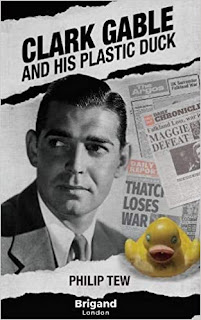
My second novel, Clark Gable and his Plastic Duck, is set in 1991 and centres on Bill Pugh, another play-leader working for the GLC. In this alternate reality Thatcher has lost the Falklands War and after a failed premiership of Michael Foot, followed by a misguided one led by Michael Heseltine, Alan Clark has become Prime Minister. He initiates a right-wing government, an effective coup. Protests and a bombing campaign follow. Pugh is more concerned with his failed romance and the arrival of an attractive female co-worker. A privatized new security apparatus (modelled in part on the wartime SOE) hires thugs to enforce a new orthodoxy and Pugh comes to their attention after the surprise visit of a school-friend, Connie Chidley. This prompts a host of memories, some highly uncomfortable. Their lives are once again intertwined, with notable consequences for both. 

JW: What are you working on now?

PT: I’m finishing off what I consider to be my best novel to date, Heroes and Villains. My son agrees, and he’s an excellent judge of these things. This narrative has various experimental elements, and it has three narrative perspectives set out in three different sections, following a different account of the tribulations of Luke Windsor. Overall, his struggle animates the narrative. If I said any more all suspense would be lost.  

JW: Having read the earlier drafts of Heroes and Villains I can attest to the fact that it will be well worth a read when published. I will be writing a review on Everybody’s Reviewing when it comes out. Phil returned to London after various adventures at home and abroad and now works out of his garden shed in Enfield. I love the nods to Leicester in his writing, evidence of the positive influence our fair city has had upon Phil.


About the interviewer
Jon Wilkins is 66. He is married to the gorgeous Annie with two wonderful sons. He was a teacher for twenty years, a Waterstones’ bookseller and coached women’s basketball for over thirty years before taking up writing seriously. Nowadays he takes notes for students with Special Needs at Leicester University. He has had a work commissioned by the UK Arts Council and several pieces published traditionally as well as on-line. He has had poems in magazines and anthologies, art galleries, studios, museums and at Huddersfield Railway Station. He loves writing poetry. For his MA, he wrote a crime novel, Utrecht Snow. He followed it up with Utrecht Rain, and is now writing a third part. He is currently writing a crime series, Poppy Knows Best, set at the end of the Great War and into the early 1920s.

You can read Jon Wilkins's review of Clark Gable and His Plastic Duck by Philip Tew on Everybody's Reviewing here. 


Friday, 8 April 2022

A Book That Changed Me, by Philip Tew: “Albert Angelo,” by B.S. Johnson.


A book that certainly changed me was Albert Angelo by B.S. Johnson (1933-1973). This tale centres on the various frustrations of young male graduate, Albert Albert, having become a peripatetic supply teacher in schools near Highbury and the Angel, Islington. In the mid-1970s I holidayed with my girlfriend (later wife) away from our Leicester home in Whitby on the Yorkshire Coast. Early closing day found us dodging showers. We retreated into a bookshop in a narrow side-street, its shelves of paperbacks part of a front for an illicit back-room trade in pornography. There was the Johnson book, a nude on the cover, unpriced. Our determination to buy several novels surprised the proprietor.

Johnson wove into life’s mundanities striking experimental devices (a hole through two pages, double columns of narrative from different simultaneous perspectives), expressing his self-referential need to account for himself. I loved the class tensions, particularly the minor privileges and snobberies of others he detailed. A unique quality permeated Johnson’s quasi-autobiographical peregrinations, his profound and troubling vulnerability. I graduated, married, divorced and retreated to London in 1981 after nine years exile.

In 1983, not quite thirty, I lived at the Angel, Islington beside the Regent’s Canal. As a reluctant supply teacher I cycled daily along the towpath. Near my flat Albert is murdered by a gang of students at the end of Johnson’s book—doors away lies the final bedsit of Joe Orton (1933-1967), evoking my Leicester days. Bored one Easter, I rediscovered Albert’s professional and creative vicissitudes. The similarities to my own life seemed uncanny, including the sexual, romantic betrayals. I was inspired to research a doctorate on Johnson’s fiction (completed in 1997), subsequently becoming an academic for many years. In April 2014 the death of a Leicester friend, Sue Townsend (1946-2014), set me off writing my own fiction, rereading Johnson’s book for inspiration. I completed a second doctorate in Creative Writing. Much revised, Afterlives: A Novel (2019) would be published, featuring Sue as a character. From her I learnt that creatively one ought to persevere since time is finite. Plus, writing is its own reward. From Johnson I gleaned two key lessons: write from direct experience; and the essence of life is to be found amidst the everyday minutiae of our existence. 


About the reviewer
Philip Tew is a novelist and Professor Emeritus in English Literature and Creative Writing at Brunel University London. He spent nine years in Leicester in his late teens and twenties both as a student and school teacher. His forthcoming third novel, Heroes and Villains, will appear later in 2022.

You can read a review of Afterlives on Everybody's Reviewing here. 

Wednesday, 16 March 2022

Review by Jon Wilkins of "Clark Gable and His Plastic Duck" by Philip Tew


It’s what we all need to know, Clark Gable. Plastic duck. What on earth? So in the true story-telling tradition of show not tell, I will show. Clark Gable. Plastic Duck.

It is your task to discover their relevance. Task? That makes it sound an onerous assignment. Reading this novel is far from that. It is an undiluted pleasure. It is one of those rare reads, one that you can honestly not put down. The end of each chapter tempts you into reading the next and so on until you have forgotten what day it is and where you are.

I get added pleasure from Philip Tew's books as we taught together in Leicester, way back in 1979. I hadn’t seen him since, until we met at an Everybody’s Reading event in 2018, at De Montfort University. Pre-Covid. Weren’t they the times!

Tew writes of a time I can remember, and so many of his allusions ring true to me, as I am sure they will ring true to any Leicester resident from those Thatcherite days of the 1970s through to the 1990s.

His novel takes us into an alternate world where Thatcher lost the Falklands and Alan Clark became Prime Minister. For those who remember his philandering ways, is that a stretch too far or a parallel to a shaggy-haired oaf that we all currently endure? Thatcher is rehabilitated as Secretary of State for Northern Ireland and the greatest irony is when the pariah Enoch Powell becomes Home Secretary.

Where would we be today if things had turned out like that? Is that what we deserve? Considering what we have now, would it be such a bad thing? You decide as Britain descends into a world of darkness, further hypocrisy, and our hero Bill Pugh doesn’t know who to trust and who to turn to. His world as broken as the society he finds himself in.

As Phil Tew writes: “Rebellion follows. And a new privatized security service full of thugs and villains. For me, Clark’s political broadcast ties my narrative together. Suddenly, the rebellion and riots all make full sense, especially after the Falklands (Malvinas) defeat. The narrative started to reflect very different priorities.”

This novel shows without telling. Readers will not need to be told; they will see the nuances of the narrative as a challenge and an invitation into Tew’s dark world. Fantasy or Dystopia? Alternate reality or too close to truth? Who is the hero: Clark Gable or the Duck or is it Bill Pugh?

You will decide because I won’t be telling you.


About the reviewer
Jonathan Wilkins is a Creative Writing PhD Student at Aberystwyth University, Wales, reading mostly Golden Age Crime fiction. His website is here. 

Friday, 3 July 2020

Review by Philip Tew of "Poppy Flowers at the Front" by Jon Wilkins


Last year, this website managed to reunite me with Jon Wilkins, a colleague of mine in the late 1970s, teachers together at a boys’ secondary modern school in Leicester, an awful place to work, but we survived. We were united by our aspirations to write and while teaching there, I completed a draft first novel with which I did nothing, exhausted by the writing process. Youth is wasted on the young!

However, eventually in 2019 I published my first novel, Afterlives, and Jon was in touch again, after a generous review. I am about to reciprocate, but certainly not out of loyalty, but merit. Jon’s novel, Poppy Flowers at the Front, has been published, a charming and skilful narrative of two young female ambulance drivers surviving the horrors and discomforts of the Western Front toward the end of the First World War. Blending diary entries, letters and a confessional and impressionistic first person account, Poppy and her feisty French friend, Élodie leap off the page, dynamic, contested and intriguing. A life amid mud, death and struggle is evoked wonderfully, with our emotion engaged, but the narrative never descends to any sentimentality. The love affair between the two young women ties together the various complex strands. I will not reveal the plot, which is teasingly seductive and exciting, and must be fresh and unexpected in the readers’ minds.

For an older male writer to capture the lives of these two young and rebellious women full of such life and hopes and dreams is literally a tour de force. Poppy Flowers at the Front unfortunately came out as the Covid lock-down started, but now we are emerging from that peculiar social nightmare, you should read this book and thrill in its twists and turns, and the emotional subtlety that is displayed in the various encounters. It is an adventure, a reflection, a social narrative, and a fine piece of writing. I rate this novel. Brigand Press, a new micro-press, have opted for another fine story, wonderfully narrated and they should be supported in their efforts. Find their website, and buy it!  You’ll want to read to the end.


About the reviewer
A graduate of both Leicester and De Montfort universities, Philip Tew is an academic and novelist. Since 2001 he has edited, written and co-written twenty-five scholarly books on various topics, including many on post-war and contemporary British fiction. He published his first novel, Afterlives, in 2019 and a second book of fiction, Fragmentary Lives: Three Novellas, in 2020. A second novel, Clark Gable and His Plastic Duck, is about to be published by Brigand Press in August 2020. He is currently preparing a further book of fiction, consisting of two novellas, a volume tentatively entitled Heroes and Villains.


You can read another review of Poppy Flowers at the Front by Jon Wilkins on Everybody's Reviewing here. 

Friday, 1 May 2020

Review by Jon Wilkins of "Fragmentary Lives: Three Novellas" by Philip Tew


It is a truism that all children should be grateful to their parents; it is not often we hear the reverse of that. Philip Tew should be pleased that his son advised him to refresh his manuscripts and add a third short story to the collection that has been published as Fragmentary Lives.

Here are three novellas, three very different aspects of a life, three versions of how life can twist and turn, bring us down or build us up. These are three stories well worth reading in isolation or more importantly together.

For me the middle story, “Swimming the Goldfish Bowl” is the stand out. It is a visceral description of a man's downfall. Luke has no idea that he is the victim in a tale of sex, abuse and kidnapping. He has no reason to conclude he is being used by a woman with her own agenda, no idea that his world can be so easily be brought crashing down. This seems to me to be the ideal building block of a full length crime or mystery thriller - a start to what could be an outstanding plot with so many outcomes possible. The denouement is both shocking and questioning, surely the perfect short story that has the reader pleading to know more.

The final novella "After the Revolution (Failed to Materialize)" is a visceral tale of a life lived, mistakes made and wrong turns taken. It is a withering account of the years of Thatcher and how the Hard Left failed in its attempt to gain power. Disillusionment is rife in this piece as we see how relationships can break down so easily despite the well-meaning of the participants. It is all so real, the accounts of partnerships foundering for so many reasons and of mistakes made in choices taken. This is a real-life account of how things don’t always work our for the best, yet an account that gives us a little hope as the writer comes full circle in his search for contentment. The beauty of “After the Revolution” is that we can meet protagonist Jim Dent again in Tew’s outstanding first novel Afterlives (reviewed here).

The first novella “Another Long Weekend” skirts around romance and infatuation as we see how relationships grow and fail. Friendship is at the centre of the story and how the writer takes advantages of friendships at all levels whilst being taken advantage of himself. It is the story of a life that we can all recognise and want to know more about. 

Life is fragmentary and these pieces can join together or be shaken apart. The novellas throw all the pieces up into the air and we wait as we turn each page to find where they have landed and what effect they will have on the protagonists. This is the final conceit of the three novellas. We are left engaged and don’t want the stories to end. We are being invited into Tew’s world and we want more as a result of this invitation.


About the reviewer
Jon Wilkins is sixty-three. He has a gorgeous wife Annie and two beautiful sons, and loves to write. He is a retired teacher, lapsed Waterstones’ bookseller and former Basketball Coach. He taught PE and English for twenty years and coached women’s basketball for over thirty years.  He has always loved books and reading.

Monday, 3 June 2019

Review by Jon Wilkins of "Afterlives" by Philip Tew


Isn’t literature a wonderful thing?

In April this year, I saw a post on the University of Leicester Creative Writing Facebook page from former student Phil Tew advertising the fact that he had just published a novel.

Phil Tew. Was that the Phil Tew I taught with in 1978 in our first teaching jobs? I messaged him, it was, friendship renewed.

When teaching, Phil always spoke about writing his novel and it was always clear he had the talent to do so. Afterlives is the proof of this: a novel about writing a novel.

That's what it is on the surface, but it is so much more. Part memoir, part road trip, part fiction, it tells of how Jim Dent plans to write about his dead friends and highlights his friendships with well-known Leicester authors, Sue Townsend, Graham Joyce and Chris Challis. We read of the collapse of a marriage, the fears for a life in academia and the pressures that brings, so relevant today in the factionalised market economy of UK Higher Education. We see the effects of Margaret Thatcher on society and how we are now tragically picking up the pieces of those days and their effects on the vulnerable.

There are nods to Ginsberg, Basil Bunting and Steve Knapper as Tew writes about who he knew and what he experienced. The mix of fact and fiction is mesmerising as Tew writes in a flow of consciousness, all against a searing backcloth of the world as it was and the world as it is now. I loved this as it is of my time and I recognised so much of Leicester in those halcyon days of student life and first jobs.

Afterlives is a poignant description of a life passed. Was it a life wasted or is there more to come? We have to make our own judgement on that score. But this is a relevant, evocative portrait of a Leicester past and a London present.


About the reviewer
Jon Wilkins is sixty-three. He has a gorgeous wife Annie and two beautiful sons, and loves to write. He is a retired teacher, lapsed Waterstones’ bookseller and former Basketball Coach. He taught PE and English for twenty years and coached women’s basketball for over thirty years.  He has always loved books and reading.