Showing posts with label Kathy Hoyle. Show all posts

Tuesday, 28 July 2026

Review by Sally Shaw of "Perfect Circle," ed. Rob Redman, illustrated by Lucy Scott


Perfect Circle, an illustrated anthology, is volume two in the Uncertain Stories series. The stories tell how life, happenings, folklore, beliefs and society move in cycles that may or may not form complete circles.

"Swineside" by David Frankel opens with "I have two mementos of my visit to Swineside: a photograph and a tape recording." Immediately I want to know what or who was in the photograph and on the recording. The photograph shows Mathew, Anne and Clara at Swineside. The protagonist is looking back on a significant time in his life. Frankel enabled me to visualise and feel the bleakness of Swineside. Mathew is wrestling with his younger-self: was he right to question the mental stability of his girlfriend Anne, due to the circumstances of her grandmother’s death? Should he have believed what was recorded on the tape or accepted what Clara said she heard? This is a story of the power of hindsight and maturity although it may not always have the answers.

"Triptych" by Eva Carson tells the story of an artist whose life’s work depicts the mountainous landscape of Scotland so much so it appears that she is possessed as her paintings always follow the same format, as if she’s trapped in a reoccurring nightmare. There’s a darkness to the paintings: something is lurking within the crevices of the rocks, "I will say that viewers almost always have the same reaction: fear, even a kind of disgust." Following the death of her mother, her daughter visits her mother’s biographer, Robert. When Robert dies six weeks later his documentation of interviews with her mother describe the place where she first encountered the mountainous landscape and a mysterious event from which she never truly escaped. Carson writes in a way that enables the reader to experience the chill of the uncanny happenings, and provides unexpected outcomes and twists. The closing line is fabulous. 

"Dead Man’s Hollow" by Kathy Hoyle is the longest of the stories and its placing within the book is perfect. "They built a skate park over Dead Man’s Hollow. We were dead chuffed. Nobody needed a reminder of the past, the councilmen said, not in this day and age." Whatever happened must have been long ago if adults were talking about it; it was as though by putting a skate park on top of the hollow it would keep the children safe. I sensed the threat of history repeating itself, and as the story is told the tension builds in this ordinary working-class community with an unspoken knowing. Hoyle has three main voices, The Boy, The Witch and The Worm. I like the way Hoyle titled each, they formed vignettes which provide clarity and heightened my anxiety with each ending, like scenes from a play. Hoyle’s microstructure provides a rhythmic flow, and at the climax I felt the panic of The Boy’s parents and aunt running towards him, while being chased. The terror was palpable. What I thought was going to happen didn’t, and an unexpected hero is burdened with a gift. I appreciated the use of local dialect, its authenticity and how it amplified the voice of The Worm. 

"The Watchkeeper" by Lauren O’Donoghue I read twice. Writing from the protagonist's viewpoint, O’Donoghue causes the reader to believe all is normal, at first glance, and then the reader sees the reality of what's happened. 

The narrator of "Date Night" by Lynsey May is a woman who opposes the eternal generational cycle of society’s opinion of what’s right for a woman. The woman is complex, her thoughts and actions projecting a feeling of the supernatural and danger. 

The book ends with "Perfect Circle" by Jo Gatford. I absolutely loved this story of knowing deep down the fragility of life and the cruelty of that one in a million chance. This is a wonderful and atmospheric human story. 

Perfect Circle was a joy to read, bringing to my mind that maybe sometimes acceptance of uncertainty will bring a sense of peace.


About the reviewer
Sally has an MA Creative Writing from the University of Leicester. She gains inspiration from old photographs, history, childhood memories, and is inspired by writers Sandra Cisneros, Deborah Morgan, Liz Berry and Emily Dickinson. She has short stories and poetry published in various online publications including the Ink Pantry, AnotherNorth, Roi Faineant PressSally lives in the countryside. 

Wednesday, 25 June 2025

Review by Kathy Hoyle of "Cuddy" by Benjamin Myers


Cuddy by Benjamin Myers is a deeply moving, highly original novel. Part historical fiction, part poetic ballad, this novel is dappled with dreamlike prose that takes us on a journey across the stunning North-East landscape as we follow the pilgrims of St Cuthbert from Anglo- Saxon times through to present day. 

This is a work of historical fiction. This is a work of contemporary fiction. It is a poetic ballad, a script, literary prose, a whimsical puzzle, a themed collection. In short, it’s a genre-defying, fragmented-yet-fully-formed hybrid novel … and like nothing I have ever read before. 

During the 7th Century Viking invasions, the body of St Cuthbert is resurrected. An unofficial saint, Cuthbert - renowned for his gentle manner and affinity to animals - is protected by his devoted servants who carry his body around the North-East until his final resting place is found – a hill upon which the mighty Durham Cathedral is eventually built. Cuddy rests, yet his connection to the people of the North-East continues, bringing great strength and comfort, not only to those who seek him out, but also those who unexpectedly find themselves drawn to him. 

Myers is a master storyteller and the collection of ‘voices’ we hear throughout the novel are utterly engaging. Much like a traditional short story cycle, each story has its own narrative arc and can be read in and of itself, yet after reading the whole novel, the themes and connections between the characters all fall into place. With Cuddy as the central focal point, and the beautiful coastal landscape and Durham Cathedral as backdrop settings, Myers exquisitely portrays North-East life. Yet this book is not a short story cycle. Nor is it a novel. It is something wonderfully experimental and undefinable. 

Myers gives a voice to the common folk, those most often eradicated from history – the women, the children, the ones who live on the margins, the ones who need the most comfort from their beloved Cuddy. Myers cleverly focuses on spiritual redemption for his characters rather than overtly religious themes, allowing readers to find emotional resonance with the stories, no matter what their own religious beliefs might be.  

At times, the storylines are brutal and harsh, often tense and strange with moments of great sadness. I had instances, when reading, where I had to pause for several minutes, simply to compose my thoughts and overwhelming feelings, so profound was the effect. 

Imaginative, original, and deeply moving, I adored this ‘novel’ and would urge everyone to read it.


About the Reviewer
Kathy Hoyle is a working-class writer form the North-East. Her work has appeared in literary magazines such as The Forge, Fictive Dream, New Flash Fiction Review and the South Florida Poetry Journal. She holds a BA (hons) and an MA in Creative Writing and is currently studying for a PhD at the University of Leicester.


Monday, 2 December 2024

Interview with Louise Powell


Dr Louise Powell is an award-winning working-class writer from Middlesbrough. She is the winner of the Sid Chaplin Northern Writer’s Award 2023 for her novel-in-progress and was jointly awarded the Peter Lathan Prize for New Playwriting 2022 for a one-act play. Louise is the author of the Coal Face collections of verbatim poetry, published by Redhills in 2023 and 2024. Her scripts have been broadcast on BBC Radio 4 Extra and performed at nine theatres, including Live Theatre, The Customs House and The Tristan Bates Theatre. She has written short films and podcasts and her memoir essay was published in Kit De Waal’s acclaimed Common People anthology. Louise has a PhD in English from Sheffield Hallam University, and her research is widely published in journals and educational magazines. She also holds a Professional Greyhound Trainers Licence from the Greyhound Board of Great Britain.

Louise’s latest podcast project can be found hereAnd you can find out more about Louise and her forthcoming projects by visiting her website here


Interviewed by Kathy Hoyle

KH: Hi Louise. It’s a real pleasure to speak with you today. You describe yourself as a working-class writer. Although I also describe myself as such, I often find it quite a tricky thing to define. What does the term ‘working-class writing’ mean to you? 

LP: It’s a real pleasure to speak to you too, Kathy; thank you for having me! 

That’s such an interesting opening question. When I was on the Common People Professional Development Programme, Kit de Waal gave a talk about her writing and class identity. She said, ‘I’m working class, I feel it in my bones’ – and for me, the same sentiment applies to working-class writing. It’s writing which speaks to my life, whether through the characters, the turns of phrase or the setting. It’s writing with a truth to it; writing which doesn’t exoticise or denigrate the subjects. Writing which could be about characters who are in work or out of it; picking up a wage or receiving long-term benefits due to ill health.

I know that some writers, who grew up as I did in a family in receipt of benefits, like to use the term ‘benefits class.’ While I understand and respect that decision, I don’t use that term about myself because I strongly believe that class identity is about more than work. It’s also about values, communities; solidarity in the funniest and the grimmest of times. 

It’s about that feeling in the bones.

KH: Your work is fascinating, and it spans almost every genre, poetry, fiction, playwriting, podcasting and filmmaking. Do you have a preference for a particular creative outlet?

LP: I think it’s not so much a question of which form I prefer, but rather which form best fits the story to be told. If I’m working with a community, then I’ll think about forms such as verbatim poetry or audio, which foreground their voices and render me much less visible. If it’s a story which needs to be encountered in real time, I’ll think about theatre. More complex stories lend themselves to prose, while strongly visual stories need to be filmed. 

There’s so much to learn from working across different forms in terms of craft and audience. I like to have multiple projects in different forms on the go at any given time. I enjoy the variety and find that if one project gets stuck, immersing myself in a different projects in a different form really helps me to find the solution to it.

KH: My own research delves into oral history and regional dialect. I use oral histories to ‘capture’ authentic dialogue and use it in my work. You’ve also been involved in several oral history projects. Tell us about those. 

LP: I’ve recently worked on two substantial Arts Council-funded oral history projects: Dogpeople and Coal Face. Dogpeople uses oral histories to build a social history of flapping (greyhound racing at independent tracks) in County Durham. I grew up racing dogs at those tracks with my family, and the world has inspired a lot of creative work, including a novel which I’ll discuss later. Yet I wanted to carry out a project which allowed other people from within the community to tell their stories about the tracks. I worked the raw oral histories into an 8 x 20” podcast series. I also developed a Project Blog with Guest Writers, held a Community Exhibition at Wheatley Hill Heritage Centre and hosted Listening Parties, where participants could come together and listen to the podcasts.

Coal Face, meanwhile, uses oral histories to preserve the stories of coalfield communities in the words of the people are part of them. I take the raw interviews and weave them into a series of verbatim poems. Some of the poems tell an individual’s story, while others bring together all of the interviewees in order to present a wider narrative about such themes as the development of Washington New Town, the 84-85 Miners’ Strike, or what it felt like to work down the pit. These pieces have then been published by Redhills CIO in two books, in which my poetry sits alongside Sunderland photographer Andy Martin’s stunning portraiture. The writing and images have also been exhibited at Washington F-Pit Museum, and we’re due to exhibit new work at Sunderland Museum and Winter Gardens from 1 February – 15 March. Redhills will also publish a third book of writing and photography in time for the exhibition, and there will be a 6 x 20” series of podcasts featuring some of the oral histories, as well as a programme of community events.

One of the loveliest things about working with oral histories is getting to speak to such a wide variety of people. Each participant has a different – but equally fascinating – story to tell, and it’s a privilege to give them the space and the time to tell it. It’s also incredibly rewarding to see their enthusiasm for the finished outcome, be that a podcast, event or poem. There’s a great deal of trust involved in working with oral histories, and that’s something I’m always conscious of honouring when writing with them. 

KH: How important is a regional ‘voice’ to you and do you think publishers / theatre practitioners are becoming more open to dialect and regional narrative voices in stories?

LP: I’m certain that if I’d had access to regional voices growing up, I’d have found a much more direct path to being a writer myself. Pretty much everything I encountered was Standard English and middle-class, which meant that I didn’t know that someone from my background could be a writer until I was in my very late 20s. Even though I now work as a professional writer, I still struggle hugely with believing that I deserve to be in this space. So much of my energy has to go into battling anxieties about not belonging and not being good enough, and that’s energy that would be much better spent on creativity. I share this because lack of regional voices has a deep and long-lasting impact, especially when it intersects with other forms of under-represented identities.

My 70,000+ word dialect novel has only been out on sub to editors for a week, so it’s too early for me to comment on publishing. In terms of theatre, I think that practitioners are becoming more open to telling stories in the voices or dialects of communities, especially in co-created work. I do still see an imbalance of representation within my home region of the North East, though. There’s definitely a preference for Newcastle-based stories, with much less interest in plays from places like the Tees Valley. Part of this is down to the fact that there are no Tees Valley producing theatres (theatres which can fund and commission new writing) for adult work, but it’s also down to a perception that Tees Valley stories are somehow of lesser value. 

t's a point which was being made to me again and again while I carried out my research for a project called ‘First Stage.’ I spoke to writers, theatremakers and other cultural professionals in order to explore the consequences of a lack of new writing and talent development in the Tees Valley. Going back to my earlier point about the deep impact of a lack of regional voices, my research found that Tees Valley creatives took longer to find out that they could have creative careers, and experienced significant geographic barriers as they tried to build those careers. I put forward a series of recommendations to address the issues and am hopeful that at least some of them will be implemented. 

KH: You hold a Professional Greyhound Trainer’s Licence and Greyhound Racing is the theme of your novel-in-progress. Tell us a little about the novel and why it’s so important to you to tell this story.  

LP: My novel is a work of literary fiction which tells the folk legend of a former miner who’s a big name at the ‘flapping’ or independent greyhound racing track of Easington. It’s set in the late 90s and written totally in the East Durham dialect. The opening 6,000 words won the Sid Chaplin Northern Writers’ Award 2023, which led to representation by my lovely agent Elise Middleton at YMU Literary, and on 13th November 2024 we sent it out on submission to editors. I can’t go into too much detail about the content at the moment, but it’s a celebration of community and family, as well as an exploration of post-industrial masculinity.

I’m incredibly nervous about the book going on submission because I’ve worked on it for almost six years, constantly experimenting, drafting and redrafting in an attempt to improve my craft. This novel also means a lot to me because I was born into the flapping community, but there’s only one track left in all of the UK now – Thornton in Scotland. The loss of our independent tracks has been devastating for our community, and I wanted to write a book which is worthy of the brilliant people who were part of it. I’ve had so much encouragement from people within my community, as well as my immediate family and organisations like New Writing North, and I really, really hope I can repay that by getting the book published.    

KH: You work closely with a variety of both regional and national groups to support emerging working-class writers and have been incredibly successful yourself to have received funding and support for several of your projects. What advice can you give to emerging writers about where to find support, both financially and creatively?

LP: That’s an incredibly kind thing to say; thank you. In terms of financial support, I’d advise emerging writers to keep an eye out for small pots of funding, often known as ‘seed commissions,’ which can give you the opportunity to try out an idea. If you get the funding and find that the idea doesn’t have legs, that’s absolutely fine, but you may find that the seed commission can be expanded into a bigger project, which may be eligible for a larger funding pot. A seed commission can also be a good opportunity for you to try out working in a new form (e.g. audio rather than flash fiction), or to test a collaboration with another writer or creative which may then bear fruit in a longer-form project. 

In terms of creative support, I’ve found X (which is still ‘Twitter’ in my mind) to be a really useful platform to connect with other writers. Networks formed through professional development opportunities or creative writing groups can also be incredibly helpful, as you’ll often find writers at a similar career stage to you. Emerging writers should also look towards their regional literature development agency as a means through which to find support, whether that’s through career advice, workshops or opportunities to meet other writers. I feel very, very lucky to live within the area which New Writing North covers, as I wouldn’t have a creative career without the brilliant team there. That said, all of the literature development agencies are doing brilliant work to support writers in a difficult climate. 

I also think it’s really important for emerging writers to know that there’s a huge disparity between the ways that organisations and institutions behave towards you when you’re commissioned or funded. Some organisations are absolutely brilliant, paying you on time and treating you like the professional that you are, while others pay you late and make you feel much less valued. I don’t say this to be negative, but because when I was starting out, I didn’t know about this disparity – so when I was treated unprofessionally, I thought it was ‘just me.’ It wasn’t until I spoke to other emerging creatives that I realised it’s sadly all too common to be undervalued and to go unpaid. 

It's a horrible situation for any writer, but particularly for one who is part of an underrepresented group. We struggle to feel like we belong to the creative industries at the best of times, and when our time and roles are undermined, it magnifies those feelings of impostor syndrome and low self-esteem which so many of us struggle with. It also puts working-class writers, many of whom are already in precarious financial positions, into real jeopardy with regards to paying the bills or covering living expenses. All of this has a knock-on effect on our mental health, our ability to create our best work and advance our careers – but often, we’re so grateful to be given any opportunity in a competitive industry that we don’t dare to say anything. I know I didn’t, for a long time.

Until I realised that by speaking up against unprofessional practices, I wasn’t just advocating for myself, but for other writers from under-represented backgrounds. If I’m unhappy with the way that I’m being treated while working under commission or receiving funding, I’ll now explain why, and work with the organisation not just to resolve the issue, but to ensure it doesn’t happen again. So my best advice for emerging writers who find themselves funded or commissioned is not to be so grateful for the work that you’ll put up with being treated badly. You – and your craft - are worth so, so much more than that.

KH: Finally, could you tell us about some of the regional writers who inspire you.

When I was sixteen, I read D. H. Lawrence’s Sons and Lovers, and it was like a match had been struck to light a fire inside of me that I didn’t know was ready to burn. It was the first time that I’d ever read a book which chronicled that fierce familial love which has underpinned my experience of working-class life, and did it in a way which was both poetic and prosaic. 

I saw something of my soul and my vocation in the first half of that novel, but I never caught another glimpse of it through A-Levels or all my seven years of University. While I studied modules on literature from the Renaissance until the present day, I was never set a text which showed the realities of working-class life that I could recognise. I’m absolutely certain that if I’d had a module which looked specifically at class, or even been made aware that such books existed, I would have found that spark before last year.

That fire was relit when I started reading the novels of Sid Chaplin. There’s such a mixture of strength and delicacy, of warmth and horror, in Chaplin’s writing, and his sense of voice is utterly remarkable. There’s a swagger and directness to the narration of The Day of the Sardine, and yet there’s a passage towards the end which is so raw and affecting that it gave me chills. I love how The Watchers and the Watched plays with the reader’s expectations of where the story will go, and I also love Chaplin’s short stories. They’re like sitting at the kitchen table, listening to an old friend tell a tale – and with oral storytelling being such an important part of my life and craft, that’s one of the highest compliments I could pay a writer.

Some of my other favourite regional books include Walter Greenwood’s Love on the Dole, as it’s one of the very few books that emotionally nails what it means to live below the poverty line, and you can tell that Greenwood was writing for his life. I’ve also enjoyed Jack Common’s Kiddar’s Luck and Thomas Callaghan’s A Lang Way to the Pawnshop, which remind me of stories I’ve heard growing up. I really admire Catherine Cookson’s The Gambling Man for how it plays with expectations of class and gender, and deeply appreciate how the dialect infuses TV adaptations of Cookson’s works. 

In terms of contemporary regional writers, I admire Benjamin Myers, whose novel Pig Iron made me realise that it was possible to tell stories in County Durham dialect. I also loved his book Cuddy not only for its stylistic ambition, but for the warmth and love which underpinned the whole work. I also love Kit de Waal’s beautiful, lucid, pinpoint-accurate prose, and deeply admire her for everything that she has done to help me and other working-class writers to develop. When Kit selected my memoir essay for publication in Common People, she set in motion a chain of events which has led to the development of my creative career, and I’d love to be able to one day pay that forward for other working-class writers.


About the interviewer
Kathy Hoyle’s work is published in literary magazines such as Northern Gravy, The Forge, Lunate, Emerge Literary Journal, New Flash Fiction Review, South Florida Poetry Journal and Fictive Dream. She has won a variety of competitions including The Bath Flash Fiction Award, The Hammond House Origins Competition and The Retreat West Flash Fiction Competition. She was recently longlisted for The Wigleaf Top 50 and her work has been nominated for Best Small Fictions, Best Microfictions and The Pushcart Prize. She is currently studying for a PhD in Creative Writing at the University of Leicester.


Sunday, 21 January 2024

Review by Laura Besley of "Chasing the Dragon" by Kathy Hoyle


Kathy Hoyle’s debut novella-in-flash, Chasing the Dragon, is an ambitious and compelling example of the form. The novella-in-flash is an emergent new genre operating largely outside mainstream publishing. It combines the concision of flash fiction standalone stories with the space in which to develop a novella-length narrative. In order to make the stories self-contained and unique, Hoyle has made good use of flash fiction techniques, such as stories written in the form of lists, letters and reports. This creates the variety and change of pace for the reader often found in novellas-in-flash while simultaneously ensuring each story adds to the overall arc.    

Despite its brevity – Hoyle’s novella-in-flash is sixty-five pages in total – Chasing the Dragon spans across generations, continents and cultures. It is told through multiple points of view and the main thread of the story is of Americans in wartime Vietnam, the difficulties they experience there and subsequently back home after their return to the United States. There is a single story written from the point of view of Bihn, a young Vietnamese boy. To create a deeper and richer understanding of these characters and their worlds, there are also stories set in an earlier time where we learn of the characters’ childhoods and childhood traumas.   

Hoyle is extremely adept at voice. The first story, which relays a Vietnamese proverb, opens with the sentence, ‘In Vietnamese legend, Lac Long Quan, the most noble king of all dragon-kind, lived near the water of the Dong Sea,’ and continues to be told in long lyrical sentences. The following story, from the perspective of Thomas Jefferson Scott or ‘[j]ust plain old JT,’ consists of much shorter sentences and a strong dialect: ‘Jacob don’t talk of it none. He don’t like guns none either. He says he’s a pacifist. That he don’t like hurtin no one nor nothin.’ The report and letter stories are both written in a more formal register befitting their forms and the list makes excellent use of repetition; each line starts with ‘He will’ or You will’ and a singular, heartbreaking, ‘They will.’ 

Through its seventeen stories – bookended with the Vietnamese proverb: Children of Dragons, Grandchildren of GodsChasing the Dragon sheds light on a largely overlooked consequence of war, as summed up by Willy telling his mama in the eponymous story: ‘Ain’t nobody won nothing.’ Kathy Hoyle’s novella-in-flash evokes a kaleidoscope of emotions, ranging from horror and outrage to compassion and awe. Each individual story is a fantastic rendering of flash fiction, but it is in its entirety that Chasing the Dragon really demonstrates Hoyle's range and ability for both the form as well as the depiction of characters and the worlds they inhabit. This is a truly stunning debut.  


About the reviewer
Laura Besley is the author of 100neHundred and The Almost Mothers. Having lived in the Netherlands, Germany and Hong Kong, she now lives in land-locked central England and misses the sea.

You can read more about Chasing the Dragon by Kathy Hoyle on Creative Writing at Leicester here.

Sunday, 14 January 2024

Review by Kathy Hoyle of "These Envoys of Beauty" by Anna Vaught


These Envoys of Beauty is a stunning memoir in which Anna Vaught’s prose sparkles with detailed observations of the natural world, contrasting sharply with a deep-rooted emotional response to childhood trauma. "When I was very young, and would run out or just stand and stare, I would look to plants and trees to help me explain to myself a bewildering world."

Structured as twelve separate essays, this memoir is journey of learning and discovery for both the writer and the reader. Vaught shares her vast knowledge of the natural world throughout, and by structuring the work in this way, the memoir becomes all the more manageable for the reader, especially when we must also traverse the deep, emotional revelations in each section. In the pause between each essay, we are able to breathe, process and decompress before beginning again, entering into the next deeply absorbing experience. And have no doubt, each essay is a completely immersive experience, exhilarating yet emotionally arduous in equal measure, a vivid sensory delight, juxtaposed with the trauma discussed. Vaught protects her reader wisely: much is implied throughout,  and though Vaught writes with vital honesty, she is never brutal. 

In her opening essay, Vaught declares, "My mother said mental health problems were an indulgence," and each essay delves further into a child’s journey through a world of shadows and unspoken truths, a world of fear and shame, where a girl is made to feel as though she is nothing but a "sufferance."  But this is also the story of a child who is curious, and despite her harsh reality, she finds beauty in the natural world around her, in the landscapes and seascapes, in dens and hollows, caves and cliffsides, in the trees and flowers, the roaring weirs and crashing waves. The child deftly slips between reality and imagination, between nature and dreams. 

This memoir embraces the wildness of nature and its cyclical patterns, and the writer truly finds comfort in the both the darkness and the light that nature provides: "One of my favourite things to this day is the nimbostratus, whose effect you feel and see: imagine the sun on your skin and light illuminating the sand. Then darkness and everything changes colour. This sudden shift is a moment of ecstasy for me in its drama. I also like sudden, powerful belts of rain, never more so than when I am by the sea. Standing in the water while being pelted – assuming you are not too cold – brings me to myself."

Despite the terrible echoes of Vaught’s past running through this memoir, there is also hope and a certain defiance in the writing which I found hugely admirable: "Epilobium angustifolium. My maternal grandmother called it fireweed, and my father said you could not kill it – which was exactly what I liked about it. It thrived."

In this examination of her "self" and her childhood memories, Vaught brings great comfort and hope to others with her resilience. I cried often when reading the essays, but I smiled too, at the beauty of them, at the hope within them. I wanted to champion the curious little girl Vaught once was, stroke her hair and lay in a meadow with her as the clouds scud above us and tell her that, one day, she will be okay. But I sense that Vaught is already one step ahead of me. In writing these essays, Vaught has reclaimed both her "self" and her power, and with her ongoing connection to the natural world, she has fashioned a protective shield. I love how Vaught has defiantly built new associations with natural world, casting off many of her childhood fears and associations, as she moves through adulthood, creating newer, safer memories: "But here was determination, and I wonder if it is strongest in those who are repeatedly told they should not survive or deserve to, who are told it would have been better if they had not been born."

I found These Envoys of Beauty such a beautiful and deeply moving memoir. It is one which will stay with me for a very long time. 


About the reviewer
Kathy Hoyle is a working-class writer of short fiction. Her stories have appeared in various literary magazines including Northern Gravy, Lunate, Ellipsiszine, Fictive Dream and The Forge. She is currently studying for a PhD in Creative Writing at the University of Leicester. She lives in a sleepy Warwickshire village and when she's not writing, she enjoys singing Dolly Parton songs to her long-suffering labradoodle, Eddie. 

You can read more about These Envoys of Beauty by Anna Vaught on Creative Writing at Leicester here


Saturday, 10 June 2023

Interview with Lisa Blower


Lisa Blower is an award-winning writer, academic and workshop facilitator. Hailed by Kit De Waal as the "natural heir to Arnold Bennett," Lisa is a champion of working-class literature and regional voices, often paying homage to The Potteries where she grew up. She's the author of two novels, Sitting Ducks (Fair Acre Press, 2016) - shortlisted for the Arnold Bennett Prize, the Rubery Award, and longlisted for the Guardian's Not the Booker - and Pondweed (Myriad Editions, 2020). Her critically acclaimed short story collection, It's Gone Dark over Bill's Mother's (Myriad Editions, 2019) won The Arnold Bennett Prize (2020), and was longlisted for The Edge Hill Short Story Prize (2020). 

She is currently working on her third novel, The Mongrels, and a follow-up short story collection, Renovations. Lisa’s academic work is focused upon her interest in working-class fictions, the short form, regional voices and autogeographical selves. 


Interviewed by Kathy Hoyle

KH: Hi Lisa. Your beautiful novel Pondweed charts the journey of two pensioners, Ginny and Selwyn, who tow a "stolen" caravan from the midlands to Wales. On the surface, it’s wonderfully quirky and funny but along the way both characters delve into their past, and come to terms with complex familial relationships, trauma and the importance of their own relationship. Tell us about where this idea came from, and did you feel you were taking a risk having two pensioners as main characters?

LB: So, there’s a story to this: my great granny Gladys was standing at the bus stop in Wem and gets chatting to an elderly gentleman. As they talk, they suddenly realise who the other is. Turns out that they were each other’s childhood sweethearts and she had thought Charlie lost to WW1. Gladys had married. So had he. Both were widowed. She was 84. He was 85. 

Charlie was of ill health and told Gladys that he was looking for some help around the house. She agreed to be his housekeeper having grown up in servitude and had pretty much cleaned ever since. He suggested she move in with him so that it would be more convenient and for companionship, but because they "didn’t want folk talking," they got married.   

I have always loved this story. There’s a sense of fate to it, happenstance, all those things we talk about when we talk about love (to quote Carver) and so I decided to reimagine it. Largely because I think there’s a lack of love stories in later life, but also because I wanted to write a story about "what if things were otherwise?" and that always means revisiting a past to understand a present. 

I was also, at the time of writing, commuting from Shrewsbury to Bangor University where I worked as a Lecturer, so was travelling the A5, A543, A55, and always following caravans. I’d occasionally see an exhibition caravan, all branded up, off to an event, and that got me thinking. What if they stole one and set off on this very journey, a road less travelled, their destination themselves rather than a place? I started thinking about Death of a Salesman and was also teaching The Great Gatsby at the time because it’s a profound study of class all tied up with the American Dream – characters travelling between places but never satisfied within them and always wanting and waiting for something else – and I started to think about Selwyn as a salesman but a salesman of "something" that exists on the margins; that we wouldn’t necessarily think about, but there was a driver behind why he did it. The product was cemented when I was in a garden centre with my daughter – she was only five at the time and she loved going to this one garden centre to look at the fish. That’s where I overheard someone selling a garden pond to a couple and I was fascinated. Pondweed was born.  

KH: Your short story collection It’s Gone Dark Over Bill’s Mother’s is a wonderful homage to working-class life in the Midlands. The stories are eclectic and yet somehow seem linked  simply because of this authentic sense of place and narrative voice. Have you always written in this way, or did it take you a while to feel comfortable and confident about writing with an authentic regional "voice"?

LB: The first thing to say is that I never set out to be a regional or working-class writer. I just wrote the stories I wanted to tell because I felt like I wasn’t reading them, and because I felt that I could give a voice to those stories that wouldn’t otherwise get told. I grew up with what I call a chattering of matriarchs – gossiping on doorsteps, up at Bingo, at the school gates – always telling stories but never about themselves. Alan Bennett says that he wrote Talking Heads to reflect the lives that were generally happening elsewhere, and I suppose that’s what I’ve always been interested in. Mainly because I know them: I heard them, I watched them, I was immersed within them. And for a long time, I heard my stories in a Potteries accent. Those chattering matriarchs and always mid-conversation. What I love about the short form is that you can do that with a story – you can start it mid-way through a conversation – you don’t have to reveal what happened before and you certainly don’t need to give it resolution and because these chattering matriarchs never finished a story, never gave themselves up to matters of self-enquiry, it felt all the more authentic to "walk away" at the end, and leave readers thinking about the story that wasn’t said but was there all the same; like they felt their story wasn’t worth the telling.  

KH: And following on from that, there’s such an authentic and vivid feel to the dialogue in your work. Have publishers always been accepting of the colloquial dialect you use, and is this something you consciously strive to include?

LB: It’s back to the fact that I hear the voices before anything else. It’s not always in regional dialect. Sometimes it absolutely is and is absolutely necessary, but not always. What I didn’t want to do was write every story with that same regional tone because that wouldn’t authentically reflect a place. There are multiple voices to any place because people move in and out and bring their voices with them. As for publishers, some have been exceptionally positive, others less so. Sometimes, the industry strives to seek out more regional voices to represent inclusivity and diversity and marginalisation, but I don’t think we’re anywhere near where we should be and especially not when it comes to the various English dialects. It’s rather homogenised. Irish and Scottish dialects have always been part of the publishing fabric, but northern accents, in particular, come with a preconceived criteria and that’s what I’m always trying to chip away at: just because there’s an accent does not mean the character must be shameless, a shyster, a sponger off the state, the lowest of the low. Yes, my upbringing was very working-class, and yes I had a Potteries accent that was ridiculed when we relocated to Shropshire, and yes, because I have had the opportunity of education and employment that has made me socially transcend my roots (in a way), I have rather lost my accent – unless drunk or angry or talking with that side of my family and then it’s right there again and I’m awful proud of it. What I try and do when writing dialogue is write a complete scene of it and then I add narrative and then I edit it down to the key exchanges so what is said says more.  

KH: You’re an advocate for working-class writing and a champion of working-class writers. Could you tell us why this is so important to you? Is it more than just a call for a levelling up on the publishing playing field?

LB: Absolutely. As I say, I never consciously set out to be a working-class writing or to write working-class fiction, however you might wish to label it. I just wrote what I wanted to and lots of my stories started semi-autobiographically so I could draw from that sense of authenticity and rawness that exists within an experience. It was only when my stories won national competitions that I started to get asked questions like, "So, you’re a working-class writer then?" and I remember thinking: what does that even mean? I did revisit the canon – mainly because I was interested to know where their voices ended and mine began – and then I did start to wonder where those other voices were in publishing now. I don’t mind admitting that it was a bit of a shock when publishers rejected my work with the words that they did – Sitting Ducks had an arduous journey because of the voice and its class subject and the word "pummelled" was used a lot. Then I met Kit de Waal and Kerry Hudson and we were all trying to do the same thing, were all frustrated with what wasn’t happening, and then Kit put out the call for Common People and all these other writers appeared on my radar. It’s been wonderful. But we need to do more. A lot more. Because what is happening is not enough, just tokens and gestures. 

KH: How would you, personally, define working-class writing? 

LB: I wouldn’t. It’s all writing.

But I do get that some writers are actively trying to reclaim the "label" as some writers will think it does the writing a disservice when it immediately confines the point of view. Granted, Sitting Ducks came from a place of defiance and belligerence because I was slightly fed up in being pigeonholed, so wrote about everything that infuriated me about the deindustrialisation of Stoke-On-Trent whilst watching other cities get rewired with major investment. And granted, academics - like myself - can provide a checklist of what working-class writing features – in terms of narrative characteristics – and talk endlessly about its perspective(s) and vantage point(s) and how this influences voice – as publishers will perhaps offer up a different criteria in order to "sell" books. But what we write about ultimately is people because of place.  

KH: You write both novels and short fiction. Do you work on both simultaneously, and do you have a preference?  What are you working on at the moment?

LB: I have just turned in my third novel The Mongrels which is a bit of a departure from my other works in that I’ve "gone rural." I’m now working on a DYCP-funded project of personal essays entitled Class Half Full, which is me working through some of these very questions(!) – a dialogue with the self maybe - as a way  to understand why my early Potteries childhood has gone onto to inform my writing in the way that it has and whether it is a matter of reclaiming the label (and especially when the UK has undergone such duress and division) or explaining why it should have no label. I’m also keen to reignite the humour and to show that being working-class was not all dank and drab and poverty-stricken. I’ve not really dabbled in non-fiction before, and I’m being mentored through it by Niall Griffiths who has always claimed that he had duty to write in the voice he was born with. If anything, it’s a pause in my writing to reflect upon what I’ve done and why I did it. And obviously, short stories because that’s the beating heart of my writing self. 

KH: What advice would you give to working-class writers who may be reluctant or unsure about writing in their own "authentic" narrative voice? 

LB: Just do it. Join us. The water is tepid, but we need more of us to raise the temperature!

KH: Finally, which other working-class writers do you admire or draw inspiration from?

LB: Alan Sillitoe and Nell Dunn. I adore them both. I based Totty Minton in Sitting Ducks on Arthur Seaton and read Up the Junction every time I need to rethink the cacophony of voice I’m trying to get across. Barry Hines turned my world upside down in secondary school and for all the right reasons. Kit de Waal is a highly competent writer and activist, and her support has meant the world; her flash fiction is dynamite. Kerry Hudson is wonderfully provocative and authentic and masterful with dialogue, and the extremely underrated James Kelman. Why Ken Loach has never adapted his books I will never know! 


About the interviewer
Kathy Hoyle is a working-class writer of short fiction. Her stories have appeared in various literary magazines including Northern Gravy, Lunate, Ellipsiszine, Fictive Dream and The ForgeShe is currently studying for a PhD in Creative Writing at the University of Leicester. She lives in a sleepy Warwickshire village and when she's not writing, she enjoys singing Dolly Parton songs to her long-suffering labradoodle, Eddie. 

Thursday, 4 November 2021

Review by Kathy Hoyle of "Ways of Living" by Gemma Seltzer


This wry, strange collection of stories was a delight to read from start to finish.  

Seltzer’s writing is quirky yet visceral. The collection is filled with wonderfully peculiar stories that pique the reader’s imagination and take us on a journey through familiar London streets, yet with each one, we find ourselves challenged with the unfamiliar. 

Imagine having bath time with a ventriloquist's dummy that has mind of her own and a scathing wit to boot. Meet Other Esther, Esther’s friend and sometimes nemesis, both vying for their father Raphael’s attention. A curious exploration of childhood yearning, Seltzer captures the confusion and bewilderment Esther feels when her father's love seems impossible to hold on to. 

How about taking a picnic with a miniature Mum, long dead, yet happily ensconced in a dressing-gown pocket? This is a strange and complex story, where a mother-daughter relationship is examined with real insight. Wry and witty in places yet dashed with poignancy and absurdism, Seltzer showcases her wonderful originality in 'Some Women Carry Silence in Their Pockets.' 

In 'Get Away from Earth for a While,' Andie is shocked when she receives a telephone call from her friend Leah: 

          ‘You’re joking.’
          ‘I’m not, Andie. Why are you being weird?’
          ‘It’s marriage, Leah.’
          ‘Don’t be bitter.’
          ‘Don’t be a facsimile of every other woman who ever existed. I thought you had principles.’ Andie regretted the words as soon as she had said them.

Instead of attending her friend’s wedding, Andie takes herself to the top of a tree in a London Park to eat ice-cream in her underwear and avoid the awful, yet inevitable, breakdown of their friendship.  

These are just a few examples from this fascinating collection. I thoroughly enjoyed every single story; each one was surprising, often uncomfortably sharp, yet beautifully written. I look forward to reading more of Gemma’s work. 


About the reviewer

Kathy Hoyle is an MA graduate from the University of Leicester. Her work has appeared in literary magazines such as Spelk, Virtualzine, Reflex Fiction and Lunate.  

She won the 2021 Crossing the Tees Short Story Prize and the Retreat West Themed Flash Fiction Prize and took third prize in the Cambridge Flash Fiction Prize and the 2020 HISSAC Flash Fiction Competition. She was a finalist in The Forge Flash Fiction competition, a semi-finalist in the LISP Flash Fiction Award and her micro piece 'My Devil' received a Special Commendation in the 2021 Blinkpot Awards. She is currently working on her first Flash Fiction collection.


Wednesday, 14 April 2021

Review by Kathy Hoyle of "Among These Animals" by Gaynor Jones


Among These Animals is a searing novella-in-flash, as brutal as it is beautiful. Jones handles this niche form with exquisite expertise, weaving each story seamlessly into the next with perfect fluidity. 

Set against the sweeping beauty of rural Wales, Jones’s compelling narrative is a visceral, powerful exploration of complex themes including sibling rivalry, parental love, familial loss, guilt and grief, all told through the eyes of Carys, the eldest daughter of farmers, Derfel and Aelwen.     

Carys is a daddy’s girl who thrives on the gentle guidance and acknowledgement of her reserved father, a man continuously surprised by the colossal weight of love he feels for his daughter. Cerys hero worships him, and he adores her. Her mother, Aelwen, often fades into the background. 

The familial relationships are established beautifully by Jones in the opening stories. In 'Heavy Is the Head That Wears the Crown,' Derfel tells Carys the story of how he met her mother but Carys struggles to see her mother’s worth: 'Carys tries to picture her mother as a princess from one of her books … She can’t. She can picture her father easily though, with a crown on his head and a staff in his arms. As she falls asleep, courtiers bow around him.'

We hear how the idyll is threatened, with the arrival of three younger brothers, 'Owain and the twins' in 'Pecking Order': 'Carys … has sworn a lot more in the years since her brothers arrived … When she was the only one, breakfast was all for her. Warm bubbled crumpets dripping with greasy butter … But that was before the stupid boys came along. Now, Carys has to sit last at the table … Carys has to be last in everything except cleaning and tidying.'

One day, a devastating event alters everything, tearing the family apart and shattering Carys and Derfel’s relationship forever. Jones delves into the themes of guilt and grief with poignancy and precision, taking the reader on a heart-breaking journey as the family try to come to terms with their loss.  

Throughout the novella, Jones showcases her inimitable style, either by pushing the boundaries of social acceptance, with stories such as the disturbing title story, 'Among These Animals,' or by showcasing her exceptional ability to leave the reader reeling with her emotional sledgehammers, often wielded in stories that are just a few paragraphs long.

Among These Animals is tremendous debut novella-in-flash, powerful and poignant. It will leave the reader stunned.


About the reviewer
Kathy Hoyle is an MA graduate from the University of Leicester. Her short stories and flash fiction have appeared in a variety of literary magazines such as Virtualzine, Silver Apples, Reflex Fiction and Lunate. She has been shortlisted for the Exeter Short Story Prize, the Fish Publishing Memoir Prize and the Ellipsiszine Flash Fiction Collection Prize. She recently received a Special Commendation in the Blinkpot Awards and won Third Prize in the HISSAC Flash fiction Competition. She is currently working on both a novella-in-flash and a short story collection, powered by tea and biscuits.

You can read more about Gaynor Jones's Among These Animals on Creative Writing at Leicester here.


Friday, 15 May 2020

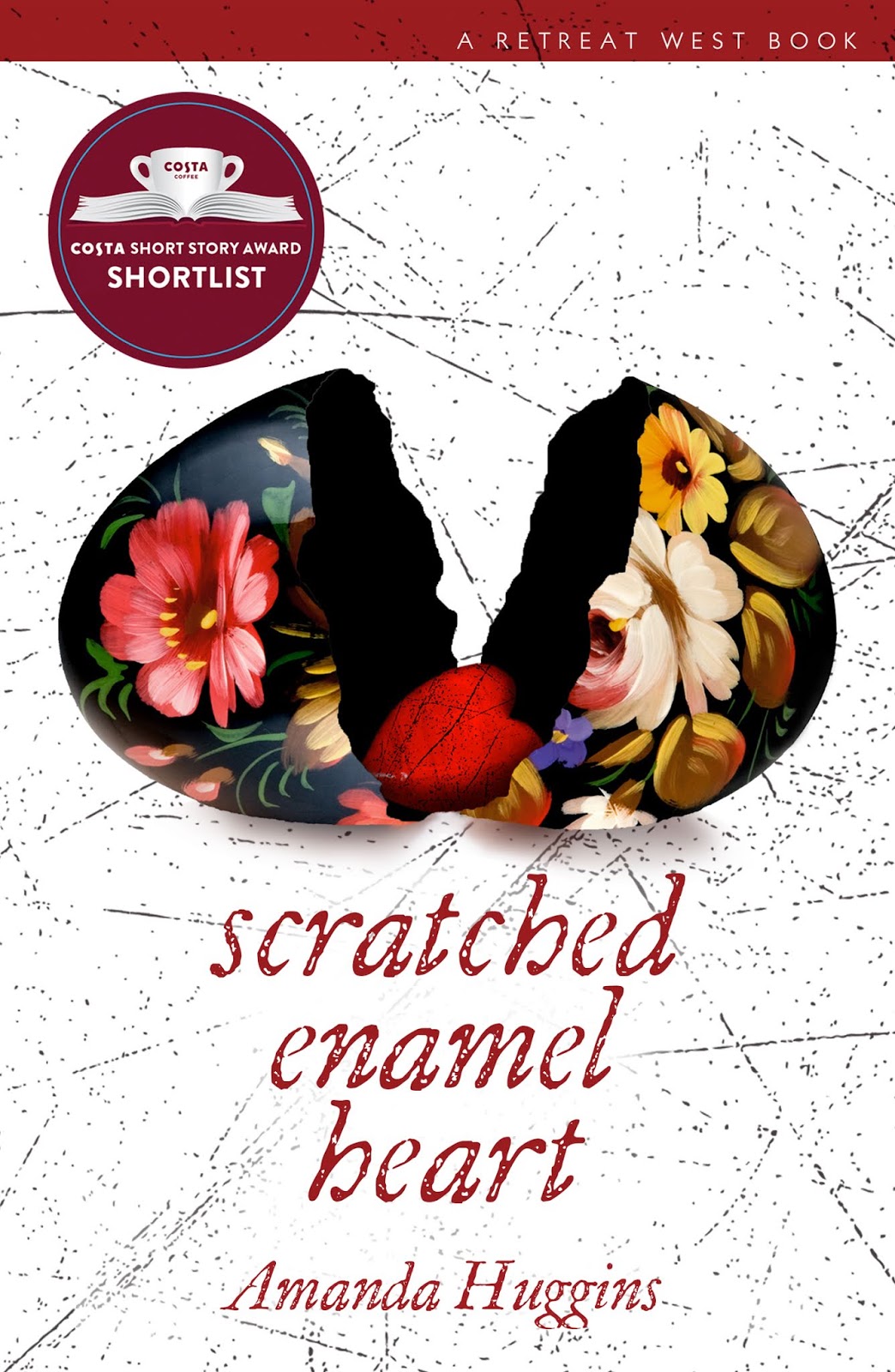
Review by Kathy Hoyle of "Scratched Enamel Heart" by Amanda Huggins


This beautiful collection from Amanda Huggins is a lyrical journey of delicate devastation. Each story is told in exquisite detail, sparking the senses so the reader really feels the ‘soft rabbit-skinned’ gloves in 'Violet Flint and the Softest Blue,' tastes the bitterness of the bourbon in 'A Brightness to It,'  and sees with startling clarity the stray dog, Hal, with his paw aloft silhouetted against the dawn sky in 'Red.'

Huggins effortlessly carries the reader from the North coast of England to the heat of India, from a farmhouse in small town USA to the bustling streets of London and yet, despite the many varied settings, the themes remain universal and instantly recognisable. Each story resonates with the reader because Huggins writes with such compelling precision about grief, hope, loss, yearning, fear and love in all its complexities.

The opening story, 'Where the Sky Starts,' has such pastoral beauty, so incongruous against the central themes of death and the cyclical drudgery of poverty. The gentle and yearning Rowe dreams of escape from the steelworks, herring fishing and the weight of responsibility.  Rowe’s final act of wilful resistance to an inevitable life, leaves the reader reeling with hope. 

'Red,' which was shortlisted for the Costa Short Story Prize, follows. It's a searing story, saved from overwhelming the reader with its brutality, by its wonderfully redemptive ending: 'Mollie hated the dark, brooding weight of the house, the trees so dense they held a part of the night’s heart within them even when the sun shone.' Mollie’s sinister new stepfather Sherman Rook threatens Mollie and her mother in the most terrible of ways. Her only friend is Hal, the stray dog she befriends. Mollie learns that sometimes we must leave behind those we love most in order to save ourselves. 

The title story, 'Scratched Enamel Heart,' is utterly mesmerising. This utterly original and compelling story tells of a refugee, Maya, who holds onto her past with her grief bound tightly into the leather plaited bracelet she wears: 'She picked up the owl with the scratched enamel heart and thought of her father. Always wise, yet unable to hide his feelings even when it was dangerous. He wore his heart on his sleeve for the world to see. The cat was her mother: green-eyed, independent and fierce, and the dolphin was her baby sister, always down at the river, swimming, diving, laughing, forgetting to come home in time for supper.' 

The collection is interspersed with some taut and sinister flash fiction pieces, such as 'Tiger' and 'Pretty,' both of which pack just as powerful a punch as the longer stories, and  'Strong not Rough,' a tiny story which demonstrates the sheer weight and power of teenage longing, in just a few lines.  

I adored these short stories; each one can be read and re-read and still you will find something new each time. Prepare for your heart to be scratched and yet, thankfully, not quite broken, with this gorgeous collection. 


About the reviewer
Kathy Hoyle is an MA graduate from the University of Leicester. Her short stories and flash fiction have appeared in a variety of literary magazines such as Virtualzine, Silver Apples, Reflex Fiction and Another North.  She was shortlisted for the Exeter Short Story Prize, the Fish Memoir Prize and the Ellipsiszine Flash Fiction Collection Prize. She is currently working on her first novel. 

Monday, 30 March 2020

Review by Kathy Hoyle of "The Almost Mothers" by Laura Besley


This stunning flash fiction debut takes us on a compelling journey, with Laura Besley skilfully weaving together a variety of narratives as far removed from the familiar womb-warmth of traditional tales of motherhood that one could possibly imagine.   

This is an exploration of motherhood, in all its complexities. Besley refuses to hold back, plunging the reader into the realisation that motherhood is often stark and terrifying, with her opening story, "Mothers Anonymous." We hear from Melissa: "'I’m Melissa,’ she says in a raspy voice like she smokes a pack a day… And I hate being a mother.'" And from there, Besley drags us through each tale by the heartstrings.  

In "Everything’s Fine," we see how being a new mum means discarding one’s own self, to emerge unrecognisable, even in your own mirror: "I see a face and step back, knocking over a bin when I realize it’s me. The new me. The she who doesn’t wear make-up, have time to wash or sometimes even brush her hair." 

Then, we have moments of wry humour in "Down To Earth," a humorous story about Earth mothers, told from an alien point of view. But quickly we find ourselves hurtling downward again, with the horrifying "Wish Upon a Star," a story that takes your breath away in just three, short paragraphs. 

Besley dips into dystopian futures, with two tense and terrifying stories, "In Hiding" and "The Unmothers," and she’s also not afraid to acknowledge the non-mothers, with her uncompromising story "That Face" and with the brief, but intensely powerful, "How to Grow Your Own Baby."

The Almost Mothers is a wonderful collection of short fiction which has real depth and poignancy. Besley captures motherhood beautifully in this raw and uncompromising debut. I look forward reading much more of her work in the future.   


About the reviewer
Kathy Hoyle is an MA graduate from The University of Leicester. Her short stories and flash fiction have appeared in a variety of literary magazines such as Virtualzine, Silver Apples, Reflex Fiction and Another North.  She was shortlisted for The Exeter Short Story Prize, The Fish Memoir Prize and the Ellipsiszine Flash Fiction Collection Prize. She is currently working on her first novel. 

Wednesday, 26 February 2020

Review by Kathy Hoyle of "Jim Neat: The Case of a Young Man Down on His Luck" by Mary J. Oliver


Mary J. Oliver describes this work as a "long narrative poem."  Whilst the book certainly does contain sections of vivid, powerful poetry, it’s also a hybrid of hospital reports, diary entries, letters and historical photographs, making it a truly fascinating and original composition.

As a child, Mary hears a whisper of a conversation between her parents, an accusation, revealing a secret her father kept to himself and refused to speak of, ever: "You’re in another world, it’s that woman you married in Canada. And her baby. Isn’t it? Still dreaming about them, after all this time."

Mary’s father is absent, often physically, as he struggles with depression and addiction, and always emotionally. As an adult, Mary has a need to understand her father better, maybe find the half-sister she thinks still lives somewhere on the other side of the world and once and for all get answers as to why her father was never really present in her life. 

Mary remembers that Jim was close to his sister Queenie, and tracks down her daughter, Sally, sparking a journey of discovery. Through Sally, Mary finds boxes of old letters and documents, revealing links to Canada, where Jim spent his early life. She carefully collates hospital reports, letters and diary entries, to build an absolutely fascinating picture of her father. Interspersed throughout the narrative are Mary’s own thoughts, expressed through poetry and short sections of creative non-fiction, as she fills in gaps and processes her feelings. 

This sometimes humorous, yet more often heart-breaking story reveals how Mary came to understand her father and the extraordinary life he led before he met her mother. Unlike anything I’ve read before, I was pulled in by the stunning prose, the gorgeous poetry written by both Jim and Mary, and the powerful themes of loss, duplicity, addiction, love and family secrets. An exceptional book.  


About the reviewer
Kathy Hoyle is an MA graduate of Creative Writing from the University of Leicester. Her flash fiction and short stories have appeared in various online zines. She has been shortlisted for The Exeter Short Story Award, The Fish Publishing Short Memoir Prize and the Ellipsiszine Flash Fiction Collection Competition. She will write for chocolate. 


Wednesday, 11 December 2019

Review by Kathy Hoyle of “The Confessions of Frannie Langton” by Sara Collins


Frannie Langton is on trial at The Old Bailey and the crowds are baying for the blood of the ‘Mulatta Murderess’.

‘Any gaol-bird could tell you that for every crime there are two stories, and that an Old Bailey trial is the story of the crime, not the story of the prisoner.
That story is one only I can tell’ 

Frannie’s lawyer gives her a sheaf of paper, ink and pen, so that she may confess the terrible secrets she has kept so close, and somehow find a way to escape the noose. 

This meticulously researched bawdy, brutal tale brings to life to Regency England, where reputation is far more important than truth, and freedom is an impossible dream.   

As a young girl Frannie Langton is given her massa’s name and brought into the big house in Paradise, Jamaica, but for what reason? Living in fear of her spiteful mistress Miss Bella and with no answers from Phibba the housekeeper, Frannie must learn to fend for herself under Massa Langton’s watchful eye. Soon Frannie learns just how terrible the mind of an inquisitive gentleman can be. When Langton forces her to perform his ‘negro’ experiments alongside him, Frannie is drawn into unspeakable acts, scarring her soul forever.  

A fortuitous event follows. A fire wipes out the Plantation and sees Langton flee, with the only chattel he has left… Frannie. Could this be the chance for freedom Frannie has hoped for? Gifted to the prominent writer George Benham in return for the publishing of his scientific papers, Langton ensures that Frannie is simply passed from one wicked master’s hands to another. 

The only light in Frannie’s life is her new mistress, the beautiful but delicate Madame Marguerite. As the love between maid and mistress grows, terrible secrets unfold. Both women are slaves to the master, each one suffocated with dreams of freedom… and then the unthinkable happens. A double murder in the Bentham household, and Frannie is the only suspect. 

The confessions of Frannie Langton is a stunning debut from Sara Collins. The inherent racism of colonial England comes through loud and horrifically clear as we follow Frannie in her search for freedom and a love that crosses the boundaries of race, gender and class.  Collins weaves gothic strands of tension throughout the story with a masterful edge, holding us in the palm of her hand as we wait with bated breath, for Frannie’s final day of judgement. A page-turner from the get-go, this novel will leave you breathless. 

  
About the Reviewer  
Kathy Hoyle is an MA graduate of Creative Writing at the University of Leicester. Her Flash fiction and short stories have appeared in various Online Zines. She has been shortlisted for The Exeter Short Story Award, The Fish Publishing Short Memoir prize and the Ellipsiszine Flash Fiction Collection Competition. 

Tuesday, 3 December 2019

Review by Kathy Hoyle of “The Glass Woman” by Caroline Lea


The Glass Woman is a stunning debut from Caroline Lea, taut and atmospheric from the very first page. 

Set against the unforgiving claustrophobic landscape of an Icelandic winter, the reader cannot help but be pulled into this dark and isolated world of secrets and superstition. 
The year is 1686. In the remote Icelandic village of Stykkishólmur, the ice cracks, and a body is pulled from the water. The villagers have their suspicions, there is talk of murder, witchcraft and punishment … and newcomer Rosa is determined to find the truth. 

Rosa’s heart belongs to Páll, but when Jón Eriksson passes through their village and asks for her hand, she cannot refuse. A girl must be dutiful and pious and Jón is not the sort of man to take no for an answer. Desperate to help her ailing mother and knowing that Jón will provide for them both through the harsh Icelandic winter, Rosa agrees.

Rosa is afraid. The women of Stykkishólmur refuse to talk, save for whispers of Jón’s first wife, Anna and her mysterious death. Rosa must stay in the house, forbidden by Jon to be anything other than his dutiful wife, trapped and afraid. Then there is Petur, Jon’s strange but trusted friend, who seems intent on catching her out. Rosa must find answers. 
What are the noises she hears in the attic above? Why do the villagers fear Jon so? And what happened to Anna, his first wife?

In this tense and powerful story, Lea weaves a brilliant tale of mystery, witchcraft secrets and lies. This debut novel is rich, dark and poetic, with twists and turns that keep the reader guessing all the way to the end.  


About the Reviewer  
Kathy Hoyle is an MA graduate of Creative Writing from the University of Leicester. Her Flash fiction and short stories have appeared in various Online Zines. She has been shortlisted for The Exeter Short Story Award, The Fish Publishing Short Memoir prize and the Ellipsiszine Flash Fiction Collection Competition. She will write for chocolate.