Showing posts with label Julie Gardner. Show all posts

Wednesday, 5 August 2026

Review by Julie Gardner of "Creative Writing and the Critical Commentary: Reflection, Influence, Process," ed. Karen Stevens and Jonathan Taylor


Anyone studying Creative Writing at undergraduate or post-graduate level is almost certainly required to write a critical commentary to accompany each piece of creative work they submit. The first time I was asked to provide one, whilst studying for an MA, I wrote a lot about the work of writers who had influenced me but hardly anything about my own output so I was (quite rightly) criticised. If I had read Creative Writing and the Critical Commentary first, I think I would have done better. There were no published anthologies of critical commentaries then, but editors Karen Stevens and Jonathan Taylor have produced a book that, in their words, "aims to address that strange pedagogical gap." This book will, I am sure, soon be on the reading list for most Creative Writing courses in the UK and beyond. 

Stevens and Taylor suggest that the world of Creative Writing is a mirror-world: "You learn to write – or learn to write better – by reflecting on your own work and the work of others. The mirror-world reflects both yourself and your (literary) surroundings, and you learn by studying those reflections, by staring into the mirror." I like this image of a writer staring obsessively into a mirror, rather like Snow White’s stepmother. I’m not suggesting writers are evil or vain, but we can be insecure and we need to be willing to look at ourselves (or at least our work) carefully, paying close attention to small details.

Part One, which consists of the first three chapters, jointly written by the editors, acts as a thought-provoking and useful introduction to the main part of the book. For those in the early stages of their writing career, particularly if they are following a formal course at university or college, there are useful lists of what might be included in a critical commentary, with questions to consider. 

Part Two provides the twelve sample critical commentaries and it is this section that gives legitimacy to the editors' claim that "there seem to be no other books like this one." The contributing writers "have experience as both published authors and educators in higher education," and "encompass, in both spheres, all the major forms of writing (prose fiction, creative non-fiction, script writing, poetry and new media)." Each chapter ends with "Works Cited," an extensive and eclectic list for further reading.

I wondered if it would be frustrating to read the commentary without first having access to the creative work, and there were times when it was. Ideally, I would have liked to have read Stevens’ short story "Among the Crows" before I read her discussion around it, but, like all the contributors, she provides quotes from the original work and information about the content. As I worked my way through the chapters (Stevens’ commentary was the first) I decided that these essays worked perfectly well as discrete pieces. I found that I was applying what I was reading to, and finding inspiration for, my own practice. As a poet I was especially interested in Shaindel Beers’ essay, "Nature and Chance as Poetic Influence" and Lily Matsumoto’s "Experimental Poetic Autography: Writing the Languaged Self," but every chapter offered useful insights. I particularly enjoyed David Swann’s "commentary-in flash" about his novella-in flash, Season of Bright Sorrow. Kit de Waal also writes about flash fiction, comparing it to parables from the Bible: "both forms invite readers to engage deeply with the subtext, relying on suggestion and resonance rather than explicit explanation."  Dan Powell’s contribution, entitled "The End Is Never Where You Think," introduced me to Preclosure Theory. His chapter included the final two paragraphs of his short story, "Not the Fall," and I am eager to read it in its entirety and interested to see how that reading is affected by my prior reading of the commentary.

Anyone who believes that there is a formula for writing a critical commentary will, on reading this book, find that they are mistaken. The twelve essays are all very different in style and tone. What they do have in common is the writers' willingness to share openly about their own work and there is something generous about this. These are, in effect, masterclasses. Without doubt the book will be extremely useful to those tasked with writing critical commentaries, but it has much to offer all writers and indeed to many readers.

Stevens and Taylor make a bold claim for the critical commentary: "If approached with the same thoughtfulness as the creative work, they are not only profoundly helpful to an author, they might also stand as works of art in themselves." This book provides the evidence to support that claim. 


About the reviewer
Julie Gardner is working towards a Critical and Creative PhD at Nottingham Trent University. Her poetry pamphlet, Remembering, was published by Five Leaves in 2024.

You can read more about Creative Writing and the Critical Commentary on Creative Writing at Leicester here. 

Tuesday, 16 September 2025

Review by Julie Gardner of "Football, Fighter Jets, Flowers & Everything in Between" by Ellistown Primary School's Year Six Students


As the title suggests, there is variety here. Thirty-two year-six pupils from Ellistown Primary School share their knowledge and interests. And what a knowledgeable and interesting group of individuals they seem to be! 

One piece is inspired by Shakespeare’s Macbeth, another by the award-winning short film Little Freak, by Edwin Schaap. We read a fictionalised account of Catherine of Aragon overhearing Anne Boleyn and Henry Vlll. A labelled diagram explains why the Eurofighter Typhoon is so unique, and an illustrated description of Japan Football Trials makes for a fascinating read. A Victoria sponge recipe is a lovely tribute to a nan who baked "so many different things." 

Recurring themes across the collection are ambitions for the future, the importance of friendship and hobbies. There are some spooky stories, eight poems and some impressive illustrations, including a fierce looking Aslan, a dolphin and an abstract interpretation of the school’s houses. A Lego enthusiast contributes a photograph of a model which was made with 2352 pieces and a photograph of a clay and paint model of an ice-cream cone was inspired "by hot summer days, when the SATs are over and we’re having fun." 

Credit goes to the teachers who have encouraged this creative and diverse project, to Constantine who edited the collection, and to the Coalville C.A.N. Community for making the publication possible. I suspect the children will remember this work long after their SATs results are forgotten. As the headteacher writes in the foreword, the children have been given "permission to embrace their own individuality and to find a voice they may not have known they had." 


About the reviewer
Julie Gardner is studying towards a PhD at Nottingham Trent University, focussing on Silence and Voice in the poetry of Vicki Feaver and her contemporaries. Her poetry pamphlet Remembering was published by Five Leaves Publishers in 2024.


Sunday, 20 July 2025

Review by Julie Gardner of "Skail" by Richie McCaffery


"Skail" is an old Scots word meaning a scattering or dispersal. This information is provided in the back-cover blurb, where we also learn that "the poems in this pamphlet take place in the aftermath of a pandemic, and in the dissolution of a long-term relationship."

The first two lines of the title poem – an especially strong piece – suggest the supernatural, perhaps hinting at threat: "The night before Halloween, he came to her in sleep, / called out her maiden name, with a cancerous rasp." But this ghost comes not so much in anger as exasperation: "He could wait no longer, it’d been 15 years already / of dilly-dally-hanging-onto-daddy’s dust." Her indecision is swiftly rectified. She involves "the great grandkids / he never even knew" who use "little grain scoops" to scatter her father’s ashes in plant pots and they leave out a "tot of his favourite whisky … to slake his thirst." 

"Little grain scoops" will not be enough. The third and final stanza returns us to the woman and then, as if mirroring the first stanza, to the intangible, the supernatural. Despite the apparent abandon of her actions, we see how keenly she feels the loss:

         But the bulk of his ash was left to her, and went
         headfirst into the remains of the vegetable bed.
         And though it was a wet night, the dust cloud of him
         hovered under the streetlamp, as if getting its bearings.

Perhaps "The Lucky Penny," one of the later poems in the pamphlet, is about the same extended family. It begins: "When you were wee, he brought back a lucky penny." Once washed, however, it is revealed to be a Victorian gold coin. That the finder has not recognised its worth is ironic, given his repetition of the well-worn maxim: "Find a penny, pick it up, all the day you’ll have good luck." This failure to recognise good fortune, is, we learn in the final stanza, characteristic:

         Over the years you’ve watched your mother’s profile
         change, caring for grandkids and holding the house
         together as he aged too, cursing a life of misfortune.
         He never knew he held gold in his hand. Still does.

The poems in this slim pamphlet avoid first-person narration, perhaps signifying a desire not to claim self-importance but to draw attention to the complexity of what it is to be human. It risks seeming disingenuous, however, especially in poems that seem to evoke the ending of the long-term relationship referred to in the blurb. In "Scrap," for example, we read, "Her last words to him were written, not spoken, / a paper cut severing them and their fourteen years." And in Cicatrix, "He never heard the wind changing. / Before he knew it, he was out of the frame." The distance between speaker and poet seems small, only the pronoun holding them firmly apart. All the poems feel natural and honest, though, the speaker assuming the role of an unobtrusive observer who reports what he sees with compassion and humour. 

In "Bolt," a man gets off a bus and is "dazzled by a camera flash." He wrongly assumes a group of teenagers have taken his picture and is about to confront them when he is saved from humiliation: "the ordnance of thunder blew them all / out of their skin." The poet trusts his reader to work out what has happened. The final lines of the poem roll together the teenagers, the man, the poet, and his readers:

           That’s being human
           one instant so full of self, the next
           made to feel like no-one, nothing.

This acknowledgement of vulnerability is a thread that weaves through the poems.


About the reviewer
Julie Gardner is studying towards a PhD at Nottingham Trent University, focussing on Silence and Voice in the poetry of Vicki Feaver and her contemporaries. Her poetry pamphlet Remembering was published by Five Leaves Publishers in 2024.


Monday, 30 June 2025

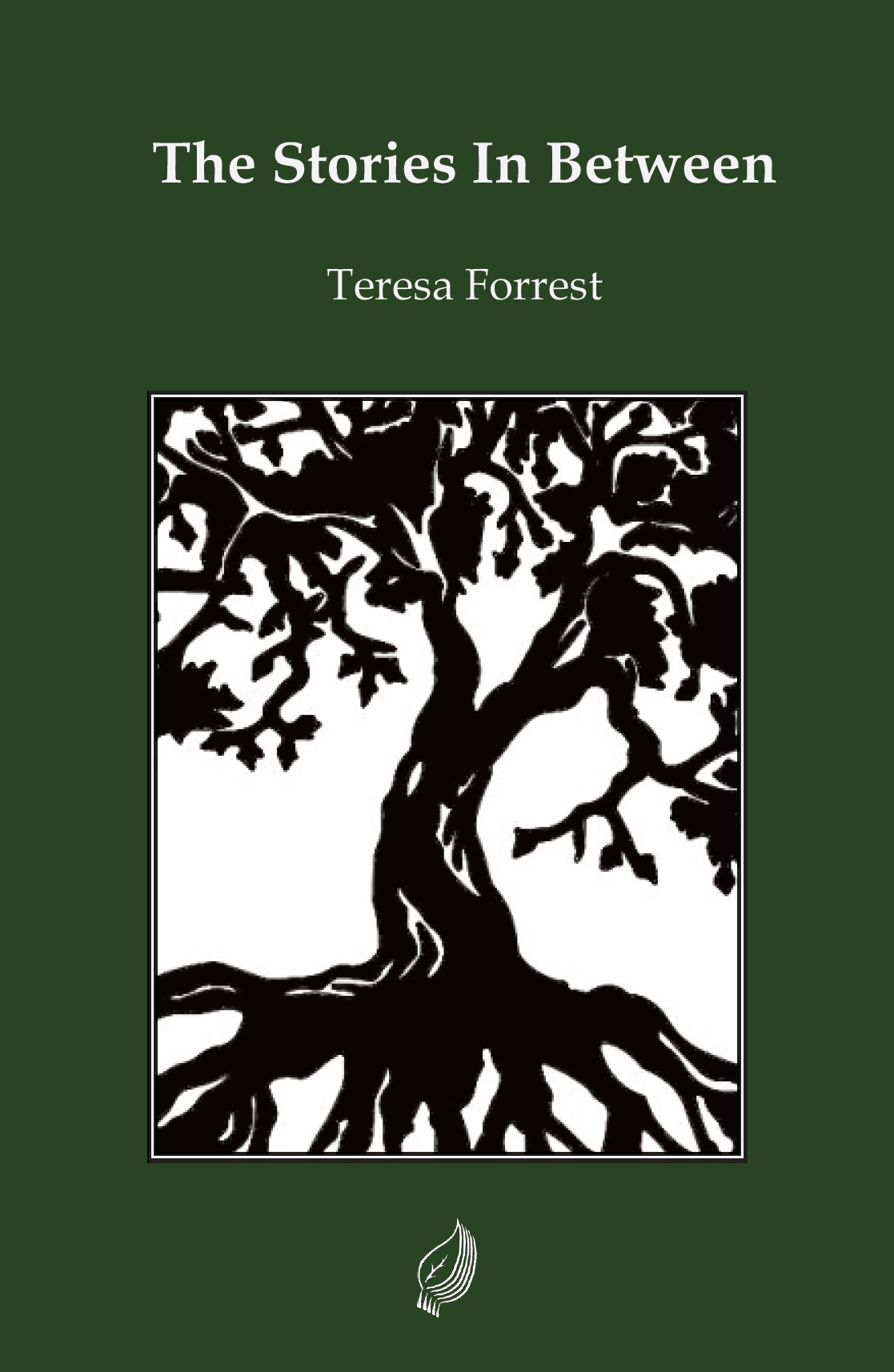
Review by Julie Gardner of "The Stories in Between" by Teresa Forrest


There are twenty-five short poems in this pamphlet; the longest is twenty-four lines. They are written in deceptively simple language - deceptive because, despite their accessibility, the poems, rooted in real people and the landscape around them, are profound and deeply moving. They reward the reader who pays close attention. 

In the first poem, "Almost Home," a mother addresses her child:

  I, your mother, am formed from folklore,
  spit and cabbage. When I made you,
  I hadn’t finished making me. I am so rough
  around the edges.

The shortest poem and one of my favourites (it is impossible to choose just one) is "In Balerin Village." The first two lines focus on a domestic appliance, "The fat-bellied range in my granny’s house" which "works hard / to warm us." But the description of the range is also suggestive of the character of its owner, "Get too close and it warns us with a scalding tongue." 

The poetic skill here is subtle – the rhyming of warm and warn, the connection between scalding and scolding. There is humour too, "Pans hiss with home grown / and, once, a cockerel that had crowed too early for her liking." The reader can be in no doubt that this grandmother is a strong and energetic character, summarized in the fifth line of this short poem which stays with the domestic imagery, "Always the kettle whistles to her tune." But the poem is not confined to the kitchen and the grandmother cannot be contained within its lines, the final two of which expand horizons, speaking volumes about the tender relationship between the narrator and her grandmother and hinting at the stories in between: "Each morning she gives me an orange, / a small globe that feels like the world."

There are other stories. "Pillow Talk" charts the gradual disintegration of a couple’s relationship from "that first moment / of easy laughter, / pillow talk between kisses." There’s the woman who lives "on the Tenth Floor of the High Rise" who has "painted her room the colours of the sun." There’s "Mrs Ritchie" who "carries her anger in a handbag, / worn-out crocodile skin, used to have matching shoes."  

The narrative voice remains consistent throughout the collection, compassionate, observant, respectful and with an Irish lilt. This is an exceptional debut pamphlet and I look forward to reading more from this talented poet.


About the reviewer
Julie Gardner is studying towards a PhD at Nottingham Trent University, focussing on Silence and Voice in the poetry of Vicki Feaver and her contemporaries. He poetry pamphlet Remembering was published by Five Leaves Publishers in 2024.

You can read a review of Remembering on Everybody's Reviewing here. 


Sunday, 12 January 2025

Review by Julie Gardner of "The Box" by Susan Jordan


This novel tackles difficult themes but Susan Jordan’s experience as a psychotherapist means that she writes with authority and compassion. The two main characters are Richard, overwhelmed with grief after the sudden death of his wife, Kate, and Kate’s twin Jo whose already fragile mental health is at breaking point as she tries to deal, not only with the loss of her beloved sister, but also with emerging memories of traumatic events from their childhood. 

The novel is written in the third person but each chapter focusses on one of the key characters, mostly Richard and Jo, although three chapters are given up to Marian, the mother of the twins and one to Fran, Richard’s sister. This shifting perspective works well and the unfolding narrative provides insights into how different people deal with grief and trauma as well as suggesting ways in which well-meaning relatives, friends and even professionals can sometimes get it wrong. 

The box of the title contains Kate’s ashes and a thread running through the novel is the need Richard and Jo both feel to find the right place to scatter them. This provides a satisfying framework within which the story is told. Jordan avoids sentimentality and while the ending provides a satisfying conclusion to the narrative, it avoids being too neat.


About the reviewer
Julie Gardner is studying towards a PhD at Nottingham Trent University, focussing on Silence and Voice in the poetry of Vicki Feaver and her contemporaries. He poetry pamphlet Remembering was published by Five Leaves Publishers in 2024.

You can read a review of Remembering on Everybody's Reviewing here. 

Wednesday, 6 November 2024

Review by James Nash of "Remembering" by Julie Gardner


This is a tender and moving collection celebrating and memorialising two lives, the poet’s mother and her own husband, but succeeding, as all good poetry does, in finding universal truths about our common humanity and shared experience of loss.

Deftly constructing a history for her mother who died at forty-seven, and recording the emptiness after her husband’s death, these are quiet but truthful poems that bind us into the ordinary, but somehow extraordinary, emotional textures of human lives, and show us how we survive in the aftermath of tragedy.

This is from ‘Moving On’:

          After the van had gone
          I mopped the kitchen floor
          then went upstairs, stood awhile,
          as empty as the house itself.

Julie Gardener is a fine poet, content to let her readers ‘join up the dots’ if you like, but also happy to acknowledge the influence of other poets like Grace Nichols and Jacob Polley. She is playful in terms of form in ‘Rondo,’ riffing on nursery rhyme (a motif which appears in several of these poems), but ultimately what we have in this fine collection is a poet using simple and gracefully chosen words to explore the territory of memory and grief. The almost Wordsworthian reliance on everyday language gives these poems an emotional reach and power that is refreshing and unusual.

This is from ‘For Arthur’:

          Widow sounds so sad and slow
          and I am neither, though I will
          forever wish you here.

The photograph on the front cover of the poet’s mother is blurred; the poems inside reclaim the misty lives of those who have gone before, mother and husband, and prove again and again that art can construct great memorials. The gift of this brilliant collection is that it allows us to connect to our own loss and mourning, our own ‘remembering’ if you like.


About the reviewer
James Nash is a poet based in Leeds. He often writes in the sonnet form and his next collection, Notes of Your Music, will be published by Valley Press.