Showing posts with label V Press. Show all posts

Friday, 18 July 2025

Review by Nina Walker of "sum of her PARTS" by Laura Besley


In sum of her PARTS, Laura Besley provides us with a beautiful series of briefly illuminated windows - vignettes that offer glimpses into the moments of intimacy that make up a life. Besley writes tiny, furious fiction concerning an increasingly fractured world. Each story acts as part mirror, part shard, as cutting as it is revealing. This sentiment is perhaps embodied best by "shattered," in which a self-hatred over physical appearance culminates in a speaker smashing a mirror and stating, "with the shards of glass / I give myself a new face." 

Besley gives a new face, not just to the nameless speaker of "shattered," but also to the presumed limitation of flash fiction. Her creative approach to the visual presentation of flash fiction gives the collection a strong visual identity, a new face. Utilising poetic lineation techniques, Besley’s work shatters and reforms our presumptions about the form.

The collection is carefully threaded together by a series of intimacies, perhaps most centrally the intimacy one must have with oneself. In the refined and precise prose that is present across all four of her published works, Besley presents the reader with moments of physicality that ripple out beyond the pieces' short word counts. Often, the body of the speaker is positioned as an object of discussion, like a museum exhibit - an object transformed by a thread of absurdism that contrasts with the collection's physicality. In one story, the speaker is transformed into a trumpet, in another, a character grows an extra arm to hide their face. Bodies in Besley’s work are central yet malleable. They are expressed through a series of familiar quirks and fault lines, "thick middles," "haggard faces," and "bruises" that can become beautiful or bizarre at a moment’s notice. When reading Besley’s work, one is left discovering, through her typical sharp and wise immediacy, a new strangeness within oneself. 

In one of my favourite stories from the collection, "fractured," Besley writes:

          the doctor says "We’re going to need to take a
             consent form." I sign. "If you could just remove your
                bruises, multiple, along the collar bone and across the patient’s back
                   home, he might be awake, be wondering why I’m not
                      there is a bed ready for you now." I don’t

Here, the body, while still central, is cut in two by the story's perspectives. The lineation is cleverly used to construct the patchwork of the patient as observer and subject. "Patient’s back" flows cleanly into "back home," as if the thoughts of the patient effectively interrupt the clinical observation. Time is clipped and stitched as the request to "remove your bruises" merges observable reality and individual desire for escape. A clashing moment of exterior reality and interior doubt culminates in the piece's final unfinished fragment, "I don’t." The final line, when read within the context of a domestic abuse victim refusing the (albeit limited) protection of the hospital, is haunting. The lack of a concluding full stop implicates all the possible moments this patient may inhabit after this one, leaving the ending of the piece jagged and frayed.

In just thirty-four pages, Besley draws us into a network of bodies, thoughts, and conversations, always, as flash necessitates, with scant context. Yet the brief nature of each piece illuminates just how interconnected we all are, each jagged edge implicating a matching edge that may yet lie beside it. The sum of the collection's parts is a moving and sharply observed portrayal of the complexities of embodied life, where one must place gentle intimacies right alongside painful metamorphosis and absurd possibilities. 


About the reviewer
Nina Walker is a first year PhD student at the University of Leicester studying the impact of digital technology on the contemporary American novel. She also co-runs the Leicester based creative writing group Amateur Hour. She enjoys writing poetry, reading speculative fiction, and pub quizzes. 


Tuesday, 29 November 2022

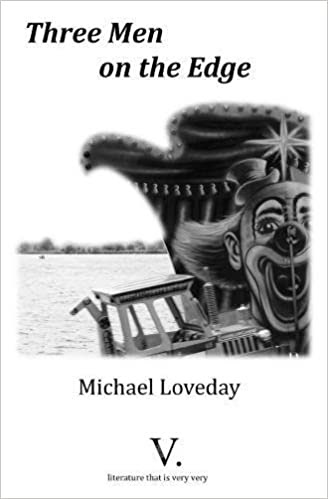
Review by Laura Besley of "Three Men on the Edge" by Michael Loveday


Three Men on the Edge by Michael Loveday is a novella-length book comprised of three short novellas-in-flash, the stories of three men: Denholm, Gus and Martyn – all struggling with life. 

The first story, ‘Cause for Alarm,’ explores the marriage of Denholm and his wife, Joan. Through the use of swans – birds which are renowned to mate for life – Loveday gives us some insights into the relationship. When Denholm’s friend shows him ‘an image of a swan pair, necks wound tight round each other,’ Denholm doesn’t see romance, but instead shrugs and says, ‘“Could be the blur … but it looks to me like they’re suffocating each other.”’ Later on he muses that ‘if he’d known, really known, how much marriage is one drowning person trying to push another under, he might not have risked it.’ 

In the second story – ‘The Invisible World’ – there are twelve micro fictions, one for each month in a year of Gus’ life following the loss of his wife whose absence he still feels acutely. He is stuck in a quagmire of grief he cannot, or does not want, to find a way to move on from. ‘There’s a veil between him and the world that will not lift, and to tear it down seems a betrayal. Why is it still not consolation – witnessing these swans, these shadows, this sky?’

The final and longest novella-in-flash is ‘Chewing Glass’ wherein Martyn navigates relationships with Anja and Rob. ‘[W]ith every relationship, the miniature sculptor works her hammer and chisel on the stone lump of your heart. If you’re really lucky, Martyn thinks, a man survives well enough to be left in the end with something recognisable.’

Throughout the book, Loveday supplements the starkness of these men’s lives with the stark beauty of nature. This adds, I feel, to the presence of a certain level of resignation, but also resilience. Because life is brutal, and all you can do is live it. 


About the reviewer
Laura Besley is the author of three collections of flash & micro fiction: (Un)Natural Elements, 100neHundred and The Almost Mothers. Having lived in the Netherlands, Germany and Hong Kong, she now lives in land-locked central England and misses the sea. 

Monday, 24 August 2020

Review by Jane Simmons of "I, Ursula" by Ruth Stacey


At an online literary festival earlier this year, I heard poet Ruth Stacey speaking about writing imagined memoirs - and the techniques which she uses to create an authentic sounding voice for historical characters. In I, Ursula, her second full-length collection of poems, she presents the reader with a wide range of voices for female characters both real and imagined. 

The poems about the imagined characters take us back into the worlds of fairy-tale, legend and folk-history – to Rose Red, to Beauty and the Beast, to mermaids and witches. These poems take us into familiar Angela Carter territory – magical, subversive, feminist - and they are often entertaining in their exploration of paradoxes of female experience. ‘Bears are not good fuck-buddies’ begins the poem ‘Rose Red’ – and though the speaker goes on to list her bear’s many faults which lead her to throw him out because she ‘just can’t stand him any more,’ the poem ends, ‘I hope he comes back / I miss the warmth of the bear in my bed.’

The poems which I find the most powerful are those where the poet explores the experience of the female muse and the male artist in both art and literature. This major theme is introduced in the wittily titled poem ‘Averse Muse’ which opens the collection, and it is easy to spot in other titles such as ‘Muses.’ There is a strong feminist agenda behind the  presentation of the muse in many of these poems, and it is perhaps most striking or shocking in the eponymously titled poems such as ‘I, Ursula,’ ‘Camille  Claudel,’ ‘Jeanne Hebuterne,’ ‘Emilie Floge.’ This is where the personal becomes political: the male artists are known, but not the names of their female muses – not even when they were talented artists in their own right. The poor ‘I’ even goes unnamed in the golden shovel ‘Decorative’ and the later poem ‘Lady of a Portrait’ - no wonder that these women rebel. These poems – like so many others in the collection – explore relationships between artist and muse, men and women, the tensions between life and art, and the creation and appreciation of various forms of art, in terms of power and powerlessness.


About the reviewer 

Jane Simmons is a former teacher/lecturer who has recently completed an MA in Creative Writing at the University of Lincoln. She is now a PhD student at the University of Leicester. As a reviewer for The Blue Nib literary magazine, Jane has built a significant publication history of writing about contemporary women’s poetry. A selection of her own poems appeared in the March 2019 edition of the magazine. Her pamphlet From Darkness into Light - poems inspired by the Book of Kells was published in 2018. Further poems have appeared in The View from the Steep, an anthology published by Pimento Press in 2019.


Sunday, 19 April 2020

Review by Gary Day of "The Escapologist" by Jinny Fisher


To the extent that many of the poems in this collection aim to give a picture of Jinny Fisher’s physical world, real and remembered, they succeed. In ‘Sunday Lunch’ Mother ‘works oil into the surface’ of a ‘long table’  with her ‘bleached wooden brush’; in ‘Screen Memory’ a ‘shiny red hand-pump … spurts brook water for the kettle,’ while in ‘Antiphon’ a crowd ‘almost trample / two tiny wellington boots, painted with daisies, / half buried in the mud.’ Fisher, who has undergone a series of metamorphoses from classical violinist, to psychotherapist to poet, has an eye for detail. Her descriptions are precise. The reader is treated to a series of clearly defined images, but a number are inert. The scene is set but nothing happens.

This is not true of all of these poems. ‘Half-Sister’s Lunch’ neatly captures the tensions between the two women; sharing a plate of food and tearing bread dramatically portray their closeness and rivalry and there is genuine tension in the build up to the magnificent last line. Another work that should be singled out for praise is ‘Regeneration’ which simultaneously keeps in play the shock, the relief, and the new found freedom that comes from the end of what appears to be an abusive relationship. But that’s not all. A faint air of regret hangs about the poem. As someone who has studied psychoanalysis, Fisher is all too aware of the dangerous ambiguity of human emotion.  

One of the eye-catching qualities of the collection is the layout of Fisher’s poems. Some, like the title poem, are laid out in paragraphs, others like ‘The Scarf’ follow the shape of the object they describe. All of them, whether they are about home, family relations or even her violin have something to recommend them.   


About the reviewer
Gary Day is a retired English lecturer. His research mainly lay in three areas, the  history of literary criticism, the workings of class in British literature and the persistence of sacrificial ritual in the development of drama. He had a column in the Times Higher for a number of years and has also edited two volumes on the history of British poetry as well as the three volume Wiley Encyclopaedia of British Literature 1660-1789. He hates management speak, has been involved in amateur theatre for over thirty years and is still trying to write poetry.

Thursday, 20 June 2019

Review by Lisa Williams of "Checkout" by Kathy Gee


Welcome to a shop with a tippy tappy till, where the shop-girl knows your name, where you work and what you drive. There is no incorrect item in the baggage area here. In this respect Checkout serves to preserve something we’re losing with the closure of so many small independent stores.

Checkout is described by the author as a duologue, combining elements of flash fiction, poetry and radio play. Each page gives us one hundred words from the nameless girl on the till. In the poet’s preface we learn she mentally nicknamed her Nona (the Roman goddess of the spinner of the thread of life). The brevity of drabble form perfectly suits the timing of a corner shop visit. Thanks to Gee’s sleek prose, we gain a familiarity with each customer with only a few words from our narrator. Each drabble introduces another customer and there’s a natural flow as each new voice enters, so much so you can almost hear the tinkle of the bell above the door. 

The twenty-six characters that join Nona at the counter are varied. City bankers join the homeless. A dog and a falcon also have a chance to tell their tale too. Many, we learn simply 'use a visit to punctuate their days.' As the customers tell their stories we leave the shop, go on trips to the hairdressers, join team meetings, we hear their dreams of death and divorce, their hopes and their histories. 

Nona’s story is a constant; we find out more with each new customer and grow increasingly attached. It’s a brief but beautifully poignant read and one that I’d love to hear performed.  


About the reviewer
Lisa Williams is also a shopgirl (at a bakery) and, like Nona, frequently furnishes friends with quiche past its sell by date.


Wednesday, 12 June 2019

Review by Jon Wilkins of "Midnight Laughter" by Paul McDonald


Midnight Laughter: an interesting title, not in this collection of seventeen stories, of flash and short fiction. As I read through the stories I recorded my one word response as I finished the last word:

Strange
Nasty
Why
Weird
Odd
Spiteful
Kismet
Schadenfreude
Superwoman
Fries
Sick
Oddity
Lecturers
Comics
Cruising
Madge
Death

So we now have a poem that we can call Midnight Laughter

Why would a man shrink until he is the size of a dot and then be swallowed by his wife? Isn’t it spiteful to get a mouse to chew through the heel of a loud woman so as to humiliate her, and then to feel so guilty you wake up and vomit at causing her shame? A man with a mistress has a heart attack as he lies next to the wife that he loves. Does this serve him right? Or is it perfect irony as it is the mistress who is the hypochondriac? There's a smiling peaceful bus passenger who resolves to hurt an old woman who dared to question his morals: she was proved right in the end, but at what a cost? Every story leaves the reader asking a question and then re-reading. How? Why? What the devil?

This is the perfect collection for someone who wants to read and think, to get something out of the time they put in to reading: weird and wonderful, seductive and strange. This collection makes you question, makes you think, makes you ask, “What mysterious place did McDonald get these ideas from?”


About the reviewer
Jon Wilkins is sixty-three. He has a gorgeous wife Annie and two beautiful sons, and loves to write. He is a retired teacher, lapsed Waterstones’ bookseller and former Basketball Coach. He taught PE and English for twenty years and coached women’s basketball for over thirty years.  He has always loved books and reading.