
Showing posts with label alternative history. Show all posts

Saturday, 28 June 2025

Review by Mellissa Flowerdew-Clarke of "The Book of Guilt" by Catherine Chidgey


1979, England. It's been thirty-six years since Hitler’s assassination ended the Second World War and a peace treaty was signed that helped fuel great advancements in medical science. In Hampshire, three identical boys—Vincent, Lawrence, and William—wake up every morning at a Sycamore Home and tell one of their three mothers what they dreamt about. Mother Morning writes them down in The Book of Dreams. Mother Afternoon teaches them lessons from The Book of Knowledge. Their sins are written in The Book of Guilt. They rarely see Mother Night unless they are sick. And they are often sick. Dr. Roach prescribes pills and injections to help keep the Bug at bay. The boys dream of the day they will get to join all the other children in Margate—a promised land of performing dolphins and bumper cars. 

In Exeter, Kenneth and Majorie dress their adored daughter, Nancy, in a silvery-green dress that gets tighter every year. Kenneth builds an intricately detailed model railway. Marjorie fills every conceivable space with items purchased from mail-order catalogues. Nancy is never allowed to leave the house. 

The Minister of Loneliness who, herself, seems terribly lonely, is assigned by the Prime Minister to find new homes for the Sycamore boys. The Scheme is coming to an end. Meanwhile, the death penalty has been re-introduced.

Nostalgic references to stickle bricks, fondant fancies, and The Generation Game indicate that this is definitely England in the 1970s, but not as we know it. Chidgey’s novel feels quintessentially British, but this England exists in an alternate political reality. It’s a reality where the state has a God complex, and everyone is dehumanised by mass complicity in the secrets that are kept. The references to Jim’ll Fix It remind us that it’s too easy to turn a blind eye to human cruelty. 

You could compare The Book of Guilt with Kazuo Ishiguro’s novel, Never Let Me Go. Sure, they touch on similar themes of medical ethics and nature versus nurture, but Chidgey’s storytelling deserves to be observed without comparison. The richness of Chidgey’s prose and her use of provincial humour amplify the unnerving horror of it all. The slow unravelling of the plot keeps the suspense throughout, giving the reader enough time to think they know what’s going on, before unexpected connections take us to an even darker place. Bold and brilliant, The Book of Guilt deserves to be read and re-read. 


About the reviewer
Mellissa Flowerdew-Clarke is a playwright and author, with a penchant for the macabre and a fascination with literary explorations of libertinism, psychopathy, narcissism, and coercive control. She is currently undertaking a PhD in Creative Writing a Leicester University, exploring Terror Management Theory in relation to representations of cultism and mass suicide.

Wednesday, 16 March 2022

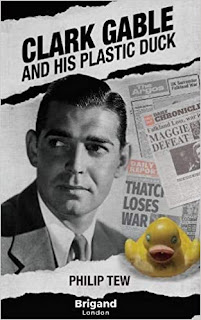
Review by Jon Wilkins of "Clark Gable and His Plastic Duck" by Philip Tew


It’s what we all need to know, Clark Gable. Plastic duck. What on earth? So in the true story-telling tradition of show not tell, I will show. Clark Gable. Plastic Duck.

It is your task to discover their relevance. Task? That makes it sound an onerous assignment. Reading this novel is far from that. It is an undiluted pleasure. It is one of those rare reads, one that you can honestly not put down. The end of each chapter tempts you into reading the next and so on until you have forgotten what day it is and where you are.

I get added pleasure from Philip Tew's books as we taught together in Leicester, way back in 1979. I hadn’t seen him since, until we met at an Everybody’s Reading event in 2018, at De Montfort University. Pre-Covid. Weren’t they the times!

Tew writes of a time I can remember, and so many of his allusions ring true to me, as I am sure they will ring true to any Leicester resident from those Thatcherite days of the 1970s through to the 1990s.

His novel takes us into an alternate world where Thatcher lost the Falklands and Alan Clark became Prime Minister. For those who remember his philandering ways, is that a stretch too far or a parallel to a shaggy-haired oaf that we all currently endure? Thatcher is rehabilitated as Secretary of State for Northern Ireland and the greatest irony is when the pariah Enoch Powell becomes Home Secretary.

Where would we be today if things had turned out like that? Is that what we deserve? Considering what we have now, would it be such a bad thing? You decide as Britain descends into a world of darkness, further hypocrisy, and our hero Bill Pugh doesn’t know who to trust and who to turn to. His world as broken as the society he finds himself in.

As Phil Tew writes: “Rebellion follows. And a new privatized security service full of thugs and villains. For me, Clark’s political broadcast ties my narrative together. Suddenly, the rebellion and riots all make full sense, especially after the Falklands (Malvinas) defeat. The narrative started to reflect very different priorities.”

This novel shows without telling. Readers will not need to be told; they will see the nuances of the narrative as a challenge and an invitation into Tew’s dark world. Fantasy or Dystopia? Alternate reality or too close to truth? Who is the hero: Clark Gable or the Duck or is it Bill Pugh?

You will decide because I won’t be telling you.


About the reviewer
Jonathan Wilkins is a Creative Writing PhD Student at Aberystwyth University, Wales, reading mostly Golden Age Crime fiction. His website is here

Wednesday, 24 March 2021

Review by Simon Elson of "The Separation" by Christopher Priest


My favourite novel genre is sci-fi (preferably earth-based and near-future). I’ve read most of Jules Verne, a lot of H. G. Wells and pretty much all John Wyndham, although recently I’ve been reading World War Two fiction – Ben Elton and Jack Higgins. The other day on a recommended books list a title I’d not heard of popped up - The Separation by Christopher Priest (published 2001) that straddled both genres. It’s already making ‘classic sci-fi’ lists after just a couple of decades. 

Its subject matter of Nazi Germany alternative history has been done a lot: Fatherland by Robert Harris, The Man in The High Castle by Phillip K Dick, SS-GB by Len Deighton, 48 by James Herbert to name just a few of them.  Because of this I nearly passed on it. I’m glad I didn’t. It was different to all the books I mentioned; it was a novel with a real ‘Oh!’ moment at the end and then a sleepless night trying to make sense of the whole book.

I hope my last comment and the sci-fi label won’t put you off. It’s not a Hitler-wins-war scenario where England lives in fear. It starts in the present day and tells its narrative through several people’s first-person memories and historical documents.

The style of it, rather than being like alternative history, was more like normal historical fiction. it reminded me a little of Robert Harris’s book Munich rather than his Fatherland. I’d also say in places there was also a touch of Kurt Vonnegut’s Slaughterhouse-Five without (spoiler alert for people who haven’t read S-H-5) the aliens.     

There were plot twists and turns all the way right up to the last full stop. If I’d been reading a physical copy of the book, I’d have been aware of arriving at the last page as I would have run out of paper to turn but reading an electronic copy it was less obvious. I tried to read the next page to find notes about the author. ‘WHAT…’ was my thought, so I turned back and re-read the last couple of pages, savouring them more the second time, then finally understanding the end (I think) after an hour or so of not sleeping, even though it was late. 

If when I’ve finished a book, I think ‘Oh no, I’ll never read that book again for the first time’ then that’s how I judge how good it was. This was one of those books.


About the reviewer
Simon Elson is a Freelance Features Writer. His articles  have appeared in numerous national magazines including Best of British, Derbyshire Life and Writing Magazine. He also writes for the popular cycling website Veloballs.com and has been a guest blogger on The Huffington Post.

Tuesday, 5 December 2017

Interview with Rod Duncan


About Rod Duncan 
Rod Duncan writes alternate history novels set in the world of the Gas-Lit Empire. The first of these, The Bullet Catcher’s Daughter, was shortlisted for the Philip K. Dick award. He has previously written contemporary crime, his novel Backlash being shortlisted for the John Creasey Dagger. Born in Wales, he has lived in Taiwan and Ghana but has been in Leicester since 1993. A dyslexic with a background in scientific research and computing, he now lectures in creative writing at De Montfort University. His next novel The Queen of All Crows will be published in January 2018. http://www.gaslitempire.co.uk/


Interview with Lee Wright

LW: When did you first know that you wanted to become a writer? 

RD: I was slow learning to read and write. Writing with a pen is still a painful process because my hand cramps up after half a page. So being a writer was never something I was going to do. But then the word processor came along. By the time I turned 30, I’d learned to type. I wrote a few poems at first and a short story. Then, naively, I started working on a novel. My writing was very poor, of course. The book wasn’t destined to get published. But creating the imaginary world of the story, I felt something ecstatic. I don’t remember thinking ‘I’m going to be a writer.’ It’s just that one day I realised I was one.

LW: Was there ever one particular writing hero that you found encouragement from? 

RD: I’ve found writers to be very generous with their knowledge and time. Many have helped me along the way, and continue to do so. But I’d like to mention the late Graham Joyce in particular. As writers, it’s our job to explore the strange lands that lie deep within our own minds. Graham exemplified that quest. Not because he wrote psychological fantasy. It was a quality revealed in the dizzying clarity of his vision. He was very helpful and encouraging to me and I will always be grateful for that.      

LW: Do you have a favourite novel? 

RD: No. And I don’t believe you do either. How could you choose? But there are certain books I keep around me to dip into from time to time for inspiration. Titus Groan, Polar Star and Under Milk Wood for example.

LW: What comes first when you sit down to write a novel? Does it start for you with a single scene? A character? Or a whole plot? 

RD: Backlash began with the voice of a character. She told me her story and I wrote it down. The Bullet Catcher’s Daughter began with an idea for an alternate history and moved on to a scene, which I didn’t understand until I wrote it. My work in progress began with a location. I don’t go out of my way to make the process different each time. I just try to approach the blank page as if I know nothing. Then I see what happens.

LW: You lived in Taiwan for a time. Do you believe that it is important for a writer to travel? 

RD: Intensity and breadth of experience are vital, in my opinion. You might get those things by travelling around the world and immersing yourself in completely different cultures. But you could equally get them by turning a corner in your home town, by looking in a different direction, by practicing seeing things as if you’ve never seen them before.  

LW: What was your 'breakthrough' in writing? 

RD: The breakthrough other people talk about would be my first big publishing deal with Simon & Schuster in 2003. Or perhaps being shortlisted for the Philip K Dick Award in 2014. But the real breakthroughs are moments of insight when the writing moves forward. I remember a moment when I stopped self-censoring. Or, rather, I learned to put aside the part of me that was asking ‘Yes, but is that seemly?’ trusting myself to ask those questions during the edit. That was a breakthrough. Another was realising what it was that created narrative drive in my work and thereafter being able to harness it consciously. I’ve made another breakthrough writing The Queen of All Crows - a conscious fluidity in the narrative voice. These are the moments that matter.  
  
LW: You take on projects that form series: The Riot Trilogy, The Fall of the Gas-Lit Empire. How do you pace yourself when writing and planning such long works? 

RD: It’s all about deadlines and fantasizing. The publishing contract will say that novel N1 should be delivered by date D. I can’t worry about N2 and N3 until the first one is out of the way. In the first month or two I relax into an experimental phase of writing. Then anxiety about date D pushes me into getting the first few chapters down in order. Then I need to keep myself going through the main body of the novel. Imagining it finished is a great help. By that, I mean fantasising about opening a box and getting out my very first copy, or standing in a shop and finding it on a shelf, or planning my acceptance speech when it wins a major award. Yes, such fantasies are thoroughly indulgent. (And yes, I know that last part is not ever likely to happen). But somehow imagining it in this way keeps me going. Please don’t judge me.

LW: Does the writing process get easier with each new work? 

RD: No. You learn something new. You work at perfecting it. By the time you have mastery over it, you’ll have spotted another couple of techniques to add to your toolbox. So now you have more things to practice. There’s never an end to the struggle. That’s the curse of our craft. But also the blessing.

LW: Have you ever had a piece of work published that you’ve later regretted? 

RD: I’ve had five novels and one non-fiction book rejected by publishers. I can stack those against the nine books I’ve seen published. The commissioning editors  have done the job of weeding out the sub-standard work. I’m a better writer now than I was at the start. But I don’t regret any of it. I hope to be a better writer in the future. 

LW: Is there a certain time of day when you work best? 

RD: I can’t work in the evening because then my mind won’t slow down enough for me to sleep. Other than that, any time is good. But generally I work on new writing in the morning. 

LW: What is your approach to the teaching of creative writing? 

RD: The writer’s life is like a journey. However long we’ve been on the road, we still approach the blank page as a challenge. We still struggle to make our writing better today than it was yesterday. This is the foundation of my teaching work - to regard all my writing students as fellow travellers. I do my best to create the conditions for them to advance along the road. You can find out more about my approach to teaching and mentoring through The Writer's Shed (a writer development agency I set up with Siobhan Logan). I share articles and resources about my own writing here: https://www.facebook.com/gaslitempire/
Also via Twitter, where I am @RodDuncan


About the interviewer
Lee Wright was born in Nuneaton, Warwickshire in 1980 and has been writing both fiction and non-fiction since 2008. He is taking an MA in Creative Writing at the University of Leicester.