Showing posts with label novella. Show all posts

Tuesday, 23 June 2026

Review by Olivia Peachey of "A Short Stay in Hell" by Steven L. Peck


Once I finally had the chance to read Steven L. Peck’s A Short Stay in Hell, I devoured the whole 100-pages-or-so in an evening. Peck’s existential tragedy did not disappoint.

The work is predicated on the idea of a Hell (indeed, I found the novel through a list of unique fictional Hells) that is neither eternal nor violent – in fact it provides everything its inhabitants need. It also contains, however, endless rows and floors of bookshelves: this Hell is a Library of Babel, with one of every book that has been written and could ever be written – meaning more books than there are atoms in our universe. Those within the library can only leave once they find a book that contains their complete life story, without spelling or grammar errors.

The book does not humour the goal of finding one’s life story in this library as a narrative end-goal. Rather, it’s how the humans trapped in this Hell act, and how the story is structured, that reveals the narrative’s true purpose – a meditation on the meaning of eternity, and the effects of such endless monotony on a human’s psyche. The novella sees its protagonist, Soren, reflect from billions of years in the future, establishing that everything he goes on to describe in his first weeks, centuries, and millennia in Hell are from aeons in the past. The initial hope the human prisoners feel in the first days are tinged with doom, which plays out in slow-motion as Peck jumps around Soren’s long, long afterlife.

As the novellas catches up with Soren’s present reflections, he reveals that he has done less in millions on billions of years than he did in a thousand with the people he loved and lost to the bookshelf mazes. The detailed description of human innovations, societies, cults, expeditions, celebrations, etc. fall away as the book nears its close, fulfilling the awful terror spelled out by its introductory pages; the book opens with a man in utter defeat, and pulls the reader along the journey that got him there without a single unnecessary detail, only a careful erosion of hope on a scale like infinity – even if Soren’s life does not even scrape infinity, a fact terrifying by itself.

With its deft use of structure and stark, uncomplicated prose, A Short Stay in Hell is as worthy an interpretation of Hell as any.


About the reviewer
Olivia Peachey is an English undergraduate at the University of Leicester. She’s written professionally for sites such as Game Rant and Dualshockers while focusing on writing poetry in her free time, much of which has also been published online.

This review was awarded an "honorable mention" in our 2026 Student Book Review Competition, held in conjunction with the Centre for New Writing at the University of Leicester. 


Wednesday, 11 February 2026

Review by Jonathan Wilkins of "All the Days I Did Not Live" by Anna Vaught


Firstly, I do judge a book by its cover, and Will Dady’s design is beautiful and instantly drew me in. I wanted to see what was inside, and I was not disappointed. From the very start, the language is beguiling and sensual. Descriptions are crystal clear and haunting.

Catherine loses her husband and doesn’t show much grief, which annoys her family - particularly her daughter Martha, who, perhaps, sees herself in her mother and now resents her for it. 

Gabriel was a functional man, Catherine a sensual woman, and she had had that slowly squeezed out of her. Her father wanted her to be "pliable" and tried to persuade her husband to make her so. They didn’t realise that she had overheard this conversation, and it had festered in her mind. She already despised her father, who was a cruel man who had crushed her mother. His behaviour is alluded to, but never fully described, so we have to make our own assumptions.

Catherine's mental health is also an issue. She is at odds again with her family, who want to protect her, who want her to act in a "normal" way, to grieve "correctly." The tensions are palpable. She eschews mourning and goes out to shows, buys "unsuitable" makeup and two phones as an act of rebellion, and also wonders whether she stole something from a shop at the same time.

This is where the story turns. We had already met Alec, another widower who lost his wife slowly to illness, and is still deeply in love with her memory. He rings the phone, his wife’s old number and finds that Catherine has purchased it. They flirt; they meet and have a brief, tumultuous sexual affair in Paris. Alec is everything that Gabriel wasn’t, and Catherine delights in his bed. Paris was the scene of her honeymoon with Alec, a clever trope echoing how cold Gabriel was compared to Alec.

Alec still misses his wife. What Catherine does next is exciting. Too much information will spoil this for you, but I found it an intoxicating story. Some words jump out and shock you, but it is all the better for the metamorphosis of Catherine. 

Will her children understand? Her mother does. What will she do with her newfound freedom? Will her hopes now come true, after the constraints of her married life? It is all in the title, and we have to interpret it as we wish. This is the beauty of the tale. It is eloquent, passionate, sensuous, and wonderfully descriptive, open to so many different interpretations. It charts a dysfunctional series of relationships, some irreversibly broken over time, but others restored. 

Do read this.


About the reviewer
Jonathan Wilkins is 69. He is married to the gorgeous Annie with two wonderful sons. He was a teacher for twenty years, a Waterstones’ bookseller and coached women’s basketball for over thirty years before taking up writing seriously. Nowadays he takes notes for students with Special Needs at Leicester and Warwick Universities. He has had a work commissioned by the UK Arts Council and several pieces published traditionally as well as on-line. He has had poems in magazines and anthologies, art galleries, studios, museums and at Huddersfield Railway Station. He loves writing poetry. For his MA, he wrote a crime novel, Utrecht Snow. He followed it up with Utrecht Rain, and is now writing a third part. He is currently writing a crime series, Poppy Knows Best, set at the end of the Great War and into the early 1920s.

You can read more about All the Days I Did Not Live by Anna Vaught on Creative Writing at Leicester here

Tuesday, 18 February 2025

Review by Sally Shaw of "Red Runs the Witch's Thread" by Victoria Williamson


Red Runs the Witch’s Thread is a novella by Scottish author Victoria Williamson. It’s a story of the impact of a young girl’s perception of childhood, puberty, childbirth and society’s expectations. 

The year is 1722. Christian and her maid Meg visit Paisley, to sell Christian’s white skein of thread to a merchant. The merchant treats them with contempt and no deal is made. Meg wants to protect her mistress but she knows better than to speak out. Once on the street she tells her mistress her thoughts but Christian can only hear one thing: "The blood was pounding in her ears, drumming out a single dreadful word that thundered up from the depths of her memory and drowned out every other sound. Witch. Witch. WITCH!"

Christian is a woman driven to ensure the economic stability of her family and home, Bargarran House. She believes that by producing the purest white thread and enhancing its production will provide security: "The hand-powered twist mill that would allow a dozen spindles of her hand-spun linen to be twisted into strong thread all at once would revolutionise linen commerce in Scotland." But Christian’s memories return her to her childhood, taking her out of herself, "Christian Shaw, the child who was bewitched." The story moves back and forth from 1696/7 to 1722. On this journey Christian’s mind and strength unravel as she is led to facing the truth behind her being bewitched and the consequences to her family and those who have contact with her. 

Williamson is able to create the atmosphere of the time, how society interpreted the functions of the human body and the individual's behaviour. The story highlights the history of witches and the human beings who were singled out as different and misunderstood. 

As Christian travels towards her own truth and identity, she is watched over by her loyal maid Meg and observed by the Ravens. Ultimately the power of the Ravens will lead to discoveries. I found this book has made me aware of how misunderstanding, fear and lack of knowledge can inflict pain and loss on communities and create mistrust within societies. What is a witch is difficult to know, Christian’s story provides an insight into the witch trials and their importance within history and the modern world.


About the reviewer
Sally Shaw has an MA Creative Writing from the University of Leicester. She gains inspiration from old photographs, history, childhood memories, and is inspired by writers Sandra Cisneros, Deborah Morgan, Liz Berry and Emily Dickinson. She has short stories and poetry published in various online publications including The Ink Pantry, AnotherNorth, Roi Faineant PressSally lives in the countryside. 

Saturday, 2 December 2023

Interview with Roppotucha Greenberg


Roppotucha Greenberg is the author of a flash and micro-fiction collection Zglevians on the Move (TwistiT Press, 2019) and four silly-but-wise doodle books for humans, Creatures Give Advice (2019), Creatures Give Advice Again and it’s warmer now (2019), Creatures Set Forth (2020) and Cooking with Humans (2022).

Roppotucha has lived in Russia, Israel and now Ireland. She speaks three languages fluently and has tried to learn six more. Arachne Press has previously published Roppotucha’s stories in the Solstice Shorts Festival anthologies, Noon and Time and Tide. She shares regular micro-fiction on X/Twitter: find her @roppotucha.

Below, she talks to Laura Besley about her new novella, Getting by in Tligolian


Interviewed by Laura Besley

LB: Firstly, congratulations on the publication of Getting by in Tligolian – it’s a fantastic novella! 

RG: Thank you so much! 

LB: Often, while I’m reading – whether it be a novel, novella or one of the various forms of short fiction – I find myself wondering what sparked the story. Was there a moment or a character or an image or something entirely different that led you to write Getting by in Tligolian

RG: It was the image of that city: those huge glass enclosures, the traffic, and the narrow streets with tired looking shops, and the river. The giant as well. His presence was almost instantly apparent in my imagination. 

LB: There are various strands to this novella, one of which being ‘language.’ In the story ‘Appendix,’ the main character states: ‘I tried to learn Tligolian so many times and forgot it just as many.’ Did you purposefully use language, or the lack of language, to disorientate her and set her up as ‘an outsider’?

RG: I think she would be an outsider regardless of the language. Apart from the physical fact of immigration, her chronic naiveté both protects her and isolates her from the world. Through learning Tligolian, which is not necessary for communication in Tligol, she attempts to ground herself in the world. Language learning makes things seem simple, especially in the beginning when one talks of girls eating apples and your mother being a teacher and things like that. Of course, this does not work, because language turns into layers of forgetting, while its difficult tenses wrap around her and make her confusion grow. 

LB: The main character describes Tligol, the fictional city in which the novella is set, as ‘so beautiful, I convinced myself that I was in charge of the perfect expression of its beauty.’ Do you feel the city functions as a character within the novella and if so, how did you go about conjuring that feeling? 

RG: Thank you for citing this line. In a way, Jenny spends the whole book chasing the city, trying to express its beauty, learn its language, find its giant, take the trains to all its time layers. The city is a character. Like other places in real life, it is alive and wonderful, but it also evades easy capture. One comes near, but only just near enough, and being in the midst of the thing you want to capture complicates matters. 

LB: Another aspect of the novella is ‘time.’ Did you layer in that complexity through multiple versions and/or edits, or was that aspect of the novella clear in your mind from the outset?

RG: That was something that became apparent very soon, in one of the early drafts. Time-travelling trains are an inherent part of the city.  Though other aspects of the city became apparent earlier – the way its spaces are not quite stable, for example, or the way living people get recorded as ‘reflections.’ 

LB: All of the chapters are short, some only a few lines. Was this a conscious choice? What is the effect of this on the reader? And what benefits do you feel you gain as a writer by learning to write/writing concisely? 

RG: Yes, this was a conscious choice, but it was motivated by the needs of the story. For me, the novella in flash works so well for fragmented narratives and stories that work with negative space - in the sense that the narrative gaps are a part of the story. Without giving away too much, I feel that the form of the text works well with its ending.  

LB: Thank you very much for taking the time to answer my questions!  

RG: Thank you for being such a generous and attentive reader. I am very grateful. 


About the interviewer
Laura Besley is the author of 100neHundred and The Almost Mothers. She has been widely published in online journals, print journals and anthologies, including Best Small Fictions (2021). Her work has been nominated for the Pushcart Prize, twice nominated for Best Micro Fiction and she has been listed by TSS Publishing as one of the top 50 British and Irish Flash Fiction writers. She is an editor with Flash Fiction Magazine and a Creative Writing MA student at the University of Leicester. Having lived in the Netherlands, Germany and Hong Kong, she now lives in land-locked central England and misses the sea. 

Tuesday, 29 November 2022

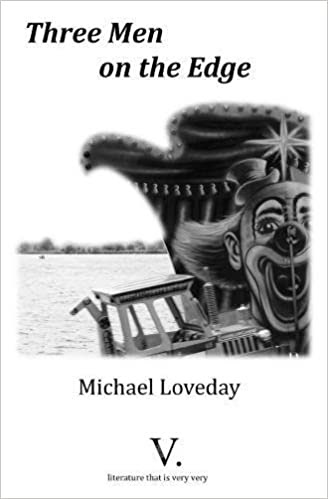
Review by Laura Besley of "Three Men on the Edge" by Michael Loveday


Three Men on the Edge by Michael Loveday is a novella-length book comprised of three short novellas-in-flash, the stories of three men: Denholm, Gus and Martyn – all struggling with life. 

The first story, ‘Cause for Alarm,’ explores the marriage of Denholm and his wife, Joan. Through the use of swans – birds which are renowned to mate for life – Loveday gives us some insights into the relationship. When Denholm’s friend shows him ‘an image of a swan pair, necks wound tight round each other,’ Denholm doesn’t see romance, but instead shrugs and says, ‘“Could be the blur … but it looks to me like they’re suffocating each other.”’ Later on he muses that ‘if he’d known, really known, how much marriage is one drowning person trying to push another under, he might not have risked it.’ 

In the second story – ‘The Invisible World’ – there are twelve micro fictions, one for each month in a year of Gus’ life following the loss of his wife whose absence he still feels acutely. He is stuck in a quagmire of grief he cannot, or does not want, to find a way to move on from. ‘There’s a veil between him and the world that will not lift, and to tear it down seems a betrayal. Why is it still not consolation – witnessing these swans, these shadows, this sky?’

The final and longest novella-in-flash is ‘Chewing Glass’ wherein Martyn navigates relationships with Anja and Rob. ‘[W]ith every relationship, the miniature sculptor works her hammer and chisel on the stone lump of your heart. If you’re really lucky, Martyn thinks, a man survives well enough to be left in the end with something recognisable.’

Throughout the book, Loveday supplements the starkness of these men’s lives with the stark beauty of nature. This adds, I feel, to the presence of a certain level of resignation, but also resilience. Because life is brutal, and all you can do is live it. 


About the reviewer
Laura Besley is the author of three collections of flash & micro fiction: (Un)Natural Elements, 100neHundred and The Almost Mothers. Having lived in the Netherlands, Germany and Hong Kong, she now lives in land-locked central England and misses the sea. 

Wednesday, 14 April 2021

Review by Kathy Hoyle of "Among These Animals" by Gaynor Jones


Among These Animals is a searing novella-in-flash, as brutal as it is beautiful. Jones handles this niche form with exquisite expertise, weaving each story seamlessly into the next with perfect fluidity. 

Set against the sweeping beauty of rural Wales, Jones’s compelling narrative is a visceral, powerful exploration of complex themes including sibling rivalry, parental love, familial loss, guilt and grief, all told through the eyes of Carys, the eldest daughter of farmers, Derfel and Aelwen.     

Carys is a daddy’s girl who thrives on the gentle guidance and acknowledgement of her reserved father, a man continuously surprised by the colossal weight of love he feels for his daughter. Cerys hero worships him, and he adores her. Her mother, Aelwen, often fades into the background. 

The familial relationships are established beautifully by Jones in the opening stories. In 'Heavy Is the Head That Wears the Crown,' Derfel tells Carys the story of how he met her mother but Carys struggles to see her mother’s worth: 'Carys tries to picture her mother as a princess from one of her books … She can’t. She can picture her father easily though, with a crown on his head and a staff in his arms. As she falls asleep, courtiers bow around him.'

We hear how the idyll is threatened, with the arrival of three younger brothers, 'Owain and the twins' in 'Pecking Order': 'Carys … has sworn a lot more in the years since her brothers arrived … When she was the only one, breakfast was all for her. Warm bubbled crumpets dripping with greasy butter … But that was before the stupid boys came along. Now, Carys has to sit last at the table … Carys has to be last in everything except cleaning and tidying.'

One day, a devastating event alters everything, tearing the family apart and shattering Carys and Derfel’s relationship forever. Jones delves into the themes of guilt and grief with poignancy and precision, taking the reader on a heart-breaking journey as the family try to come to terms with their loss.  

Throughout the novella, Jones showcases her inimitable style, either by pushing the boundaries of social acceptance, with stories such as the disturbing title story, 'Among These Animals,' or by showcasing her exceptional ability to leave the reader reeling with her emotional sledgehammers, often wielded in stories that are just a few paragraphs long.

Among These Animals is tremendous debut novella-in-flash, powerful and poignant. It will leave the reader stunned.


About the reviewer
Kathy Hoyle is an MA graduate from the University of Leicester. Her short stories and flash fiction have appeared in a variety of literary magazines such as Virtualzine, Silver Apples, Reflex Fiction and Lunate. She has been shortlisted for the Exeter Short Story Prize, the Fish Publishing Memoir Prize and the Ellipsiszine Flash Fiction Collection Prize. She recently received a Special Commendation in the Blinkpot Awards and won Third Prize in the HISSAC Flash fiction Competition. She is currently working on both a novella-in-flash and a short story collection, powered by tea and biscuits.

You can read more about Gaynor Jones's Among These Animals on Creative Writing at Leicester here.


Wednesday, 10 March 2021

Review by Rob Jones of "Light" by C. M. Taylor


I’m too young to be personally familiar with the heady, turn-of-the-millennium setting of Light, but it’s enjoyable enough to reminisce about things I can just remember – genuinely down-at-heel pubs, the Eurostar leaving from Waterloo – and trace the way things have changed and the recent origins of things which now seem assumed and enshrined.

The description of East and West London and the way they intersect in the art world is abstract but profoundly evocative, however rapidly East London is becoming unaffordable in our present. The sardonic criticism of the swish, fast-moving and unobtainable West and the way it “slums over” to the East in search of “authentic” art will resonate with and amuse anyone whose visits to the capital are fleeting, who engages with it as an interloper.

Humour is a strength of this novella, underpinning descriptions, interactions and events. Larger-than-life characters spill out of the glass towers into bistros, galleries, barns and fields, to be dismantled at a distance in the self-centred voice of the jaded narrator, Ben. Beyond humour, Taylor is a creative prose writer in the best sense, using a broad spectrum of detail, from sparse to decadent, to relate, reflect and characterise.

In the best traditions of the form, the story gains pace like a piano rolling down a hill. Disparate strands clunk into place in a finale which only once you have read it seems all too horrifyingly predictable.

I would argue that there are different ways to read Light. I certainly enjoyed it as a critical and meta-textual examination of art in different forms, including prose, an opinion which would doubtless earn me the derision of its narrator. It’s a funny old world.


About the reviewer
Rob Jones studied English with Creative Writing options at the University of Leicester and completed an MA in Victorian Studies there. He lives in Sileby with his wife, sings with Leicester University Chamber Choir and dreams of working in heritage.

Thursday, 10 September 2020

Review by Jon Wilkins of "Wretch" by Ansgar Allen


Wretch.
A novella.
A stream of consciousness.
Bleak.
Brutal.
Visceral.
A tale set perhaps in the past, a present or a foreboding future.
Dystopian.
We don’t know when or where.
A tale of a prisoner.
The Wretch.
Why is he there?
Physically and mentally rotting away in a prison where he copies
(“A diligent copyist”) 
words.
“Producing my own words, or more exactly reproducing and reordering words I have heard!"
A world where travellers explore the unknown city.
The unknown regions.
What are they looking for?
Who threatens them?
Returning mad.
Or not at all.
What breaks their sanity?
Writing reports.
Hiding reports.
Collecting reports.
Returning reports.
On paper that rots away.
The paper mill produces
paper that disintegrates.
Another metaphor.
For what?
Hope?
Despair?
There is no hope for the Wretch.
The Wretch copies.
His writing machine breaks.
Or he destroys it.
Replaced, he copies.
This is his life compared to the travellers
with their burdens.
Reminding them of what?
Just as the Wretch carries his burden.
His machine.
Punishment for what?
Reminder or crime?
And their struggles in a frightening outside.
Why do they lose their teeth?
A novella full of metaphor but so
black and white.
Full of repetition.
Emphasising the solitary 
repetitive world of
the Wretch.
His life is repetition.
Who put the Wretch away?
Why are they threatened?
As many questions as answers.
The answers are for you to find.
They are what makes this novella unique.
Wretch by Ansgar Allen:
an experimental novella of an experiment?
You decide.
It is an ugly world inside and outside of the known city.
Discover it.


About the reviewer
Jon Wilkins is sixty-four. He has a gorgeous wife Annie and two beautiful sons, and loves to write. He is a retired teacher, lapsed Waterstones’ bookseller and former Basketball Coach. He taught PE and English for twenty years and coached women’s basketball for over thirty years.  He has always loved books and reading. You can read a review of Jon's recent novel, Poppy Flowers at the Front, here

Monday, 8 June 2020

Review by Laura Besley of "In the Sweep of the Bay" by Cath Barton


          The gulls sitting on the freshly-painted blue railings flap into the morning sky as one,  
          before peeling off on their individual journeys across the bay, riding the thermals   
          here, swooping down on abandoned chip papers there … The gulls know their
          territory. They stay within the sweep of Morcambe Bay.

- Cath Barton, In the Sweep of the Bay


In the Sweep of the Bay, a novella by Cath Barton, starts in 2009 in the village of Morecambe, Lancashire, where a statue of Eric Morcambe, the British comedian, has been erected. A retired street sweeper takes on the role of part-time cleaner. He watches people, he talks to the tourists and is happy to take their photos. He says: “People are something else; they open your eyes to things you’ve not thought of. They really do.”

At the heart of the story is a married couple, Ted and Rene. Their story starts in the '50s, where they meet at a dance, court for two years and then marry: “His mother got hold of all sorts and put on a wonderful spread, such as they hadn’t seen for years.” The language Barton uses easily conjures up the feel of a bygone era. Ted works for the family ceramics firm, first as an apprentice, but later designing beautiful hand-painted vases. Rene works until she marries, then stops to take care of her husband, the house, and later their two daughters. 

In later chapters there are threads of the story told from different characters’ points of view: Dot and Peg (the daughters), Cecily (the granddaughter), Vincenzo and Henry (who live in Italy); Barton has woven the threads of these seemingly separate stories together so they intertwine and come full circle. 

Cath Barton’s quiet style is perfectly suited to this narrative about a marriage, delicately exploring "all the sadness, and all of the love."


About the reviewer
Laura Besley writes short fiction in the precious moments that her children are asleep. Her fiction has appeared online, as well as in print and in various anthologies. Her flash fiction collection, The Almost Mothers, was published in March 2020. She tweets @laurabesley

Friday, 1 May 2020

Review by Jon Wilkins of "Fragmentary Lives: Three Novellas" by Philip Tew


It is a truism that all children should be grateful to their parents; it is not often we hear the reverse of that. Philip Tew should be pleased that his son advised him to refresh his manuscripts and add a third short story to the collection that has been published as Fragmentary Lives.

Here are three novellas, three very different aspects of a life, three versions of how life can twist and turn, bring us down or build us up. These are three stories well worth reading in isolation or more importantly together.

For me the middle story, “Swimming the Goldfish Bowl” is the stand out. It is a visceral description of a man's downfall. Luke has no idea that he is the victim in a tale of sex, abuse and kidnapping. He has no reason to conclude he is being used by a woman with her own agenda, no idea that his world can be so easily be brought crashing down. This seems to me to be the ideal building block of a full length crime or mystery thriller - a start to what could be an outstanding plot with so many outcomes possible. The denouement is both shocking and questioning, surely the perfect short story that has the reader pleading to know more.

The final novella "After the Revolution (Failed to Materialize)" is a visceral tale of a life lived, mistakes made and wrong turns taken. It is a withering account of the years of Thatcher and how the Hard Left failed in its attempt to gain power. Disillusionment is rife in this piece as we see how relationships can break down so easily despite the well-meaning of the participants. It is all so real, the accounts of partnerships foundering for so many reasons and of mistakes made in choices taken. This is a real-life account of how things don’t always work our for the best, yet an account that gives us a little hope as the writer comes full circle in his search for contentment. The beauty of “After the Revolution” is that we can meet protagonist Jim Dent again in Tew’s outstanding first novel Afterlives (reviewed here).

The first novella “Another Long Weekend” skirts around romance and infatuation as we see how relationships grow and fail. Friendship is at the centre of the story and how the writer takes advantages of friendships at all levels whilst being taken advantage of himself. It is the story of a life that we can all recognise and want to know more about. 

Life is fragmentary and these pieces can join together or be shaken apart. The novellas throw all the pieces up into the air and we wait as we turn each page to find where they have landed and what effect they will have on the protagonists. This is the final conceit of the three novellas. We are left engaged and don’t want the stories to end. We are being invited into Tew’s world and we want more as a result of this invitation.


About the reviewer
Jon Wilkins is sixty-three. He has a gorgeous wife Annie and two beautiful sons, and loves to write. He is a retired teacher, lapsed Waterstones’ bookseller and former Basketball Coach. He taught PE and English for twenty years and coached women’s basketball for over thirty years.  He has always loved books and reading.

Friday, 12 April 2019

Review by Louise Brown of "Between the Lines" by Matthew Bright and Christopher Black


Between The Lines is an unusual and charming love story between a lonely Victorian gentleman and a sad young girl living two centuries later. Dashby is uninterested in the female suitors in his life, while Beth has become jaded by the modern world of dating and casual relationships. She types a bleak text after soulless sex with her ex, although she doesn’t intend to send it, and when she wakes the next day she discovers it has been sent to an unknown recipient. It then mysteriously arrives in the form of a letter to Dashby. He replies to her by letter and she receives it as an email. The ensuing texts, emails and letters become a sort of time travel with both characters traversing the ages and communicating with the other.

The stories intertwine cleverly, and they start to sit side by side on the same page as each narrator tells their story in step with the other. In the 21st century Beth has some terrible sex, and in Dashby’s tale he is being pursued by a keen female admirer who, after he spills hot tea on himself, then insists on trying to dry the stain by rubbing him with a cloth.

The authors repeat this mirroring technique in each story until they merge and coalesce into one  whole. This method of story-telling makes you think about how the real stuff of human existence, matters of the heart that is, never change over the centuries, and speak to the human condition of wanting to find a soul-mate and someone to love. I became immediately invested in both characters and was willing them to overcome the boundaries of time so that each character could have their fairy-tale ending. The writing is beautiful and the form skilful and innovative, and I recommend this original and inventive publication to any reader.  


About the reviewer
Louise Brown is studying for her MA at the University of Leicester. She started writing in the summer of 2018, believing that it is never too late to start something new, and will have her poem 'The Deep Blue' published in Acumen in May 2019. She is writing poetry, short stories and is also working on the first draft of her novel. She lives on a farm in Rutland, and is kept busy working as an employment solicitor, while also writing, reading and looking after her three children. 

Friday, 7 December 2018

Review by Heidi J. Hewett of "The Plankton Collector" by Cath Barton


I had been meaning to read this novella, which won the New Welsh Writing Award in 2017, and I kept putting it off because it’s about grief - it would be late, just before bed, and that sounded depressing. But it turns out the book is anything but. From the very first sentence, it’s like being able to crawl into the lap of your grandmother or grandfather in a rocking chair. There’s a flow to the language which is like breathing in and out, or rocking gently in a boat, and then the characters are drawn with such subtly, honesty, and compassion. Even though the central event of the book is coming to terms with death, it was the David and Rose—the quiet disintegration and equally quiet rebuilding of a marriage—that had me riveted. This is a short, utterly original, very human, marvellous book.


About the reviewer
Heidi J. Hewett writes science fiction, mysteries, and romantic comedies. When she is not reading or writing, she plays the violin, inspired by Sherlock Holmes. She also enjoys tinkering with recipes and inflicting strange food combinations on her hapless family. She is a member of RWA.