
Showing posts with label politics. Show all posts

Friday, 19 June 2026

Review by Charlie Black of "Homage to Catalonia" by George Orwell


Orwell delivers a gripping and insightful read in this human, politically sharp and dare I say hopeful account of his time serving the anti-fascists in the Spanish Civil War. Orwell joins a militia soon after arriving in revolutionary Barcelona. What he thinks is a trivial choice soon has ramifications as the ideologies of each faction begin to cause friction, whether for power or moral integrity.

Orwell conveys this web of ideologies well. He names the militias but gives little explanation to their allegiances at first, evoking his own confusion, since he did not even know the philosophy of his own militia until long after he joined. Further confusion is created as he travels back and forth to the many places he is posted. Orwell seems to have the lay of the land but as somebody unfamiliar with Spain’s geography I was often left disorientated. Orwell never loses sight of the human tragedy at the heart of war. In his essay "Looking back on the Spanish war," which served as an epilogue in my copy, he ends with a verse in dedication to a soldier he met in Barcelona.

Regardless of this, Orwell still offers superb analysis of the clashes between these ideologically driven militias. It is clear where his sympathies lie but he provides fair criticism to all. Orwell is, as usual, superbly articulate, often humorous, and astonishingly relevant. It is the sections of socio-political analysis, using the context of Spain to make broader statements about fascism, socialism, and class, that kept me reading. Orwell reminds us that fascism is unsustainable; it is the working class it needs but the working class it will always betray.

What caught me by surprise was how being in the mind of someone living through the lead up to the Second World War connected with me. We live in a turbulent time, and to hear from someone living through a similarly uncertain period was oddly comforting. We are not alone in our disdain for the world. It reminds us that although many then were in the "deep, deep sleep of England," as many are now, there were those like Orwell who saw what was happening inside and outside of the country and stood against it.

I would recommend anybody who is feeling anxious about the state of the world to read Homage to Catalonia, if only for the reassurance that failure does not mean the end.


About the reviewer
Charlie Black is a mature student working towards a BA in English with Creative Writing at the University of Leicester. He really enjoys fantasy and science fiction but will read just about anything.

This review won second prize in our 2026 Book Review Competition, held in conjunction with the Centre for New Writing at the University of Leicester. 

Wednesday, 16 March 2022

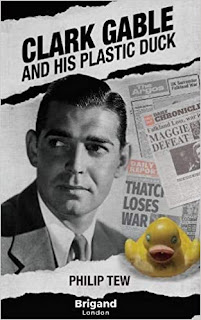
Review by Jon Wilkins of "Clark Gable and His Plastic Duck" by Philip Tew


It’s what we all need to know, Clark Gable. Plastic duck. What on earth? So in the true story-telling tradition of show not tell, I will show. Clark Gable. Plastic Duck.

It is your task to discover their relevance. Task? That makes it sound an onerous assignment. Reading this novel is far from that. It is an undiluted pleasure. It is one of those rare reads, one that you can honestly not put down. The end of each chapter tempts you into reading the next and so on until you have forgotten what day it is and where you are.

I get added pleasure from Philip Tew's books as we taught together in Leicester, way back in 1979. I hadn’t seen him since, until we met at an Everybody’s Reading event in 2018, at De Montfort University. Pre-Covid. Weren’t they the times!

Tew writes of a time I can remember, and so many of his allusions ring true to me, as I am sure they will ring true to any Leicester resident from those Thatcherite days of the 1970s through to the 1990s.

His novel takes us into an alternate world where Thatcher lost the Falklands and Alan Clark became Prime Minister. For those who remember his philandering ways, is that a stretch too far or a parallel to a shaggy-haired oaf that we all currently endure? Thatcher is rehabilitated as Secretary of State for Northern Ireland and the greatest irony is when the pariah Enoch Powell becomes Home Secretary.

Where would we be today if things had turned out like that? Is that what we deserve? Considering what we have now, would it be such a bad thing? You decide as Britain descends into a world of darkness, further hypocrisy, and our hero Bill Pugh doesn’t know who to trust and who to turn to. His world as broken as the society he finds himself in.

As Phil Tew writes: “Rebellion follows. And a new privatized security service full of thugs and villains. For me, Clark’s political broadcast ties my narrative together. Suddenly, the rebellion and riots all make full sense, especially after the Falklands (Malvinas) defeat. The narrative started to reflect very different priorities.”

This novel shows without telling. Readers will not need to be told; they will see the nuances of the narrative as a challenge and an invitation into Tew’s dark world. Fantasy or Dystopia? Alternate reality or too close to truth? Who is the hero: Clark Gable or the Duck or is it Bill Pugh?

You will decide because I won’t be telling you.


About the reviewer
Jonathan Wilkins is a Creative Writing PhD Student at Aberystwyth University, Wales, reading mostly Golden Age Crime fiction. His website is here

Saturday, 20 November 2021

Review by Richard Byrt of "Bollocks to Brexit: An Anthology of Poems and Short Fiction," ed. Ambrose Musiyiwa


I strongly recommend this entertaining collection. Authors consider Brexit from a wide variety of viewpoints, frequently with passion, and sometimes movingly. 

Virtually all the contributions are anti-Brexit. The title reflects many people’s views but might be seen as disrespectful to Brexit voters, including those living in very deprived areas. However, Joel Baccas observes that the term “bollocks” is not always disrespectful. 

Topics of poems include Jo Cox (Mark Connors, Paul Francis), the campaign “Brexit bus” (Anthony L. Church, Tracy Davidson, Lizza Lane) and young people’s futures (Carole Coates, Josh Granville, Kelly Knight, Wayne McDonald, Jacob Spivey). Pessimism is expressed (Nicollen Meek) in relation to shops (Colin Gardiner), splits in the UK (Selina Lock) and the island of Ireland (Richard Kilian Neville). “Brexit” is described as a “synonym for … boring” (Chloe Jacquet). 

Unusual “starting points” to poems include “pictures of derelict factories” (Stephen Wylie); scenes of Harwich (Harry Gallagher), Whitby Abbey (Deborah Harvey) and a “Servants’ Ball” (Nathan Evans). Effective contrasts are made between Brexit and memories of Europe (antonia langford, Isabella Mead, Pappageno). Several poems contain vivid concrete details and original metaphors, with Brexit compared, for example, to birds (Yvonne Reddick), and the breakup of close relationships (Ayodele, Ellie Curtis, Steve Pottinger). Brexit is also considered in relation to Pandora’s box (Nathan Evans), an Italian cafĂ© (Pam Thompson), chess (Trinity-Grace Robinson), “red boots” (Mariya Pervez), and voyages to the moon (Mantz Yorke), and by ship (Carole Coates, Elizabeth Uter). There are four refreshingly different treatments of the topic, “March” (Anne Howkins, Melissa Oram, Bethany Rivers, Mark Rutter). 

Effective short prose pieces include a conversation about the consequences of Brexit (Danielle Allen), an account of a small girl who joins in the shout, “Bollocks to Brexit” (Anne Howkins), and a presentation on “The Sundering of the Kingdom” (Selina Lock). 

There is a wide range of free verse and fixed forms, the latter including “No country for young men” (Wayne McDonald), a version of Psalm 23 (Trevor Wright), and four sonnets (Gareth Calway, Isabella Mead, Glen Wilson, Michael Woods). There is also a terza rima (Sarra Culleno), a pantoum (Tracy Davidson), and a modified rondeau (Charis Cooper). 

Songs include a ballad (Gareth Calway), a “Hokey Cokey” poem (David R. Mellor), and a stirring “Song for Europe” (Joe Williams). There is a reverse poem (Rachel Hardisty Vincent), skilful use of couplets (Pam Thompson), and an exhortation (Michele Witthaus). Serious messages are conveyed in witty poems, “Deal or No Deal” (Garry Maguire) and “How to Skin a Cat” (Joe Williams).

Congratulations to the authors and editor on a thought-provoking, enjoyable read. 


About the reviewer
Much of Richard Byrt’s work is concerned with the experiences of those of us who face “othering” and discrimination. This is reflected in some of his published poetry, facilitation of creative writing and work for an LGBT+ history project. 

You can read another review of Bollocks to Brexit on Everybody's Reviewing here