Showing posts with label flash fiction. Show all posts

Friday, 18 July 2025

Review by Nina Walker of "sum of her PARTS" by Laura Besley


In sum of her PARTS, Laura Besley provides us with a beautiful series of briefly illuminated windows - vignettes that offer glimpses into the moments of intimacy that make up a life. Besley writes tiny, furious fiction concerning an increasingly fractured world. Each story acts as part mirror, part shard, as cutting as it is revealing. This sentiment is perhaps embodied best by "shattered," in which a self-hatred over physical appearance culminates in a speaker smashing a mirror and stating, "with the shards of glass / I give myself a new face." 

Besley gives a new face, not just to the nameless speaker of "shattered," but also to the presumed limitation of flash fiction. Her creative approach to the visual presentation of flash fiction gives the collection a strong visual identity, a new face. Utilising poetic lineation techniques, Besley’s work shatters and reforms our presumptions about the form.

The collection is carefully threaded together by a series of intimacies, perhaps most centrally the intimacy one must have with oneself. In the refined and precise prose that is present across all four of her published works, Besley presents the reader with moments of physicality that ripple out beyond the pieces' short word counts. Often, the body of the speaker is positioned as an object of discussion, like a museum exhibit - an object transformed by a thread of absurdism that contrasts with the collection's physicality. In one story, the speaker is transformed into a trumpet, in another, a character grows an extra arm to hide their face. Bodies in Besley’s work are central yet malleable. They are expressed through a series of familiar quirks and fault lines, "thick middles," "haggard faces," and "bruises" that can become beautiful or bizarre at a moment’s notice. When reading Besley’s work, one is left discovering, through her typical sharp and wise immediacy, a new strangeness within oneself. 

In one of my favourite stories from the collection, "fractured," Besley writes:

          the doctor says "We’re going to need to take a
             consent form." I sign. "If you could just remove your
                bruises, multiple, along the collar bone and across the patient’s back
                   home, he might be awake, be wondering why I’m not
                      there is a bed ready for you now." I don’t

Here, the body, while still central, is cut in two by the story's perspectives. The lineation is cleverly used to construct the patchwork of the patient as observer and subject. "Patient’s back" flows cleanly into "back home," as if the thoughts of the patient effectively interrupt the clinical observation. Time is clipped and stitched as the request to "remove your bruises" merges observable reality and individual desire for escape. A clashing moment of exterior reality and interior doubt culminates in the piece's final unfinished fragment, "I don’t." The final line, when read within the context of a domestic abuse victim refusing the (albeit limited) protection of the hospital, is haunting. The lack of a concluding full stop implicates all the possible moments this patient may inhabit after this one, leaving the ending of the piece jagged and frayed.

In just thirty-four pages, Besley draws us into a network of bodies, thoughts, and conversations, always, as flash necessitates, with scant context. Yet the brief nature of each piece illuminates just how interconnected we all are, each jagged edge implicating a matching edge that may yet lie beside it. The sum of the collection's parts is a moving and sharply observed portrayal of the complexities of embodied life, where one must place gentle intimacies right alongside painful metamorphosis and absurd possibilities. 


About the reviewer
Nina Walker is a first year PhD student at the University of Leicester studying the impact of digital technology on the contemporary American novel. She also co-runs the Leicester based creative writing group Amateur Hour. She enjoys writing poetry, reading speculative fiction, and pub quizzes. 


Wednesday, 16 October 2024

Review by John Goodby of "Friends of Friends" by Geoff Sawers


Friends of Friends is a series of connected, overlapping, parallel and divergent tales. These are narrative fragments - though without the bittiness that might imply. They range from single sentence flash-fictions to three or four page short stories. Each has its own coherence and narrative logic. Occasionally, two or three are related to each other in sequence. Usually, the linkages are more fugitive. A number of named characters re-appear – 'Sandra' and 'Nush' are in two tales, 'Nicky' in three, 'Mabel' in four, and so on. Recurring themes range from trivial to sublime: rain, buses (or forms of public transport), libraries, apocalyptic or post-apocalyptic landscapes. Scenarios repeat themselves, too; perhaps the most persistent is that of people who were separated in early adulthood, meeting up in middle-age, and trying to deal with the odd mixture of knowing and not-knowing, intimacy and distance, which colours and shapes such encounters ('The clutch bag' is one example). Ours is the age of Friends Reunited, Facebook, social media. This is now a common experience; we have become used to it, but it is relatively new and unprecedented, and no writer, as far as I know, has responded to it as variously or as imaginatively as Sawers. 

Friends of Friends is not set in the present; it is not 'set,' in any fixed sense, anywhere. In historical terms it jumps about, particularly at the outset, with tales in eighteenth- or nineteenth-century settings ('The Ticket' is explicitly set 'in 1859'), recounted in vaguely appropriate pastiche styles, as in 'Constance,' 'Green Eyes,' or 'Home from China'; socially, we could be dealing with countesses or beggars; territorially we might be in MittelEuropa, Spain, the USA, although it is predominantly England. The pastiche is a little contrived, deliberately it seems to me, because Sawers is concerned at all times to prevent us skimming, slipping into the complacency induced by naturalistic styles. In generic terms Friends of Friends is more wide-ranging; the first tale, 'The tree half in flames,' takes its title from the episode of a half-burning, half-verdant bush in The Mabinogion, there are Märchen elements in 'City Air,' and Irish legend in 'Yoss and Finn,' a brief, wittily-told encounter with the Salmon of Wisdom, while 'The Translators' reads like a parable by Zbigniew Herbert. 

Like the styles, the generic mix is often unstable; the nineteenth-century mode of 'City Air,' for example, has a counterfactual history in the form of an invasion of Britain by Russia and France, and 'The Ticket,' in a quasi-SciFi aside, tells of colliding galaxies. 

As all this may suggest, the liberties taken with fiction verge on poetry. Prose poetry in English, as many critics have observed, can tend towards pawky charm and rather voulu symbolism. Sawers's semi-disjunctive framework and disconnective practices mitigate against these dangers. The tales are often dreamlike, and hardly ever explicit - dénouments are partial or ambiguous, but always precise. The temptation is to use adjectives like 'Borghesian' or 'magic realist' at this point. But for one thing, so many stories are rooted in specific British realities: a student union building, a number 17 bus, Oxford Road. For another, the pieces often break into 'real' poetry; there are moments of genuine metaphorical power and originality, as in the close of 'In Blue': 'An electric river runs through her and it circles us now like a halo around the moon on a frosty night, and an odd delight begins to burn in my fingertips. I am caves of ice, I am the sun cracking ice in mid-afternoon, I am the jostling, lacerating glassy plates pressing up against the lock gates. Rivers never reach the sea. You haven’t heard me before.' 

Even the titles of the tales can be poems in themselves: 'After you die, you will never have loved me.' Sawers is a poet, too, in his ability to quickly conjure up mood and atmosphere, but lest this seem an over-Romantic definition, he is alert to the weight of words in a contemporary, experimental way. It's no coincidence that the opening sentence has mayflies 'sawing in the air,’ in a play on his own name, or that we find Sandra waking up to find herself 'a pear. Maybe a bear. She felt comfy in her new pelt ... she didn't miss having a waistline.' The humour of the waistline line is evident throughout; Sawers is a gifted comic writer when he wants to be. It is a sign that Sawers is a genuine writer, not a re-treader of old ground. This doesn't apply simply to mainstream fiction, but to modernism; a woman who wakes up and finds herself a pear is clearly a descendant of Gregor Samsa, but her metamorphosis does not lead to the angst and anguish in Kafka.

Angst and anguish there is, however, as in any genuine art, but it's of what we used to call the postmodern variety. This is a term that was overused for a long time. But it's wholly applicable to Friends of Friends, which ticks all the boxes; along with stylistic pastiche, generic hybridity, ontological uncertainty and linguistic self-consciousness, we get explicit finger-pointing, as when a 'panning camera comes to rest' on a discussion at a nineteenth-century dinner-table. The criticism of such writing was often that it was heartlessly playful. But that isn't the case here. Despite its fragmentariness, Friends of Friends has real heft: the whole is more than the sum of its brilliant parts. Large issues are raised, subtly yet powerfully, occasionally outcropping as questions - 'How can we resist the marketisation of ourselves?' – but usually by implication. At its heart is that old universal, namely a keen awareness of the brevity of life, and hence the urgency to connect, create,  be aware of others and other life-forms. Mayflies, traditional emblems of the brevity of life, 'swarm in the morning' in the opening story and return to 'swarm in the evening' in the penultimate story. The very final tale, a coda (we have passed through the wood to a mythic sea-shore), is another reverberating miniature which punches many times above its weight, an enigma I won't ruin, except to say it finds the words that 'don't mean anything' but are nevertheless, 'a path, a boardwalk,' for its readers.


About the reviewer
John Goodby is a poet and critic, and Professor of Art and Culture at Sheffield Hallam University. His new biography of Dylan Thomas, co-authored with Chris Wigginton, has just been published by Reaktion Books. 


Sunday, 21 January 2024

Review by Laura Besley of "Chasing the Dragon" by Kathy Hoyle


Kathy Hoyle’s debut novella-in-flash, Chasing the Dragon, is an ambitious and compelling example of the form. The novella-in-flash is an emergent new genre operating largely outside mainstream publishing. It combines the concision of flash fiction standalone stories with the space in which to develop a novella-length narrative. In order to make the stories self-contained and unique, Hoyle has made good use of flash fiction techniques, such as stories written in the form of lists, letters and reports. This creates the variety and change of pace for the reader often found in novellas-in-flash while simultaneously ensuring each story adds to the overall arc.    

Despite its brevity – Hoyle’s novella-in-flash is sixty-five pages in total – Chasing the Dragon spans across generations, continents and cultures. It is told through multiple points of view and the main thread of the story is of Americans in wartime Vietnam, the difficulties they experience there and subsequently back home after their return to the United States. There is a single story written from the point of view of Bihn, a young Vietnamese boy. To create a deeper and richer understanding of these characters and their worlds, there are also stories set in an earlier time where we learn of the characters’ childhoods and childhood traumas.   

Hoyle is extremely adept at voice. The first story, which relays a Vietnamese proverb, opens with the sentence, ‘In Vietnamese legend, Lac Long Quan, the most noble king of all dragon-kind, lived near the water of the Dong Sea,’ and continues to be told in long lyrical sentences. The following story, from the perspective of Thomas Jefferson Scott or ‘[j]ust plain old JT,’ consists of much shorter sentences and a strong dialect: ‘Jacob don’t talk of it none. He don’t like guns none either. He says he’s a pacifist. That he don’t like hurtin no one nor nothin.’ The report and letter stories are both written in a more formal register befitting their forms and the list makes excellent use of repetition; each line starts with ‘He will’ or You will’ and a singular, heartbreaking, ‘They will.’ 

Through its seventeen stories – bookended with the Vietnamese proverb: Children of Dragons, Grandchildren of GodsChasing the Dragon sheds light on a largely overlooked consequence of war, as summed up by Willy telling his mama in the eponymous story: ‘Ain’t nobody won nothing.’ Kathy Hoyle’s novella-in-flash evokes a kaleidoscope of emotions, ranging from horror and outrage to compassion and awe. Each individual story is a fantastic rendering of flash fiction, but it is in its entirety that Chasing the Dragon really demonstrates Hoyle's range and ability for both the form as well as the depiction of characters and the worlds they inhabit. This is a truly stunning debut.  


About the reviewer
Laura Besley is the author of 100neHundred and The Almost Mothers. Having lived in the Netherlands, Germany and Hong Kong, she now lives in land-locked central England and misses the sea.

You can read more about Chasing the Dragon by Kathy Hoyle on Creative Writing at Leicester here.

Friday, 31 March 2023

Review by Laura Besley of "Postcard Stories" by Jan Carson


Collections of micro fiction are rare. Collections of micro fiction by novelists are rarer still. I recently read The Fire Starters by Jan Carson, and loved its surreal lyrical qualities through which the devastating reality of living in Northern Ireland was explored. A month or so later I was browsing the online catalogue of The Emma Press and saw Postcard Stories (2017), illustrated by Benjamin Phillips. The title is in reference to how the book came about: ‘Every day in 2015, Jan Carson wrote a story on the back of a postcard and mailed it to a friend.’ The book contains 52 stories, one for each week, in which ‘Carson presents a panoramic view of contemporary Belfast.’

In her book, Going Short, Nancy Stohlman writes: 'One of my favorite approaches to writing a flash fiction story is what I call the zoom lens – taking an ultra close-up shot of what’s potentially a much bigger story. It’s like narrowing the focus from a wide-angle landscape to a single flower. In flash fiction, the single flower can be the whole world.' This zoom-lens approach is often used by Carson in her stories. One example is in August’s opening story in which the main character leaves her father in Ikea because ‘he was too old to go on.’ The actual story takes place in a slither of time, but it also encompasses the difficulties which arise from having to watch the struggles of an ageing parent: ‘I could see he was glad of the rest, glad to have the expectation lifted from him.’ 

Carson’s stories don’t have titles. Instead readers are given the week in which they were written, where and to whom. The last story, written in St George’s Market, Belfast, opens with ‘every year during the month leading up to Christmas, Eleanor takes a stall at St George’s Market and sells disappointment in small, hand-made bottles.’ There is a myriad of different disappointments and ‘it is mostly locals who buy from her. The tourists tend to skip straight from the felt handbag stall on her left to the organic candles on her right.’ Tania Hershman writes that ‘the reader more willingly accepts oddities and suspends disbelief in the ‘truth’ of such worlds than with a longer piece’ (Short Circuit). Carson takes full advantage of this in many of her stories; for example, a child is born with a bird’s egg in his/her hand or in the backseat of a car is a horse and a tunnel. 

Over and over Jan Carson asserts her authority as a competent and compelling short fiction writer. Along with her astute insight, Postcard Stories is a wonderful collection of poignant and touching narratives.  


About the reviewer
Laura Besley is the author of three collections of flash & micro fiction: (Un)Natural Elements, 100neHundred and The Almost Mothers. She is also an editor for Flash Fiction Magazine. She tweets @laurabesley.


Tuesday, 29 November 2022

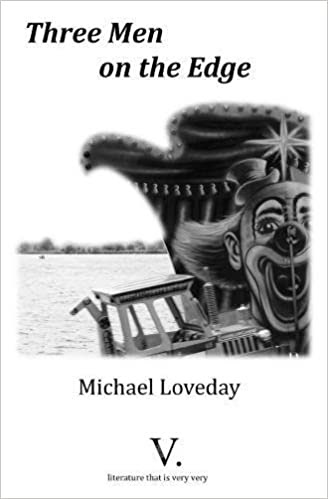
Review by Laura Besley of "Three Men on the Edge" by Michael Loveday


Three Men on the Edge by Michael Loveday is a novella-length book comprised of three short novellas-in-flash, the stories of three men: Denholm, Gus and Martyn – all struggling with life. 

The first story, ‘Cause for Alarm,’ explores the marriage of Denholm and his wife, Joan. Through the use of swans – birds which are renowned to mate for life – Loveday gives us some insights into the relationship. When Denholm’s friend shows him ‘an image of a swan pair, necks wound tight round each other,’ Denholm doesn’t see romance, but instead shrugs and says, ‘“Could be the blur … but it looks to me like they’re suffocating each other.”’ Later on he muses that ‘if he’d known, really known, how much marriage is one drowning person trying to push another under, he might not have risked it.’ 

In the second story – ‘The Invisible World’ – there are twelve micro fictions, one for each month in a year of Gus’ life following the loss of his wife whose absence he still feels acutely. He is stuck in a quagmire of grief he cannot, or does not want, to find a way to move on from. ‘There’s a veil between him and the world that will not lift, and to tear it down seems a betrayal. Why is it still not consolation – witnessing these swans, these shadows, this sky?’

The final and longest novella-in-flash is ‘Chewing Glass’ wherein Martyn navigates relationships with Anja and Rob. ‘[W]ith every relationship, the miniature sculptor works her hammer and chisel on the stone lump of your heart. If you’re really lucky, Martyn thinks, a man survives well enough to be left in the end with something recognisable.’

Throughout the book, Loveday supplements the starkness of these men’s lives with the stark beauty of nature. This adds, I feel, to the presence of a certain level of resignation, but also resilience. Because life is brutal, and all you can do is live it. 


About the reviewer
Laura Besley is the author of three collections of flash & micro fiction: (Un)Natural Elements, 100neHundred and The Almost Mothers. Having lived in the Netherlands, Germany and Hong Kong, she now lives in land-locked central England and misses the sea. 

Thursday, 10 November 2022

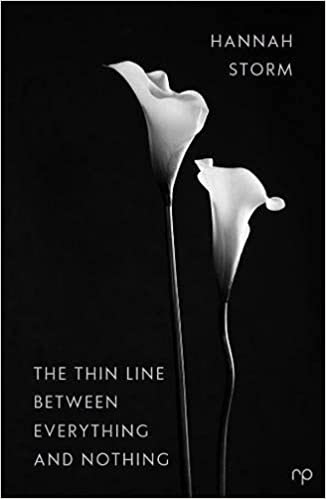
Review by Laura Besley of "The Thin Line Between Everything and Nothing" by Hannah Storm


As Russia continues to invade neighbouring Ukraine, it feels particularly poignant to be reading – or in my case rereading – Hannah Storm’s flash collection, The Thin Line Between Everything and Nothing (Reflex Press, 2021). One of its main themes is the effects of war – on individuals and what they lose as a consequence, or on a rare occasion gain, although hardly ever through choice. Further themes explored are the power struggles between men and women, and violence against women in particular, as well as the kaleidoscope of experience and emotion surrounding motherhood. 

The opening story, ‘Sarajevo Rose,’ is directly about war and the displacement Damir suffers where his name no longer means peace, but ‘scorn’ and ‘stranger’ and ‘the soiled sheets of a bedsit he [can] scarcely afford.’ Even stories not directly about war are peppered with war-like phrases, such as in the title story: ‘[h]e weapons his words’ and ‘the sound of its freedom pops like gunfire.’ Or in the case of ‘The Huntsman,’ a story about a teenager’s first French kiss, there is a distinct feeling of battle, or enemies fighting, as a ‘terrified’ Sarah locks herself in the toilet and ‘pray[s] the lock will hold.’

‘When I go to war, they loan me a flak jacket, a big blue thing designed for men’: ‘Bulletproof’ is one of several stories about women reporting on warzones, being forced to survive, and forced upon, in a world dominated by – often dominating – men, mined presumably from the author’s own journalistic experiences. 

Combining the themes of war, displacement and motherhood is the story ‘Behind the Mountains, More Mountains’ in which the main character ‘[gives] birth to a daughter, the child of men, the child of a history and country she would never really know.’

The Thin Line Between Everything and Nothing is a deep and heartfelt collection, which never shies away from the painful experiences of war, its effects, and those affected by it. 


About the reviewer
Laura Besley is the author of three collections of flash & micro fiction: (Un)Natural Elements, 100neHundred and The Almost Mothers. Having lived in the Netherlands, Germany and Hong Kong, she now lives in land-locked central England and misses the sea. 

Monday, 3 May 2021

Review by Elizabeth Chell of "100neHundred" by Laura Besley


Turning the pages of Laura Besley’s 100neHundred flash fiction stories is as delightful as being inside a huge box of chocolates. Here, bite-size stories meet with you for any and  every occasion; they will delight every literary palate. You enter stories wrapped with intrigue, or revenge, others seductive, haunting, dark, and bitter. They seem like snippets of someone’s private life, as if you have overheard someone’s thoughts as they pass you by - thoughts that you shouldn’t be eavesdropping on, but glad that you did. 

As you absorb these expertly crafted morsels you will be given an emotional workout: you will be touched by the sadness of some, captivated by the confessional nature of others, or made to shudder at true wickedness. There are stories which will leave your heart  warmed by love's first splendour and others that  will give you sheer joy with a wash of nostalgia - all of them knitted together perfectly in a hundred words. There are so many original wonderful lines, such as: 'She can’t leave because he’d find her ...' 'Leftovers of his life ...' 'Accordion wrinkles around her eyes …' 'A storm in an hour glass ...' and so on.

Each of her stories have one thing in common: you will want to read them several times as they are layered with meaning not often apparent with the first bite. Besley is such a good wordsmith not one word is out of place or wasted and what is not said is just as important as what is. These stories are like little magic spells, far from the ordinary.


About the reviewer
Elizabeth Chell is a full-time teacher, and is currently studying for an MA in Creative Writing at Leicester University.

Monday, 5 October 2020

Review by Laura Besley of "Seventy Percent Water" by Jeanette Sheppard


In the title story of her debut flash fiction collection, Seventy Percent Water, Jeanette Sheppard describes how a woman’s body transforms from the usual seventy percent water to a hundred percent after a relationship ends. ‘In the sea she reformed and swam away from the storm.’ 

Sheppard has a natural flair for the obscure. In 'Trumpets,' a woman who wanted her arms to be more ‘finely tuned’ ends up with trumpets for arms. On the surface this is a piece dealing with the practical repercussions of having arms that no longer bend and are made of cold metal, but in reality it’s about the deterioration of her relationship. ‘This morning, as he left for work, I saw him glance at my brass arms and swallow a sigh.’ 

Although there is a wide variety of stories, it is in her stories about old age and all the frustrations and fears that come with that – for both the older person, and those caring for them – that Sheppard truly shines. 

In 'Mirror in the Bird Bath,' the main character puts her mirror in the bird bath because ‘the new one at physio said you had to adapt to your circumstances’ and ‘she had dementia, she knew that, but it didn’t make her a fool’; rage ignites in 'Kindling' at the main character’s brother who takes no responsibility for the care of their mother; in 'Domestic Fairy Tale,' the main character’s ‘mother lays in her hospital bed, reading over and over the two sheets of A4 … attached to the cupboard doors explaining where she is,’ as her care plan is discussed, just out of earshot; 'The Last Time I visited My Mum' hits hard when the mother produces a photo, saying ‘Look, it’s my daughter!’ 

Seventy Percent Water is an accomplished debut flash fiction collection with rich imagery and beautiful language. 


About the reviewer

Laura Besley is a full-time mum to two young boys and squeezes her writing time into the bookends of her day. She has recently been listed by TSS Publishing as one of the top 50 British and Irish Flash Fiction writers with her story ‘On Repeat’ (Reflex Fiction). Her flash fiction collection, The Almost Mothers, was published in March 2020 and her collection of micro fiction, 100neHundred, will be published in May 2021. She tweets @laurabesley


Friday, 11 September 2020

Review by Laura Besley of "This Alone Could Save Us" by Santino Prinzi


          What would be lost if the moon were to disappear, how ordinary the sky might be
          without it.
- Santino Prinzi

The moon features heavily in Santino Prinzi’s flash fiction collection, This Alone Could Save Us. Sometimes a recurring character, always a metaphor for each of the powerful stories in this collection, the moon is steady, looming large above us, but also pulling away at a pace that is imperceptible to the naked eye. It’s in these gentle shifts that Prinzi’s stories shine.   

The first and last stories of the collection act as bookends, almost mirroring each other. At the beginning of the collection, people are desperate: ‘When we realise the moon is shifting away, we beg it not to go. We vow we can change. ’ By the end, this desperation is intensified, but has turned against the moon: ‘Following the will of the people, the government decide to nuke the moon .… Some people believe the moon is the source of all their worldly problems and it’d be for the best if the moon was gone.’ Prinzi’s layered messages in 'The Moon is a Foreign Body, We Can No Longer Trust It' shine as bright as a full moon on a clear night. 

This is a fabulous collection, exploring a range of emotions and situations. There is hope for Louise and her fourth husband, Edwin, who find their way back to each other in 'It Sometimes Snows in April' and the boy who is finally freed from his mother’s snapping in 'How to Make the Magic Work'; sadness for Clyde in 'Bonsai and Clyde,' and something in between for the characters in the title story. Highly recommend. 


About the reviewer
Laura Besley writes short fiction in the precious moments that her children are asleep. Her fiction has appeared online, as well as in print and in various anthologies. Her flash fiction collection, The Almost Mothers, was published in March 2020. You can read a review of it here. She tweets @laurabesley.

Monday, 30 March 2020

Review by Kathy Hoyle of "The Almost Mothers" by Laura Besley


This stunning flash fiction debut takes us on a compelling journey, with Laura Besley skilfully weaving together a variety of narratives as far removed from the familiar womb-warmth of traditional tales of motherhood that one could possibly imagine.   

This is an exploration of motherhood, in all its complexities. Besley refuses to hold back, plunging the reader into the realisation that motherhood is often stark and terrifying, with her opening story, "Mothers Anonymous." We hear from Melissa: "'I’m Melissa,’ she says in a raspy voice like she smokes a pack a day… And I hate being a mother.'" And from there, Besley drags us through each tale by the heartstrings.  

In "Everything’s Fine," we see how being a new mum means discarding one’s own self, to emerge unrecognisable, even in your own mirror: "I see a face and step back, knocking over a bin when I realize it’s me. The new me. The she who doesn’t wear make-up, have time to wash or sometimes even brush her hair." 

Then, we have moments of wry humour in "Down To Earth," a humorous story about Earth mothers, told from an alien point of view. But quickly we find ourselves hurtling downward again, with the horrifying "Wish Upon a Star," a story that takes your breath away in just three, short paragraphs. 

Besley dips into dystopian futures, with two tense and terrifying stories, "In Hiding" and "The Unmothers," and she’s also not afraid to acknowledge the non-mothers, with her uncompromising story "That Face" and with the brief, but intensely powerful, "How to Grow Your Own Baby."

The Almost Mothers is a wonderful collection of short fiction which has real depth and poignancy. Besley captures motherhood beautifully in this raw and uncompromising debut. I look forward reading much more of her work in the future.   


About the reviewer
Kathy Hoyle is an MA graduate from The University of Leicester. Her short stories and flash fiction have appeared in a variety of literary magazines such as Virtualzine, Silver Apples, Reflex Fiction and Another North.  She was shortlisted for The Exeter Short Story Prize, The Fish Memoir Prize and the Ellipsiszine Flash Fiction Collection Prize. She is currently working on her first novel. 

Thursday, 20 June 2019

Review by Lisa Williams of "Checkout" by Kathy Gee


Welcome to a shop with a tippy tappy till, where the shop-girl knows your name, where you work and what you drive. There is no incorrect item in the baggage area here. In this respect Checkout serves to preserve something we’re losing with the closure of so many small independent stores.

Checkout is described by the author as a duologue, combining elements of flash fiction, poetry and radio play. Each page gives us one hundred words from the nameless girl on the till. In the poet’s preface we learn she mentally nicknamed her Nona (the Roman goddess of the spinner of the thread of life). The brevity of drabble form perfectly suits the timing of a corner shop visit. Thanks to Gee’s sleek prose, we gain a familiarity with each customer with only a few words from our narrator. Each drabble introduces another customer and there’s a natural flow as each new voice enters, so much so you can almost hear the tinkle of the bell above the door. 

The twenty-six characters that join Nona at the counter are varied. City bankers join the homeless. A dog and a falcon also have a chance to tell their tale too. Many, we learn simply 'use a visit to punctuate their days.' As the customers tell their stories we leave the shop, go on trips to the hairdressers, join team meetings, we hear their dreams of death and divorce, their hopes and their histories. 

Nona’s story is a constant; we find out more with each new customer and grow increasingly attached. It’s a brief but beautifully poignant read and one that I’d love to hear performed.  


About the reviewer
Lisa Williams is also a shopgirl (at a bakery) and, like Nona, frequently furnishes friends with quiche past its sell by date.


Wednesday, 12 June 2019

Review by Jon Wilkins of "Midnight Laughter" by Paul McDonald


Midnight Laughter: an interesting title, not in this collection of seventeen stories, of flash and short fiction. As I read through the stories I recorded my one word response as I finished the last word:

Strange
Nasty
Why
Weird
Odd
Spiteful
Kismet
Schadenfreude
Superwoman
Fries
Sick
Oddity
Lecturers
Comics
Cruising
Madge
Death

So we now have a poem that we can call Midnight Laughter

Why would a man shrink until he is the size of a dot and then be swallowed by his wife? Isn’t it spiteful to get a mouse to chew through the heel of a loud woman so as to humiliate her, and then to feel so guilty you wake up and vomit at causing her shame? A man with a mistress has a heart attack as he lies next to the wife that he loves. Does this serve him right? Or is it perfect irony as it is the mistress who is the hypochondriac? There's a smiling peaceful bus passenger who resolves to hurt an old woman who dared to question his morals: she was proved right in the end, but at what a cost? Every story leaves the reader asking a question and then re-reading. How? Why? What the devil?

This is the perfect collection for someone who wants to read and think, to get something out of the time they put in to reading: weird and wonderful, seductive and strange. This collection makes you question, makes you think, makes you ask, “What mysterious place did McDonald get these ideas from?”


About the reviewer
Jon Wilkins is sixty-three. He has a gorgeous wife Annie and two beautiful sons, and loves to write. He is a retired teacher, lapsed Waterstones’ bookseller and former Basketball Coach. He taught PE and English for twenty years and coached women’s basketball for over thirty years.  He has always loved books and reading.