Showing posts with label novella-in-flash. Show all posts

Sunday, 21 January 2024

Review by Laura Besley of "Chasing the Dragon" by Kathy Hoyle


Kathy Hoyle’s debut novella-in-flash, Chasing the Dragon, is an ambitious and compelling example of the form. The novella-in-flash is an emergent new genre operating largely outside mainstream publishing. It combines the concision of flash fiction standalone stories with the space in which to develop a novella-length narrative. In order to make the stories self-contained and unique, Hoyle has made good use of flash fiction techniques, such as stories written in the form of lists, letters and reports. This creates the variety and change of pace for the reader often found in novellas-in-flash while simultaneously ensuring each story adds to the overall arc.    

Despite its brevity – Hoyle’s novella-in-flash is sixty-five pages in total – Chasing the Dragon spans across generations, continents and cultures. It is told through multiple points of view and the main thread of the story is of Americans in wartime Vietnam, the difficulties they experience there and subsequently back home after their return to the United States. There is a single story written from the point of view of Bihn, a young Vietnamese boy. To create a deeper and richer understanding of these characters and their worlds, there are also stories set in an earlier time where we learn of the characters’ childhoods and childhood traumas.   

Hoyle is extremely adept at voice. The first story, which relays a Vietnamese proverb, opens with the sentence, ‘In Vietnamese legend, Lac Long Quan, the most noble king of all dragon-kind, lived near the water of the Dong Sea,’ and continues to be told in long lyrical sentences. The following story, from the perspective of Thomas Jefferson Scott or ‘[j]ust plain old JT,’ consists of much shorter sentences and a strong dialect: ‘Jacob don’t talk of it none. He don’t like guns none either. He says he’s a pacifist. That he don’t like hurtin no one nor nothin.’ The report and letter stories are both written in a more formal register befitting their forms and the list makes excellent use of repetition; each line starts with ‘He will’ or You will’ and a singular, heartbreaking, ‘They will.’ 

Through its seventeen stories – bookended with the Vietnamese proverb: Children of Dragons, Grandchildren of Gods – Chasing the Dragon sheds light on a largely overlooked consequence of war, as summed up by Willy telling his mama in the eponymous story: ‘Ain’t nobody won nothing.’ Kathy Hoyle’s novella-in-flash evokes a kaleidoscope of emotions, ranging from horror and outrage to compassion and awe. Each individual story is a fantastic rendering of flash fiction, but it is in its entirety that Chasing the Dragon really demonstrates Hoyle's range and ability for both the form as well as the depiction of characters and the worlds they inhabit. This is a truly stunning debut.  


About the reviewer
Laura Besley is the author of 100neHundred and The Almost Mothers. Having lived in the Netherlands, Germany and Hong Kong, she now lives in land-locked central England and misses the sea.

You can read more about Chasing the Dragon by Kathy Hoyle on Creative Writing at Leicester here.

Saturday, 2 December 2023

Interview with Roppotucha Greenberg


Roppotucha Greenberg is the author of a flash and micro-fiction collection Zglevians on the Move (TwistiT Press, 2019) and four silly-but-wise doodle books for humans, Creatures Give Advice (2019), Creatures Give Advice Again and it’s warmer now (2019), Creatures Set Forth (2020) and Cooking with Humans (2022).

Roppotucha has lived in Russia, Israel and now Ireland. She speaks three languages fluently and has tried to learn six more. Arachne Press has previously published Roppotucha’s stories in the Solstice Shorts Festival anthologies, Noon and Time and Tide. She shares regular micro-fiction on X/Twitter: find her @roppotucha.

Below, she talks to Laura Besley about her new novella, Getting by in Tligolian. 


Interviewed by Laura Besley

LB: Firstly, congratulations on the publication of Getting by in Tligolian – it’s a fantastic novella! 

RG: Thank you so much! 

LB: Often, while I’m reading – whether it be a novel, novella or one of the various forms of short fiction – I find myself wondering what sparked the story. Was there a moment or a character or an image or something entirely different that led you to write Getting by in Tligolian? 

RG: It was the image of that city: those huge glass enclosures, the traffic, and the narrow streets with tired looking shops, and the river. The giant as well. His presence was almost instantly apparent in my imagination. 

LB: There are various strands to this novella, one of which being ‘language.’ In the story ‘Appendix,’ the main character states: ‘I tried to learn Tligolian so many times and forgot it just as many.’ Did you purposefully use language, or the lack of language, to disorientate her and set her up as ‘an outsider’?

RG: I think she would be an outsider regardless of the language. Apart from the physical fact of immigration, her chronic naiveté both protects her and isolates her from the world. Through learning Tligolian, which is not necessary for communication in Tligol, she attempts to ground herself in the world. Language learning makes things seem simple, especially in the beginning when one talks of girls eating apples and your mother being a teacher and things like that. Of course, this does not work, because language turns into layers of forgetting, while its difficult tenses wrap around her and make her confusion grow. 

LB: The main character describes Tligol, the fictional city in which the novella is set, as ‘so beautiful, I convinced myself that I was in charge of the perfect expression of its beauty.’ Do you feel the city functions as a character within the novella and if so, how did you go about conjuring that feeling? 

RG: Thank you for citing this line. In a way, Jenny spends the whole book chasing the city, trying to express its beauty, learn its language, find its giant, take the trains to all its time layers. The city is a character. Like other places in real life, it is alive and wonderful, but it also evades easy capture. One comes near, but only just near enough, and being in the midst of the thing you want to capture complicates matters. 

LB: Another aspect of the novella is ‘time.’ Did you layer in that complexity through multiple versions and/or edits, or was that aspect of the novella clear in your mind from the outset?

RG: That was something that became apparent very soon, in one of the early drafts. Time-travelling trains are an inherent part of the city.  Though other aspects of the city became apparent earlier – the way its spaces are not quite stable, for example, or the way living people get recorded as ‘reflections.’ 

LB: All of the chapters are short, some only a few lines. Was this a conscious choice? What is the effect of this on the reader? And what benefits do you feel you gain as a writer by learning to write/writing concisely? 

RG: Yes, this was a conscious choice, but it was motivated by the needs of the story. For me, the novella in flash works so well for fragmented narratives and stories that work with negative space - in the sense that the narrative gaps are a part of the story. Without giving away too much, I feel that the form of the text works well with its ending.  

LB: Thank you very much for taking the time to answer my questions!  

RG: Thank you for being such a generous and attentive reader. I am very grateful. 


About the interviewer
Laura Besley is the author of 100neHundred and The Almost Mothers. She has been widely published in online journals, print journals and anthologies, including Best Small Fictions (2021). Her work has been nominated for the Pushcart Prize, twice nominated for Best Micro Fiction and she has been listed by TSS Publishing as one of the top 50 British and Irish Flash Fiction writers. She is an editor with Flash Fiction Magazine and a Creative Writing MA student at the University of Leicester. Having lived in the Netherlands, Germany and Hong Kong, she now lives in land-locked central England and misses the sea. 

Tuesday, 29 November 2022

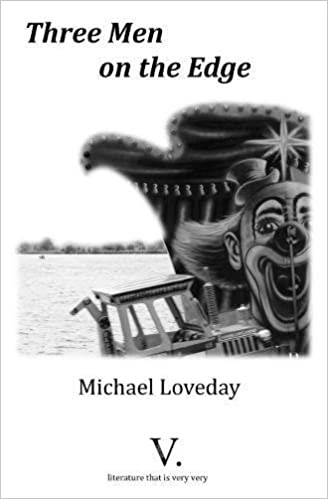
Review by Laura Besley of "Three Men on the Edge" by Michael Loveday


Three Men on the Edge by Michael Loveday is a novella-length book comprised of three short novellas-in-flash, the stories of three men: Denholm, Gus and Martyn – all struggling with life. 

The first story, ‘Cause for Alarm,’ explores the marriage of Denholm and his wife, Joan. Through the use of swans – birds which are renowned to mate for life – Loveday gives us some insights into the relationship. When Denholm’s friend shows him ‘an image of a swan pair, necks wound tight round each other,’ Denholm doesn’t see romance, but instead shrugs and says, ‘“Could be the blur … but it looks to me like they’re suffocating each other.”’ Later on he muses that ‘if he’d known, really known, how much marriage is one drowning person trying to push another under, he might not have risked it.’ 

In the second story – ‘The Invisible World’ – there are twelve micro fictions, one for each month in a year of Gus’ life following the loss of his wife whose absence he still feels acutely. He is stuck in a quagmire of grief he cannot, or does not want, to find a way to move on from. ‘There’s a veil between him and the world that will not lift, and to tear it down seems a betrayal. Why is it still not consolation – witnessing these swans, these shadows, this sky?’

The final and longest novella-in-flash is ‘Chewing Glass’ wherein Martyn navigates relationships with Anja and Rob. ‘[W]ith every relationship, the miniature sculptor works her hammer and chisel on the stone lump of your heart. If you’re really lucky, Martyn thinks, a man survives well enough to be left in the end with something recognisable.’

Throughout the book, Loveday supplements the starkness of these men’s lives with the stark beauty of nature. This adds, I feel, to the presence of a certain level of resignation, but also resilience. Because life is brutal, and all you can do is live it. 


About the reviewer
Laura Besley is the author of three collections of flash & micro fiction: (Un)Natural Elements, 100neHundred and The Almost Mothers. Having lived in the Netherlands, Germany and Hong Kong, she now lives in land-locked central England and misses the sea. 

Wednesday, 14 April 2021

Review by Kathy Hoyle of "Among These Animals" by Gaynor Jones


Among These Animals is a searing novella-in-flash, as brutal as it is beautiful. Jones handles this niche form with exquisite expertise, weaving each story seamlessly into the next with perfect fluidity. 

Set against the sweeping beauty of rural Wales, Jones’s compelling narrative is a visceral, powerful exploration of complex themes including sibling rivalry, parental love, familial loss, guilt and grief, all told through the eyes of Carys, the eldest daughter of farmers, Derfel and Aelwen.     

Carys is a daddy’s girl who thrives on the gentle guidance and acknowledgement of her reserved father, a man continuously surprised by the colossal weight of love he feels for his daughter. Cerys hero worships him, and he adores her. Her mother, Aelwen, often fades into the background. 

The familial relationships are established beautifully by Jones in the opening stories. In 'Heavy Is the Head That Wears the Crown,' Derfel tells Carys the story of how he met her mother but Carys struggles to see her mother’s worth: 'Carys tries to picture her mother as a princess from one of her books … She can’t. She can picture her father easily though, with a crown on his head and a staff in his arms. As she falls asleep, courtiers bow around him.'

We hear how the idyll is threatened, with the arrival of three younger brothers, 'Owain and the twins' in 'Pecking Order': 'Carys … has sworn a lot more in the years since her brothers arrived … When she was the only one, breakfast was all for her. Warm bubbled crumpets dripping with greasy butter … But that was before the stupid boys came along. Now, Carys has to sit last at the table … Carys has to be last in everything except cleaning and tidying.'

One day, a devastating event alters everything, tearing the family apart and shattering Carys and Derfel’s relationship forever. Jones delves into the themes of guilt and grief with poignancy and precision, taking the reader on a heart-breaking journey as the family try to come to terms with their loss.  

Throughout the novella, Jones showcases her inimitable style, either by pushing the boundaries of social acceptance, with stories such as the disturbing title story, 'Among These Animals,' or by showcasing her exceptional ability to leave the reader reeling with her emotional sledgehammers, often wielded in stories that are just a few paragraphs long.

Among These Animals is tremendous debut novella-in-flash, powerful and poignant. It will leave the reader stunned.


About the reviewer
Kathy Hoyle is an MA graduate from the University of Leicester. Her short stories and flash fiction have appeared in a variety of literary magazines such as Virtualzine, Silver Apples, Reflex Fiction and Lunate. She has been shortlisted for the Exeter Short Story Prize, the Fish Publishing Memoir Prize and the Ellipsiszine Flash Fiction Collection Prize. She recently received a Special Commendation in the Blinkpot Awards and won Third Prize in the HISSAC Flash fiction Competition. She is currently working on both a novella-in-flash and a short story collection, powered by tea and biscuits.

You can read more about Gaynor Jones's Among These Animals on Creative Writing at Leicester here.