
Thursday, 4 January 2024

Favourite Reads of 2023

At the end of every year, we ask readers to submit a micro-review of a favourite book they've read in the last twelve months. The book can be from any time or genre - the only qualification is that it has to be a book the reader found particularly memorable, striking or enjoyable. Here are the responses for 2023. Everybody's Reviewing wishes all its readers a happy new year of reading in 2024!


Kirsten Arcadio


The Running Grave, by Robert Galbraith: Not normally a fan of long, overly wordy novels, I've made an exception this year for Robert Galbraith's The Running Grave. This was a highly enjoyable, complex thriller with terrifying yet believable cult leaders and a damming insight into the psychological inner workings of its followers. If you think you'll never get sucked into a cult, think again. 


Joe Bedford


Local Fires, by Joshua Jones: In this collection of interconnected short stories, Jones’s treatment of his hometown (Llanelli, Wales) is by turns sensitive, evocative and ultimately mournful for a place, and a moment, which is fragile enough to vanish forever. In that sense, its resonance carries far beyond the borders of Llanelli, into those quiet parts of ourselves which know that what once was – our people and our places – can never be again.  


Kathleen Bell


Favourite non-fiction book: Dinner with Joseph Johnson: Books and Friendship in a Revolutionary Age, by Daisy Hay: I delved delightedly into Dinner with Joseph Johnson, which is centred on the remarkable career of one eighteenth-century bookseller and publisher (the two roles overlapped). Every few pages I would learn something new whether about the evolution of children’s literature, the risks of printing or selling radical pamphlets, or the tricky class status of booksellers. Many famous people knew and were published by Joseph Johnson; he employed Mary Wollstonecroft as a full-time writer while William Blake was one of his engravers. But there are numerous other characters outlined in this history who deserve to be just as well known.


Favourite fiction: Maud Martha, by Gwendolyn Brooks, was first published in 1953 but I only came across it this year. It’s the shortest novel I read this year and many of the chapters are only one or two pages long but I spun out the reading for weeks, often relishing a single chapter at a time. As might be expected, Gwendolyn Brooks has a poet’s skill with language as well as a sharp observation, here turned towards the details of African-American life. Maud Martha - perhaps drawing on Brooks’s own experience - is full of dreams, hopes and ambition even as she contends with grating humiliations from people who see her only in terms of her social class and darker skin colour. I started reading this hoping to gain insights into Brooks’s poetry, which it certainly provided, but this is a great and perceptive novel in its own right.


Laurie Cusack


The Three-Body Problem, by Cixin Liu: Cosmic Rentokil: Complete Experts in Galactic Pest Control – Distance, not a problem! Competitive … oh, yes! Gallows humour aside − Cixin Liu’s mighty doorstoppers The Three-Body Trilogy blew me away! Frenzied page turning. Unputdownable. I could hear my head squeaking. Scared? we should be ...


Sam Dawson


11.22.63, by Stephen King: Somewhere, out in the netherworld of possibility, a story exists about a time-traveller stopping the assassination of JFK on the 22nd of November 1963. Thankfully, 11.22.63 by Stephen King is a whole lot more. 11.22.63 is a time capsule, a love story, an ode to the uncanny. At over 700 pages, it somehow never outstays its welcome. Brilliant! 


Kristy Diaz


Penance, by Eliza Clark: Examining both the morally ambiguous explosion of society's fascination with true crime and the esoteric world of 2010s Tumblr culture, this ambitious novel brings you to a northern seaside town with a dark history and a horrifying murder case—a thrilling glimpse inside the mind of the 'extremely online' teenage girl. 


Rosa Fernandez


When Death Takes Something From You Give It Back: Carl's Book, by Naja Marie Aidt (translated by Denise Newman): This is a moving, poetic, tragic, beautiful text; an incredible document of the absolutely unthinkable. A masterclass in writing about grief, one you stay up to finish, it's that good. The resilience to make art out of awfulness is a real feat and this is a great demonstration of that.


Mellissa Flowerdew-Clarke


You Let Me In, by Camilla Bruce, reads like a horrific fairytale. It entwines folklore with reality, slipping between the two to create a surreal world where dark sexual awakenings, abuse, and murder flit between the real and unreal. Sinister, cruel, and totally enthralling, it encapsulates the complexity of trauma, and how the escapism we construct for ourselves can be equally as horrifying as what it is we’re trying to forget.


Neil Fulwood


Erotic Vagrancy: Everything about Richard Burton and Elizabeth Taylor, by Roger Lewis: Assiduous, acerbic, scabrous, highbrow, lowbrow and all the brows in between, Erotic Vagrancy swings from passages of blazingly passionate declamation to grumpy-old-man irascibility. It’s a work that simultaneously wants to hymn a certain period in pop culture and start a fight with the modern age. Unlike any other biography or film-related title out there, it is easily the book of the year.


Beth Gaylard


The Giver of Stars, by Jojo Moyes: Set between two world wars in the Appalachian Mountains, this is the story of how a dedication to enabling readers in remote areas leads to near disaster for Margery and Alice, two women who definitely don't fit the expected feminine mould. Together with other local misfits they form an intrepid band of librarians, travelling into the hills to deliver books to outlying homesteads, a mission that is not always well received at home. The story entwines two heartrending love stories, a childbirth scene that will have you on the edge of your seat, and a murder mystery to solve. Oh yes, and lots of horses. The horses are amazing. 


Timothy Grayson


The Black Spider, by Jeremias Gotthelf: A Faustian novella from 1842. To prevent her village from starving, a woman makes a pact with a mysterious stranger for his assistance (in exchange for something priceless), but when the village goes back on their word, something terrible awaits them all. My goodness, this was dark. Horrifying, but excellent.

And also ...


For Thy Great Pain Have Mercy On My Little Pain, by Victoria Mackenzie: A magnificent book. It brings fresh eyes and vitality to the lives of two real, medieval women of faith: Margery Kempe, and the anchoress Julian of Norwich. It is a work of fiction, but takes its inspiration from The Book of Margery Kempe (the first autobiography written in English by a man or woman) and Julian's Revelations of Divine Love (the earliest surviving book in English written by a woman). Interestingly, these women did meet in real life, and the latter part of the book deftly imagines their conversation. At times, I found myself moved beyond words, as if it was speaking to my soul. It may be classed as fiction, but the author has worked wonders here; it's almost as if she's assisted Margery and Julian in creating a new holy book. Outstanding. 


Gus Gresham


Murphy, by Samuel Beckett: I challenge anybody to best the humour and profundity of the opening line: 'The sun shone, having no alternative …' From this point on, Murphy's life is a tragedy shrouded in an absurdist daymare.


David John Griffin


The Barnum Museum, by Steven Milhauser: With its high-quality prose and the author's extraordinary imagination showing through the words, I was repeatedly blown away (and, should I be honest, slightly envious of his wonderful writing skills!).

Jack Peachey


Brave New World, by Aldous Huxley, presents a dystopia that is outwardly and inwardly repulsive in character, yet one that is shown with a verisimilitude I've scarcely seen in the genre; a naturalistic state with comprehensive worldbuilding. A challenging novel delivered with evocative prose, it far surpasses its contemporaries in creating a society that is at once alien and disconcertingly real. 


Karen Rust


Stonemouth, by Iain Banks: Set in the fictional Scottish coastal town of Stonemouth, we meet twenty-five-year-old Stu standing on the edge of what sounds like the Firth of Forth Bridge. He's back home for the first time in five years for the funeral of the patriarch of one of the towns' two gangster families - a family he was about to join, until a drunken indiscretion led to them trying to kill him, and a hasty exit on a goods train. Set over a few days, this is a masterclass in how to keep the reader hooked and drip feed the back story in until everything makes sense. Funny, cool and sometimes violent, we follow Stu as he navigates old school friends, the family who wanted him dead, and the woman he lost in his escape to London. An edgy and fun read, I could picture it in my head as a Trainspotting-style film, and have since found out it's been dramatised by the BBC, so will be checking it out on iPlayer! 

Teika Marija Smits


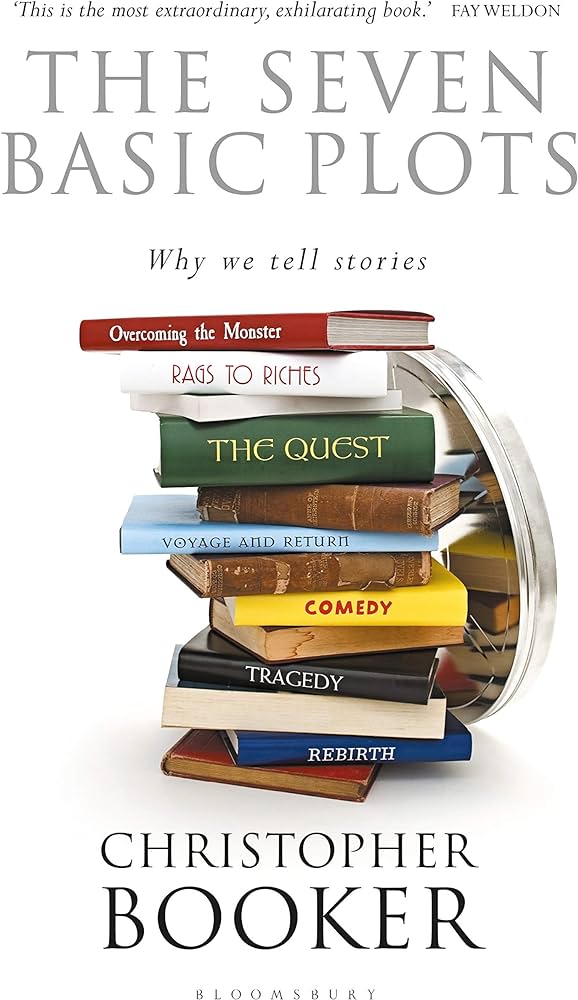
The Seven Basic Plots, by Christopher Booker: At over 700 pages long, it took me a long time to make my way through this book, but I know I’ve been profoundly changed by reading and reflecting on Booker’s theories. Not only has The Seven Basic Plots greatly enhanced my knowledge of literature, it has also deepened my understanding of how humans make sense of the world, and their lives, through stories. And as a fan of the theories of Carl Jung I appreciate the way Booker approached storytelling through a Jungian lens. To my mind, this is an essential read for everyone. After all, we are all the authors of at least one story - the story of our life.

Jonathan Taylor


What to Do Next, by Sue Dymoke: Brilliant author and educator Sue Dymoke died in 2023. This is her last collection of poems, and includes a beautiful preface by her partner, David Belbin. The book is a poignant memorial, then, but it is also a joyful celebration of life, of travel, of childhood, of science, of allotments, of what to do next.  


Maria Taylor


Half of a Yellow Sun, by Chimamanda Ngozi Adiche, is one of the best novels I’ve ever read. It’s an evocative and stirring narrative of two sisters both before and during the brutal Nigerian-Biafran war of 1967-70. The novel vividly depicts the emotional truth of their lives.


Miranda Taylor


Fruits Basket, by Natsuki Takaya, follows Honda Tohru, a young girl who has lived her life in solitude after losing her parents and her house. She encounters a family who takes care of her - however, the family is not as it seems, as they can change into animals of the zodiac. The story is a sad one yet also hopeful.


Rosalind Taylor


The Scum Villain's Self-Saving System, by Mo Xiang Tong Xiu, follows Shen Yuan, who reincarnates in a very badly-written novel as the abusive teacher of the protagonist, Shen Qingqui, whose fate is to die at the end at the hands of the protagonist. Scum Villain's Self-Saving System is very funny and enjoyable to read. I liked reading about the characters and how they change. 


Paul Taylor-McCartney


Prophet Song, by Paul Lynch: This is a visceral, heart-wrenching story of one woman's fight to keep her family together as her country descends into a totalitarian nightmare. Urgent and timely dystopian fiction that will live long in the memory.


Harry Whitehead


In the Eye of the Wild, by Nastassja Martin: In this fierce, dark and utterly unique memoir, French anthropologist Martin is attacked by (and attacks!) a huge bear in the Kamchatka wilderness, an event the shaman of the people she’s been studying had long warned her was coming. Unable to rationalise the psychological fallout from her injuries back in France, she returns to Siberia to embody the bear/human she’s become.  


Lee Wright


Ducks: Two Years in the Oil Sands, by Kate Beaton, is a graphic memoir of a young woman’s experiences working in the oil sands in Alberta. Kate Beaton grapples with the morality of the oil industry, faces harassment and sexual violence while working in an overwhelmingly male work force, reflects on environmental degradation, homesickness, loneliness, the health risks caused by the oil sands, and the destruction of the lands of the First Nations. 


Thursday, 21 December 2023

Review by Gary Day of "A Word with Bede" by Neil Curry


At first glance, the title suggests that the Venerable One is being taken on one side to receive advice or admonition in his shell-like. In fact it is an instance of the rich and indeed reverential language at play in this collection which is full of atmosphere, marvels and profundities. The word ‘Word’ simultaneously evokes casual conversation and the Logos itself. The pronoun ‘with’ suggests that Bede and Curry (a nomenclature that suggests a comedy duo) are on equal terms, true companions.

Among others receiving a mention in this meditation on past and present are St Ceolfrith, who looked after Bede from the age of seven, St Hilda of Whitby and Caedmon, regarded as the first English poet, his song a song of creation. Even the Vikings make a brief if bloody appearance, ‘like wolves they tore and slaughtered.’ The assonance nearly bringing those two verbs together is at variance with the frenzied dismemberment of the monks' bodies. This may seem a trivial, even pedantic point, but it touches on one of the main themes of the volume, ‘the fluidity of things,’ how everything is interlinked. This comes across strongly in ‘St Cuthbert’s Beads’ where fossils become beads on a rosary, the scientific and the spiritual meeting in a perfect circle. Another poem, ‘And with a Feather,’ is the most perfect expression of the unity at the heart of things. It is the verbal equivalent of the repeating patterns of Celtic art which have no beginning and no end.

These poems touch not just on history but something deeper, the time of solitude and silence which stretches from the desert to the edge of the expanding cosmos. Every page contains a verbal gem. It is a kind of holy book, not exactly an illuminated manuscript but a source of light nonetheless.


About the reviewer
Gary Day is a retired English lecturer and the author of several critical works including Literary Criticism: A New History and The Story of Drama. His debut poetry collection, The Glass Roof Falls as Rain, published by Holland Press, is due out in February


Wednesday, 20 December 2023

Review by Colin Dardis of "No Small Thing" by Trevor Conway


Trevor Conway opens up his third collection with an engaging essay, expanding on the themes of the book, serving as an amuse-bouche for what lies within. In the world of post-pandemic literature, Conway realises that we have all been forced to look inwards, spending more time in the house, shut off from others. Naturally, what arises are the themes of home and family, and chiefly for Conway, the new arrival of a daughter. Imagine Bill Bryson’s At Home, exploring the dichotomy of the home and all its trappings, but told through the intimate prism of a small (and often sleep-deprived) family. 

One of the highlights of the collection is the personification of certain rooms in the house, given voice to comment on their nature, and the comings and goings of the people who use them. These poems are rich in humour and fancifulness: we find a hallway that feels neglected because it’s only used to get from one place to another; it is rarely the desired destination. Elsewhere, an attic ponders on its quietude, whereas the bathroom sees all manner of private horrors. 

Le Corbusier’s Five Points of Architecture states that "a house is a machine for living in," and so we find ruminations on laundry, child-rearing, cooking, cleaning and other domestic demands. It is within this endless machination that Conway gives us his richest descriptions: minced beef cooked until "all its red head are dulled," "nappies full as the shell of a snail," the emptying of a wheelie bin "taken like fish in one gulp," or a television set that "jabbers like a senile uncle." There is beauty in mundanity here, and Conway excels as reimagining these tasks through language into things of affection and astonishment.

The daughter poems show us a sense of fragility: "Oh, Man" muses on how some men struggle with fatherhood. "Baby Steps" marvels at the child "coming to terms | with the new physics | of her body machinery," but fears what new dangers walking will bring. Hope for the future also arises, coupled with the uneasy undercurrent of knowing that no future is wholly secured, the shadow of the pandemic looming over the years ahead.

         Other images we have yet to see:
         a schoolbag tight like a barnacle to your back,
         the jagged, crayon scrawl of your name,
         your face womaned in make-up.

It is a testament to Conway’s effectiveness that this reviewer – childfree and with no desire to rear – found the tenderness and devotion inescapable. 

There is the occasional poem outside of the home, of airplane flights, of ruminations on Galway city and a new beginning in Catalonia. Yet it is the scenes that take place inside the familial four walls that come across as most personal. No Small Thing lives up to its title, showing the reader that the apparent microcosms of daily life are a huge part of our being and our identity, and that fatherhood has brought with in a new appreciation of these "houses shared like simmering saucepans | of routine, belief and ritual."


About the reviewer
Colin Dardis is a neurodivergent writer, editor and sound artist from Northern Ireland. His most recent book is with the lakes (above/ground press, 2023), a series of twenty-five poems loosely connected by the theme of water. His work, largely influenced by his experiences with depression and Asperger's, has been published widely throughout Ireland, the UK and USA.


Tuesday, 19 December 2023

Review by Kim Wiltshire of "Best British Short Stories 2023" ed. Nicholas Royle


In this form since 2011, Best British Short Stories 2023 is the thirteenth volume and yet again delivers an anthology that includes a range of styles and subjects to suit any reader. This is the joy of the short story collection or anthology, there is always a completely different tale awaiting you a few pages on, a different world to explore and new characters to meet. 

This edition includes work from twenty different writers from across Britain, telling a range of stories from the lyrical (A K Blakemore’s ‘Bonsoir’) to the dark and weirdly dystopian (Gareth E Rees’ ‘The Slime Factory’) alongside the more character-based literary stories, ranging from the quite short, for example Lydia Gill’s ‘The Lowing’ at only four pages, through to the longer short story, such as the final one in the collection ‘Tinhead’ by Gabriel Flynn.

The collection is thoughtfully curated by Royle, a task which is always difficult, but when you’re presenting ‘the best’ stories then the journey the editor takes the reader on has to ensure there are no bumps or potholes in the road, although a sharp turn now and then can be quite exhilarating. Royle does a grand job as editor here, juxtaposing the stories that lean towards magic realism with the more down to earth, life-lived-as-it-is type of story. It has been carefully thought through for the reader, which in turn showcases the talent of all the writers in the best possible way. Yes, I had my favourites, but they will be completely different to your favourites, which in turn will be different again to the next person’s. There are clear themes that run through the collection: concerns about the world we live in, and where it is heading, alongside the loneliness of life for so many. Some stories make you laugh out loud, other make you think, and one did bring a tear to my eye. 

Royle’s introduction is also a journey through the short story alphabet with many good tips for those writers starting out in the genre. I’ve always enjoyed reading these yearly collections, and this (lucky?) thirteenth is no different - I hope they continue for many years more.


About the reviewer
Dr Kim Wiltshire is a playwright and writer whose research involves theatre/writing for social change and arts for health. She is a British Academy Innovation Fellow and is a Reader and Programme Leader for Creative Writing at Edge Hill University. 


Friday, 15 December 2023

Review by Christine Hammond of "Sea-Fever: Selected Poems" by John Masefield, ed. Philip Errington


Born in Ledbury, Herefordshire in 1878, the scope and diversity of John Masefield’s life experience at home, at sea and abroad is nothing short of diverse. This resulted in a rich seam of lifelong inspiration that fed his early aim to be a writer "come what might."  

Speaking about the poem "The Piper of Arll" written in 1895 by Duncan Campbell Scott, Masefield is reputed to have written to Scott some years later saying: "I had never (till that time) cared very much for poetry, but your poem impressed me deeply, and set me on fire. Since then poetry has been the one deep influence in my life, and to my love of poetry I owe all my friends, and the position I now hold."

Prolific writer he did become, not just as a poet - holding Laureateship from 1930 until 1967 - but also as a novelist whose work included two classic children’s novels: The Midnight Folk and The Box of Delights.

From "Salt Water Ballads" (1899 -1911), comes "Sea Fever," whose opening is arguably one the most quoted and instantly recognisable lines of 20th century English poetry: "I must go down to the seas again, to the lonely sea and the sky." The easily digested quatrain structure of just three verses contains a wealth of accessible imagery that speaks eloquently to the romance, mystery and calling of the sea. This is further enhanced with alliteration and rhyme that lend a melody and cadence redolent of the waves themselves: 

           ... and the wheel’s kick and the wind’s song and the white sail’s shaking
          and a grey mist on the sea’s face and a grey dawn breaking

           … and all I ask if a windy day with the white clouds flying
           and the flung spray and the blown spume and the sea-gulls crying

           … to the gull’s way and whale’s way where the wind’s like a whetted knife

Having sailed in 1894 he experienced illness that cut short his life at sea, and returning home for a period, left again for America. Failing to report for duty on a subsequent ship posting in New York resulted in a spell of vagrancy and he finally returned to England in 1897 having his first published poem in 1899. 

Despite the adversities, Masefield repeatedly re-visited his experience of the sea and travel. His combined sensory appreciation of other lands resulted in a muse that was rich in texture. This is evident in another well-known work, "Cargoes" (1903), with its multi-sensory, image-rich depictions of the ships, their passages and cargo in stanzas 1 and 2:

          … ivory, 
          And apes and peacocks, 
          Sandalwood, cedarwood and sweet white wine

          … diamonds
          Emeralds, amethysts,
          Topazes, and cinnamon and gold moidores

This is compared with an English counterpart in the third and final stanza:

          Dirty, British coaster with a salt-caked smoke stack
          Butting through the Channel in the mad March days,
          With a cargo of Tyne coal,
          Road-rails, pig-lead
          Firewood, ironware and cheap tin trays

Selected Poems is an especially enjoyable body of work. It articulates colour and exoticism combined with contrast. This provides an expressive and profound response to not just the conservative "green and pleasant land," but importantly, highlights the grey and grinding industrial oppression on the senses.


About the reviewer
Christine Hammond began writing poetry whilst studying English Literature at Queen’s University, Belfast. Her early poems were published in The Gown (QUB) and Women’s News where, as one of the original members she also wrote Arts Reviews and had work published in Spare Rib. She returned to writing after a long absence and her poetry has been featured in a variety of anthologies including The Poet’s Place and Movement (Poetry in Motion – The Community Arts Partnership), The Sea (Rebel Poetry Ireland), all three editions of Washing Windows and Her Other Language (Arlen House). She has also been a reader at "Purely Poetry" - Open Mic Night, Belfast. Her poem "Ritual" has recently been accepted for publication by literary journal The Honest Ulsterman. 

Sunday, 3 December 2023

Review by Gus Gresham of "Umbilical" by Teika Marija Smits


While savouring this stunning collection of stories, I kept asking myself (as an avid reader and writer) ‘What’s the most effective way of getting a reader’s attention?’ Because Umbilical does grab the attention and does not let go. It’s stylish, intriguing, beautifully written. There are characters and concepts that fascinate, beguile, bewilder. But there is something else going on here …

Teika Marija Smits is not writing sci-fi, fantasy, horror or speculative fiction for its own sake; she is employing elements of these in ways that are on-point. Whether a story has social justice at its core, the human condition, relationships, or the dangers of unfettered medical and tech development, the ideas are handled with subtlety and skill. 

She trusts her own intuitions, too – like the narrator of the title story who hears “those ancient, knowing whisperings arising from my womb”. Smits knows that the ‘darker’ parts of ourselves that we so often dismiss are the places where treasures may be found.

Because it would be difficult to summarise any of the stories (without committing spoiler-crime), I can only tantalise and tease:

In ‘Death of the Grapevine,’ we meet a computer engineer whose job it is to troubleshoot an in-house AI system and carry out a bizarre and strangely sad form of maintenance. In ‘His Birth,’ amid the sensitive and powerful rendering of the bond between a mother and child, we meet a creature known as a lamphine. In ‘Girls’ Night Out,’ the first-person plural pronoun ‘we’ takes on a whole other mysterious and resonant meaning. In ‘Our Lady of Flies,’ loss, misunderstanding and a failing relationship are deftly explored. In other stories, such as ‘Star Making at Sellafield,’ we encounter tenderness and hope.

As for the earlier question (What’s the most effective way of getting a reader’s attention?) Teika Marija Smits’s answer is to explore issues from quirky angles, thereby offering unique, enthralling perspectives.

A thoroughly engaging and enjoyable collection.


About the reviewer
Gus Gresham has a Master’s degree in Creative Writing (NTU) and has worked as a mechanical engineer, construction worker, fruit picker, community activist for Greenpeace, writer, English tutor, audio-book producer, medical-scenario simulator/facilitator, civil funeral celebrant, and building surveyor. He’s had short stories published in literary magazines including Brittle Star and Under the Radar, and his most recent novel, Kyiv Trance – a dark, twisty, love story and crime thriller – is available on Amazon.

You can read more about Umbilical by Teika Marija Smits on Creative Writing at Leicester here. 

Saturday, 2 December 2023

Interview with Roppotucha Greenberg


Roppotucha Greenberg is the author of a flash and micro-fiction collection Zglevians on the Move (TwistiT Press, 2019) and four silly-but-wise doodle books for humans, Creatures Give Advice (2019), Creatures Give Advice Again and it’s warmer now (2019), Creatures Set Forth (2020) and Cooking with Humans (2022).

Roppotucha has lived in Russia, Israel and now Ireland. She speaks three languages fluently and has tried to learn six more. Arachne Press has previously published Roppotucha’s stories in the Solstice Shorts Festival anthologies, Noon and Time and Tide. She shares regular micro-fiction on X/Twitter: find her @roppotucha.

Below, she talks to Laura Besley about her new novella, Getting by in Tligolian. 


Interviewed by Laura Besley

LB: Firstly, congratulations on the publication of Getting by in Tligolian – it’s a fantastic novella! 

RG: Thank you so much! 

LB: Often, while I’m reading – whether it be a novel, novella or one of the various forms of short fiction – I find myself wondering what sparked the story. Was there a moment or a character or an image or something entirely different that led you to write Getting by in Tligolian? 

RG: It was the image of that city: those huge glass enclosures, the traffic, and the narrow streets with tired looking shops, and the river. The giant as well. His presence was almost instantly apparent in my imagination. 

LB: There are various strands to this novella, one of which being ‘language.’ In the story ‘Appendix,’ the main character states: ‘I tried to learn Tligolian so many times and forgot it just as many.’ Did you purposefully use language, or the lack of language, to disorientate her and set her up as ‘an outsider’?

RG: I think she would be an outsider regardless of the language. Apart from the physical fact of immigration, her chronic naiveté both protects her and isolates her from the world. Through learning Tligolian, which is not necessary for communication in Tligol, she attempts to ground herself in the world. Language learning makes things seem simple, especially in the beginning when one talks of girls eating apples and your mother being a teacher and things like that. Of course, this does not work, because language turns into layers of forgetting, while its difficult tenses wrap around her and make her confusion grow. 

LB: The main character describes Tligol, the fictional city in which the novella is set, as ‘so beautiful, I convinced myself that I was in charge of the perfect expression of its beauty.’ Do you feel the city functions as a character within the novella and if so, how did you go about conjuring that feeling? 

RG: Thank you for citing this line. In a way, Jenny spends the whole book chasing the city, trying to express its beauty, learn its language, find its giant, take the trains to all its time layers. The city is a character. Like other places in real life, it is alive and wonderful, but it also evades easy capture. One comes near, but only just near enough, and being in the midst of the thing you want to capture complicates matters. 

LB: Another aspect of the novella is ‘time.’ Did you layer in that complexity through multiple versions and/or edits, or was that aspect of the novella clear in your mind from the outset?

RG: That was something that became apparent very soon, in one of the early drafts. Time-travelling trains are an inherent part of the city.  Though other aspects of the city became apparent earlier – the way its spaces are not quite stable, for example, or the way living people get recorded as ‘reflections.’ 

LB: All of the chapters are short, some only a few lines. Was this a conscious choice? What is the effect of this on the reader? And what benefits do you feel you gain as a writer by learning to write/writing concisely? 

RG: Yes, this was a conscious choice, but it was motivated by the needs of the story. For me, the novella in flash works so well for fragmented narratives and stories that work with negative space - in the sense that the narrative gaps are a part of the story. Without giving away too much, I feel that the form of the text works well with its ending.  

LB: Thank you very much for taking the time to answer my questions!  

RG: Thank you for being such a generous and attentive reader. I am very grateful. 


About the interviewer
Laura Besley is the author of 100neHundred and The Almost Mothers. She has been widely published in online journals, print journals and anthologies, including Best Small Fictions (2021). Her work has been nominated for the Pushcart Prize, twice nominated for Best Micro Fiction and she has been listed by TSS Publishing as one of the top 50 British and Irish Flash Fiction writers. She is an editor with Flash Fiction Magazine and a Creative Writing MA student at the University of Leicester. Having lived in the Netherlands, Germany and Hong Kong, she now lives in land-locked central England and misses the sea. 

Friday, 24 November 2023

Review by Gus Gresham of "The Mad Road" by Laurie Cusack


As reviewer Alexandros Plasatis says on the back cover, "The Mad Road is a hooligan of a book.” It’s easy to see why as you dive headlong into these riveting, gutsy tales. If you like your fiction cosy and fluffy and all wrapped up with a pink bow, stay clear!

In the opening story, "The Bottle and the Trowel," a man walks out along a soggy rotten board on a scaffold, falls to his near-doom and ends up on life support. "You’ve got to hear this, Gerry!" his friend says at the bedside as he begins to narrate the harrowing circumstances that plague their lives. And this story could be a metaphor for the whole collection. Reading these stories feels like walking along a dodgy scaffold, hoping that the next step you take won’t send you plummeting to the ground where unknown horrors await.

"A Doc Marten boot met the crack of Desmond O’Hara’s arse" is the opening line to "Ghost Estate" in which our anti-hero faces retribution for his exploitative dealings during the years of the Celtic Tiger economy. What will become of him? 

Whether the stories are set in Ireland itself or amid London Irish communities, Cusack serves up a smorgasbord of characters who are as contrary as the day is long. In The Mad Road, we get an up-close-and-intimate perspective on these fallible lives. Lovable smooth-tongued travellers; a young man new to London whose rites of passage bring him face to face with the menacing Zen-like character known as "The Bear"; a woman on the edge making a passionate stand against social injustice; a father who will give anything to get his girl through dancing school.

What will become of any of them? As Oscar Wilde once said, "Work is the curse of the drinking classes." So if you like your fiction gritty, turbulent and off-the-leash, this is the book for you. It has heart, it has soul, it has guts. It will mess with your head.

One thing’s for sure, I’ll probably never be able to look at a building site or a coin-operated laundrette in quite the same way again.


About the Reviewer
Gus Gresham has a Master’s degree in Creative Writing (NTU) and has worked variously as a mechanical engineer, construction worker, fruit picker, community activist for Greenpeace, writer, English tutor, audio-book producer, medical-scenario simulator and facilitator, and building surveyor. He’s had short stories published in literary magazines including Brittle Star and Under the Radar, and his most recent novel, Kyiv Trance – a dark, twisty love story and crime thriller – is available on Amazon. You can read more about Kyiv Trance on Creative Writing at Leicester here. 

Thursday, 16 November 2023

Review by Lee Wright of "The Mirror and the Road" by William Boyd and Alistair Owen


Alistair Owen’s extensive conversations with William Boyd that took place over a two-year period are not just for smitten Boyd fans. Whether you’re an aspirant writer or a seasoned writer, whatever your chosen field – fiction, non-fiction, novel, short story, or screenplay – The Mirror and the Road makes for a fascinating interrogation into the mind of one of Britain’s best writers. The book is structured chronologically, covering Boyd’s seventeen novels, five short story collections, twelve film screenplays, five television screenplays, and three stage plays. Boyd talks about the vim and vigour of writing, about his unpublished, semi-autobiographical novels, of how his first, A Good Man in Africa, came to be written in three months flat. But what this collection of interviews does best is to show us the process and the torments that come with being a writer, digging deep into the craft and the ingredients that has produced a staggering body of work. It is a 330-page writing masterclass, full of advice about what works for Boyd, his methods and modus operandi, how his plots evolve, how he chooses what he wants to write next, the research stage before writing, the importance of finding the right title for a project, the unimportance of writing sympathetic characters and the deliberate echoes of his many literary influences – Kingsley Amis, Evelyn Waugh, Graham Greene, Ernest Hemingway, F. Scott Fitzgerald and Anton Chekhov – underlining the importance of reading. And Boyd isn’t afraid to borrow from genre fiction to power his narrative, as he did in the case of his 1993 novel, The Blue Afternoon. 

The book explores Boyd’s preoccupations, seeing how they interact and interconnect and how he brings these different fixations together in his novels and short stories: “Short stories are like a laboratory for me,” Boyd says. He also stresses the importance of trusting the imagination: “I’ve often written about places I’ve never been to,” he says, writing about Los Angeles before he ever went there. “I wanted to see if I could inhabit the place vicariously through my imagination.” 

It sent me back to my time studying for an MA in Creative Writing and the recommended reading list we were given. Other than David Morley’s Cambridge Introduction to Creative Writing, no other book on the list offered the kind of embarrassment of riches (with regards to fiction writing) that comes with these interviews. It should be on the shelf of every university library to be discovered and show what can be done with narrative and how a writer can get there.      


About the reviewer
Lee Wright has an MA in Creative Writing and is currently working towards a PhD researching memoir and film. His fiction and poetry have been published with Fairlight Books, époque press and Burning House Press.